




|
|
Did you know Thursday, May 20, 2021, is Global Accessibility Awareness Day? Would you like to learn how building accessibility into your products and services from the ground up can save you thousands and help grow your customer base? Would you like to be at the head of the Global Accessibility curve?
To mark this special day, and for a select few, we’re offering a package to jumpstart your company’s accessibility journey at a 50% discount. Yes, you read that right!
The LightHouse Access Technology team helps hundreds of blind people gain tech skills each year, and leverages the insights we gain from our community to help dozens of companies design products that are accessible for all.
Our Accessibility awareness package includes:
We’re offering this package of 2 of our most popular services at a 50% discount.
For $500, you can book this package for your company or team. Packages on the official May 20 date will fill quickly, so we are extending this offer throughout the month of May.
To learn more, and reserve your spot, please email Erin Lauridsen, Director of Access Technology, at elauridsen@old.lighthouse-sf.org

2020 was a highly unusual year for everyone around the world. Despite such unprecedented circumstances, we are proud to present the 2020 Annual Report, documenting how LightHouse supported the blind community through a global pandemic in new and innovative ways.
In 2020 we were proud to celebrate the 70th Anniversary of Enchanted Hills Camp, and announced ambitious plans to reimagine the entire camp as a global center for blindness, with construction planned over the next few years.
In other news, big things happened at LightHouse Industries: Sirkin Center, LightHouse’s blind labor-force manufacturing plant. We expanded the production line, including adding a hard surface cleaner effective at killing the novel coronavirus. We doubled our staff and hired a blind scientist to oversee the product blends. Our customer base of government agencies and private companies continues to grow, and so do the employment opportunities for people who are blind or have low vision. Watch the BBC’s coverage of Sirkin Center’s unprecedented growth.
Last Saturday, April 17, LightHouse held its annual Cycle for Sight fundraiser for Enchanted Hills Camp (EHC). After cancelling Cycle for Sight in 2020 due to the COVID-19 pandemic, we were thrilled to bring the event back, this year in a virtual format.
Participants first gathered Saturday morning on Zoom for an opening ceremony, before getting down to business and exercising for at least 90 minutes, by hiking, running, swimming, and yes cycling, before gathering for an afterparty in the afternoon.
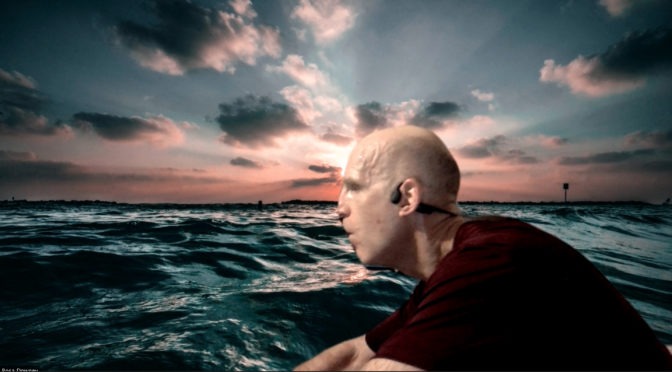
Two weeks ago we brought to you the story of Chris Downey, renowned architect who is blind and the immediate past LightHouse Board President and current board member. Chris has taken part in Cycle for Sight for the past ten years. This year, with the event’s virtual format, Chris used his garage rowing machine, along with some high-tech gadgets, to row across the English Channel a distance of 33.8 kilometers.
So how did it go? HE DID IT!!
Chris says:
“It was a fun experience and I’m thrilled it paid off with this level of support to the LightHouse and Enchanted Hills Camp. the (virtual) water was splendid as was the weather. The row was intense – especially the extra 15K beyond my weekly Saturday row. All went according to plan and I was able to knock it out without injury or total exhaustion. That said, there was nothing left in the tank had there been any challenge to row back to the other side! I could sense a little protest from my body when resuming my regular workout routine this morning – no pain, just lethargy!”
Oh and what’s more? Chris raised $15,500 for EHC.
Thank you, Chris!
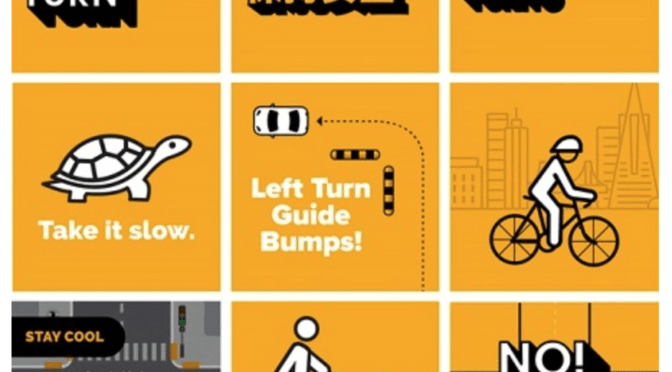
On April 8, LightHouse, in partnership with the San Francisco Municipal Transportation Agency (SFMTA), held a second Tactile Intersections Workshop to promote the citywide campaign Safety—It’s Your Turn. The campaign is designed to encourage safer driving around left turns. Individuals who are blind or have low vision who live or work in San Francisco joined LightHouse Orientation & Mobility (O&M) Specialist Sarah McIntyre and Senior Accessible Media and Braille Specialist Frank Welte for the workshop where they received an overview of interpreting and comprehending tactile diagrams of various intersections found throughout San Francisco.
Upon registering for the workshop, participants were sent a packet of the tactile intersection diagrams (designed and produced in-house by LightHouse’s Media and Accessible Design Lab) to follow along from home with Sarah and Frank as they guided students through understanding what the different tactile traffic lines and symbols on each diagram represented. The two LightHouse employees made a dynamic duo as they offered valuable insights, as Sarah has the many years’ experience teaching O&M and working alongside blind and low vision people, while Frank has the first-hand knowledge and experiences of traveling in cities all over the country as a blind man.
“Understanding how various common types of intersections are configured and how traffic flows through them makes it possible for a blind traveler to cross streets efficiently and safely in a wide variety of situations.” Frank said. “The intersection diagrams produced by the LightHouse make it much easier for Orientation & Mobility students to acquire this important knowledge.”
I had the opportunity to participate in last week’s workshop. As a person who has low vision and as a non-driver, I found the workshop incredibly informative. The geography of San Francisco is unique with its many neighborhoods and busy city streets that spread out across climbing hills and flat shorelines, but while it makes for a beautiful landscape, it also makes for many complicated travel routes, both in car and on foot. Exploring the different types of intersections and gaining an understanding of what all the painted lines along the city streets actually mean helped me form and understand my own mental map of the city and specifically different busy traffic areas within my own neighborhood.
“I’ve used the intersection diagrams in two different ways,” Sarah McIntyre explained. First, with students who started learning intersection analysis and street crossing skills in person, I’ve used the intersection diagrams to reinforce and strengthen what they had begun learning.
“Second, with students who are learning spatial awareness skills and have progressed to the point of examining TMAPs [tactile street maps produced using an automated tool], I’ve used the intersection diagrams to discuss the different types of intersections found along their routes.”
Building confidence, independence and knowledge for those in the blind and low vision community is at the heart of every service LightHouse provides. It is a very empowering experience to partner with local agencies like SFMTA to help increase safety and awareness, not just for San Francisco’s blind and low vision residents and commuters, but for everyone who travels the streets of our beloved San Francisco.
If you missed out on the workshop but are interested in obtaining a copy of the Tactile Intersections Diagrams packet, you can do so by ordering the diagrams from the LightHouse store, Adaptations, by calling (888) 400-8933 or finding LightHouse for the Blind and Visually Impaired under specialized help in the Be My Eyes app. For more information about the fantastic strides the city is making to improve traffic safety visit SFMTA’s Safety—It’s Your Turn page on their website. For any inquiries about Orientation & Mobility lessons and services provided by LightHouse, contact info@old.lighthouse-sf.org or Esmerelda Soto at 415-694-7323.
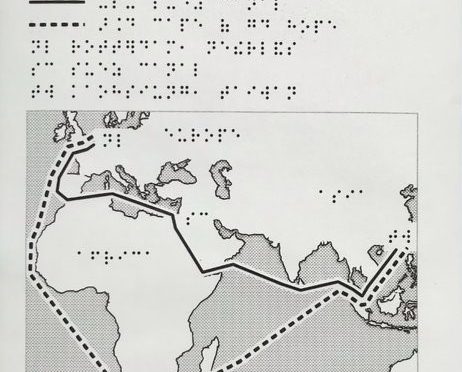
Have you ever been reading a news item or watching it on TV, and thought to yourself: “I wonder what that picture is?” Ever witnessed a meme on social media go viral and want to get your hands on it to really understand what it is? As people who are blind or have low vision, we are surrounded by visual information there is no other way to experience without somebody else interpreting it for us, usually by describing it verbally. That, of course, is great. We love and appreciate the thought and effort that goes in to doing that. But what if you were delivered, into your mailbox, a tactile graphic associated with a news story. So you could then emboss it yourself, or have it raised on swell paper?
That very thing will be coming to you in the next couple of weeks. You will also get the opportunity to choose from a list of proposed graphics each time, and the one with the most votes will be the one produced that week.
You might find yourself thinking: “I wish I could get my hands on one of those Oscar statues”, well, now you just might, even without being at the Academy Awards. Space travel might be your obsession and you’re itching to know what the helicopter is like that recently took off from and landed on Mars.
There will be more in the coming days but if you are interested in subscribing to this new free service, send an email to ttn@old.lighthouse-sf.org.
As I hopped out of my Lyft at 7th and Market Street and turned the corner toward the LightHouse headquarters in San Francisco, I was hit with a wave of nostalgia. It had been months, nearly a year since I’d last entered this building. As I reached for the door handle of the front entrance, I was welcomed in by a friendly face. The man asked kindly, “Here for the clinic?” to which I replied, “Absolutely!”
After being directed towards the elevators I stepped in and pressed the button for the 10th floor. The door opened to the familiar sound of the automated announcer, “10th floor, LightHouse Main Reception.” I stepped into the lobby and was greeted by friendly, masked volunteers. I looked around and noted the many people in line, spaced at a safe distance apart from one another, patiently awaiting their turn to receive the COVID-19 vaccination.
When I joined the line, a nurse approached me and asked my name and birthdate. She found my vaccination card in the stack of other names scheduled to be vaccinated that day. She assisted me in filling out a pre-vaccine medical form. (Do I have any allergies? Have I received any vaccines within the past 14 days? Etc.) After completing the form, I waited for my turn to be taken into Multipurpose Room B, where there were three vaccination stations set up.
When it was my turn, I was directed to the available station. I rolled up my left sleeve as a very kind and friendly nurse walked me through the process. I turned my cheek away from my left shoulder as I received the vaccine. (Needles make me queasy!)
When I sat down in the post-vaccine waiting area adjacent to the vaccination stations, it hit me. For two years I would come to this building every day. Working with the blind community, my community, has always been important and enjoyable for me. On March 13, 2020 we were told that LightHouse would be closed for two weeks due to the onset of COVID-19 cases increasing in the area. Two weeks turned into 56 weeks (and counting) and the “increasing number of COVID-19 cases” turned into a global pandemic. Through the past thirteen months of confusion, devastation, and fear, here I was, one year later in the same place where I had first learned of the severity of this disease, receiving the COVID-19 vaccination. It was emotional. It was hopeful. It was a triumph. The experience felt surreal.
I want to express my sincere gratitude to all the nurses, volunteers, and all of those responsible for giving LightHouse the opportunity to become a vaccination site. With the help and coordination of many LightHouse and San Francisco Public Health employees, I am proud to say that not only was I vaccinated, but the nonprofit I work for, the work in which I hold so dear, was able to provide yet another accessible and vitally important service to our community.
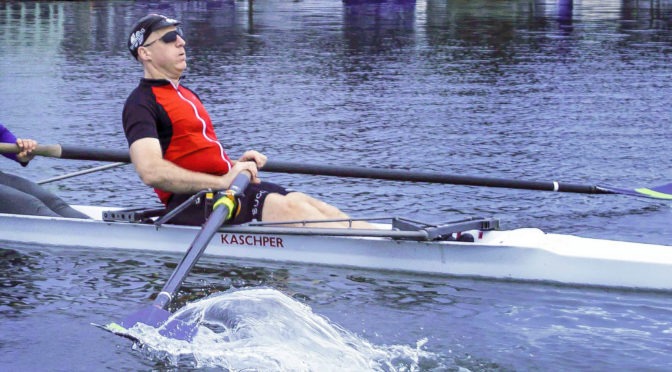
Chris Downey, immediate past Chair of the LightHouse board and renowned blind architect, is a bike rider. He has ridden as part of Team Enchanted Hills in Cycle for Sight, a fundraiser to raise funds for Enchanted Hills Camp, almost every year in the past decade. As a blind rider, Chris and his tandem partners always choose to ride the hilly 50-mile route. If Chris is participating, he wants to be all in. Cycle for Sight is an event he looks forward to every year.
During the pandemic, Chris has had to curtail his cycling, as his tandem partners aren’t in his household, and on a bike they’d be closer than six feet apart. Thinking creatively, Chris thought of how he could take part in this year’s Virtual Cycle for Sight where participants can invent their own athletic way to exercise. In addition to bike riding, Chris is an avid rower and usually goes in a group in a racing shell with a total of two to eight rowers. Although he has done solo rowing with an accompanying vessel providing navigational input. Sadly, COVID-19 has kept Chris off the water as well.
But this year to take part in Virtual Cycle for Sight on April 17, Chris will be rowing the distance of the crossing of the English Channel: 33.8 kilometers. Chris won’t even have to leave his garage. He will be using his rowing machine. A dedicated athlete, Chris will be challenging himself to row this distance by rowing at 20 minutes at a time, with five-minute breaks, anticipating completing his goal in a few hours.
When training on his rowing machine, Chris fancies himself as an electronic “Pigpen”. Like the character in the comic strip Peanuts, Chris is surrounded by a cloud, only his is comprised of Bluetooth, WIFI and streaming data. Using his phone like a conductor’s wand and screen reader VoiceOver as the instrument, he will be listening through wireless earbuds to his rows-per-minute, distance covered, heartrate and the motivating music of his choice.
You can emulate Chris and create your own individual athletic event for this pandemic year’s Cycle for Sight. Support Enchanted Hills Camp on Saturday April 17 with a ride, run, hike, walk, dance, swim, skate or row for at least 90 minutes. Sign up at the Cycle for Sight website, and be part of Team LightHouse. We would be thrilled if you post photos of your virtual participation using hashtag #C4S2021 or email your photos to events@old.lighthouse-sf.org. The event includes a morning livestream opening ceremony, and then we will regroup in the afternoon for a virtual party. The $45 registration fee includes a goody bag mailed to your home. If you opt for the $85 VIP registration, you’ll receive a premium goody bag.
Even if you can’t participate in Cycle for Sight, you can support Chris Downey’s row at old.lighthouse-sf.org/donate and choose Cycle for Sight from the dropdown menu.
We can’t wait to see you at the opening ceremony.

PURE Bioscience and LightHouse announce the approval and use of PURE Hard Surface sanitizer and disinfectant by the Federal Aviation Administration (FAA). Succeeding a vetting process which took several weeks the FAA approved and announced that PURE Hard Surface was the only antimicrobial on the Environmental Protection Agency (EPA) List-N Antimicrobial Approved for use Against Corona Virus authorized to be used in the FAA locations: Control Towers, Radar Centers and Regional Control Centers.
The lead scientist on the evaluation committee for the FAA stated:
“The Federal Aviation Administration (FAA) is one of 16 critical infrastructure sectors, meaning their assets, systems, and networks, whether physical or virtual, are considered so vital to the United States that their incapacitation or destruction would have a debilitating effect on security, national economic security, or national public health or safety. The arrival of COVID-19 presented unique challenges to keeping FAA personnel and equipment safe and functional and planes moving safely through the skies. Rigorous chemical and physical testing identified only one product out of hundreds on EPA List N that met all FAA criteria (no harm to people or equipment, no warning labels or PPE required, no odors, 30-second contact time for human coronavirus, product volume available on demand, rated for Emerging Viral Pathogens, secure supply chain and ease of use. PURE Hard Surface met and exceeded all required criteria.”
Following the initial use rollout of an FAA pilot testing program the FAA is requiring its janitorial service providers for these locations to sanitize daily after cleaning using PURE Hard Surface. This test was successful and to date there are 85 FAA locations that are sanitized with PURE Hard Surface including major airports.
PURE’s Chief Operating Officer and President Tom Y. Lee said, “We are proud that our technology met the needs and requirements for the Federal Aviation Administration’s antimicrobial use. PURE Bioscience is honored to be a part of the overall effort to maintain critical US infrastructure. The chemistry and it’s attributes that lead to approval by the FAA committee are the same that we offer to all our customers for their effective antimicrobial requirements.”
75% of the workforce employed to ship, bottle, and blend Pure Bioscience chemistries is blind or has low vision.
“Our expanding social enterprise at our Sirkin Center will provide dozens of jobs for Bay Area blind employees,” said LightHouse CEO Bryan Bashin. “With the FAA’s large orders we’ll be hiring blind line workers, supervisors, technicians and supporting jobs, at our new Alameda plant. And we’re only beginning”

By Mario Burton, Director of People and Culture
Hate crime attacks on the Asian American and Pacific Islander (AAPI) community have grown over the last year both at the local and national level. Videos, articles, and news reports have been informing us of an increase in attacks of about 150% since the pandemic started. Additionally, a report released by Stop AAPI Hate explains that there were over 4,000 reported incidents between March 2020 and February 2021. We can’t and shouldn’t go without calling attention to this clear sense of racism and xenophobia against AAPI persons.
Our goal is to always stand up for and in solidarity with various marginalized and underserved communities. This is especially true in instances like this where community members are being physically attacked.
Many people educated within the U.S. education system do not know that AAPI communities have a history of both struggles and triumphs in this country. Some people are unfamiliar with the Chinese Exclusion Act or the internment of Japanese Americans during WWII as heightened anti-Asian paranoia permitted the manifestation of these biases into blatant discrimination. Hundreds of Asian-Americans were abducted, removed from their homes and places of work and placed in prison camps. Even with these challenges, various AAPI leaders such as Yuri Kochiyama, Lydia X.Z. Brown, Mia Mingus, Alice Wong, and Patsy Mink have participated in the Civil Rights Movement, Women’s Rights, Disability Rights and various other movements for change in the U.S. These milestone moments are reflective of how AAPI persons have been key players in influencing many parts of American history. Learn more about Asian American and Pacific Islander heritage and history in the U.S at the NEH-Edsitement website.
Below are some additional resources taken from the website Stop APPI Hate for those interested in supporting the AAPI community during this time:
5 Things to Consider When Experiencing Hate
5 Ways to Help If You Witness Hate
Services for Victims:
We stand in support of the AAPI community and against the racist and xenophobic hate crimes that have occurred recently.
Susan Kitazawa, an Asian American community advocate, gave her perspective on how people can confront their own prejudices.
“The biggest thing people can do to reduce APPI violence is to look into their own unconscious biases. Hate and violence are born of fear and not knowing the other. I’ve read two great books, Blindspot: Hidden Biases of Good People (DB 80639 on the National Library Service Braille and Audio Reading Download) and Biased: Uncovering the Hidden Prejudice That Shapes What We See, Think, and Do by Jennifer Eberhardt. I believe bias is a survival mechanism we have wired into us. It’s the ‘that’s not someone from my village’ mentality and a knee-jerk reaction that doesn’t make sense in the modern world. Everyone has biases and that’s the driving force of what’s going on.”