Category Archive

LightHouse News

Meet DictationBridge: Hands-free Typing Sponsored by LightHouse for the Blind

Speech recognition and screen readers are both valuable tools for the blindness community, but what about technology that combines the two? Unfortunately, the current options are few, sometimes unstable and often expensive.

image of microphone with headphones on itThat’s why, when a group of notable blind technologists and power-users from around the country brought the idea for DictationBridge, to LightHouse Labs, our organization knew we had to help. The investment in DictationBridge, which represents the LightHouse’s expanding capability to invest in projects meaningful to the blindness community, will help ensure that the software is released into to the universe free-of-charge.

“We on the DictationBridge team are proud to have the Lighthouse for the Blind and Visually-Impaired on our team,” says Lucy Greco, assistive tech expert and spokesperson for DictationBridge, “We hope this is a first in what will become a series of projects like this moving into the future.”

As the highest level sponsor in DictationBridge’s Indiegogo campaign, which met its funding goal this week, the LightHouse is proud to help bring free hands-free typing to blind folks all around the world. If you’re still a little unclear about what DictationBridge actually does, DB’s website invites you to imagine a scenario:

“James is a blind entrepreneur but injures his hand and is unable to type. He knows he has to continue working. He has heard of speech-recognition and decides to try it. He has a little bit of vision so he uses ZoomText for magnification and speech. In the current scenario, he does not have a solution. DictationBridge is going to be a generic solution which will talk to ZoomText and WSR [Windows Screen Reader] or Dragon. Once James recovers, he may continue to use speech-recognition for productivity or he can resume a keyboard only way of working.”

That’s what we want for our community: to be able to keep working.

“The overwhelming majority of blind people worldwide cannot afford expensive and unstable solutions when they need to use dictation and a screen reader,” CEO Bryan Bashin said last week, “The Lighthouse believes it has a moral obligation to support the access needs of blind and visually-impaired people wherever they live. We applaud the creativity of the DictationBridge team to address this need and are happy to be part of their success.”

Happy typing, and check back for updates on DictationBridge’s public release.

Disney•Pixar Unveils Mobile Audio Description for ‘Finding Dory’

Disney•Pixar Unveils Mobile Audio Description for ‘Finding Dory’

After lots of collaboration, tweaking and testing, the LightHouse is proud to announce that this week, blind people will be able get audio description for one of the summer’s biggest movies, on their own device, without asking for help.

That’s right! Starting on Friday, June 17, blind and visually impaired audiences will be able to get free, mobile audio description to accompany the release of Disney•Pixar’s Finding Dory.

The past year has seen lots of technological advancement in audio description technology, with Disney•Pixar leading the way for film studios with their app, Disney Movies Anywhere. The app was first demonstrated at the White Canes Red Carpet event in December, released at home with The Good Dinosaur, and discussed at length at our SXSW panel in March. Between these events, focus groups, and enthusiastic collaboration with Guide Dogs for the Blind, the Blind Babies Foundation, and other blindness organizations, this has grown much bigger than just one app: it’s a statement of purpose.

Disney•Pixar’s smart-syncing audio description, native to the mainstream app, represents thoughtful design that works for everybody.  When activated, it provides an add-on experience which levels the playing field for audiences who are blind or have low vision.

Paired with any Disney•Pixar film using headphones or earbuds, the app delivers an extra audio track which elegantly narrates important on-screen action for those who can’t always follow along visually. Now tested and available to use with Pixar’s 16 other feature films, the app’s functionality will work for its first new release when Finding Dory hits theaters this week.

Accolades for DMA

Earlier this week, FCC Chairman Tom Wheeler honored Disney Movies Anywhere with the FCC’s Advancement in Accessibility Award, which recognizes achievements in communications technology for those with disabilities. Alongside other innovators in the accessibility field, Disney•Pixar is proud to guarantee audio description to its fans when it comes to both new and classic films.

How to get Audio Description, anywhere:

1. Download DMA: Disney Movies Anywhere app from the App Store.

2. Make sure the iOS accessibility features are in use, or switch accessibility mode to ON in the DMA settings section.

3. Find the movie you’re watching in the “Audio Description” section of the Featured tab.

4. Hit “sync and play audio” button while the movie is playing. (You need to “Allow” to use your microphone for sync).

5. Sit back and enjoy!

Note: Please be considerate of others – makes sure headphones are connected and always use screen curtain (three-finger triple tap in VoiceOver) at any theater! We recommend using the app to download the audio description track before you go to the movie for best results.

More audio description, please!

The rollout of empowered audio description technology is no small task, and Disney•Pixar needs all the encouragement it can get in continuing its mission to serve blind and visually impaired audiences. Let’s face it, not everyone is totally tech savvy, and theaters are understandably wary of cell phone use in theaters. Not only do we want to show studios, cinemas and distributors that we take theater etiquette seriously, but we need to show them that equal access to movies is a mandate from our community.

Disney•Pixar has set up an open line for your stories, and it’s crucial that you weigh in to tell them how much this matters. Send your audio description testimonials and experiences to dmaappfeedback@pixar.com.


Thank You for Marching: A Recap of our Grand Opening Day

Thank You for Marching: A Recap of our Grand Opening Day

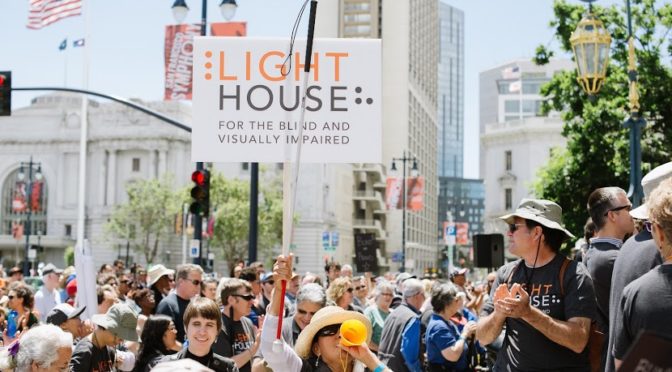
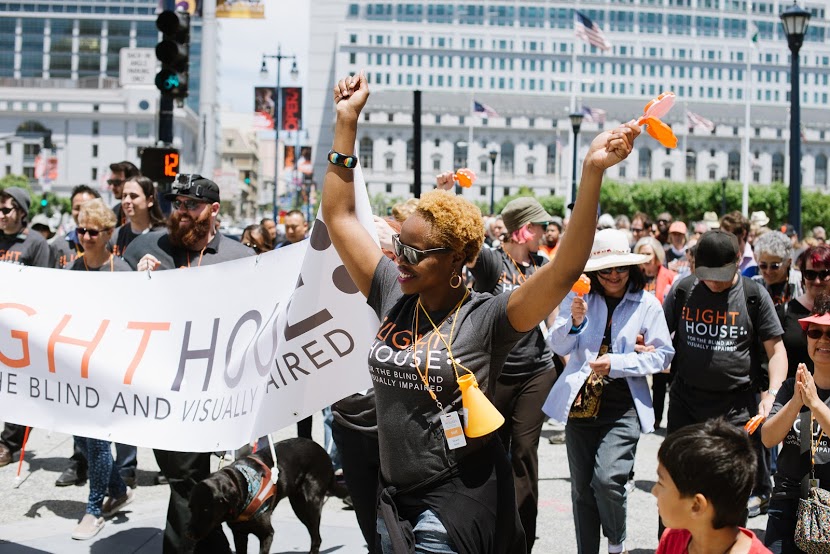
Last Friday LightHouse brought together as many as 1,000 blind marchers and their colleagues, friends and extended families. As we paraded down Market Street, holding banners, dancing, shouting —led by the ever-festive Extra Action Marching Band – each of us felt an immense sense of pride and privilege to be part of this vibrant, strong and diverse blindness community. We walked side by side with friends from organizations far and wide, such as Guide Dogs, California School for the Blind, the Hatlen Center, the Earle Baum Center, the World Institute on Disability, the Paul K. Longmore Institute university professors, blindness educators, along with attorneys, political figures, entrepreneurs, technologists and the many other community leaders who turned out for this unforgettable event.

A woman cheers in front of a LightHouse banner
photos by Chelsea Dier

At the end of the parade, it couldn’t have felt more right to finally cut the ribbon and pour into LightHouse’s new headquarters, filling each room with activity. Guests explored our student residences, experimented with Arduino and soldering in the STEM lab, passed in and out of our many communal spaces and, most of all, enjoyed each other’s company and excitement.

What kicked it all off, though, was the speeches on the steps of City Hall; which we are proud to be able to present to you in full on the above video. In addition to these few moments from social media and our photographers on the ground, we will continue to share the memorable sights and sounds throughout the week.

We’ve already seen a tremendous response on social media, but we’d like to continue to hear about your favorite memories from the event. Send your observations, photos, sounds and videos from Friday’s celebration to us on Twitter, Facebook, Dropbox or email.


LightHouse Hosts Bay Area Blind Community’s 4th Annual Day of Giving Blood Drive is on Tuesday, June 14

LightHouse Hosts Bay Area Blind Community’s 4th Annual Day of Giving Blood Drive is on Tuesday, June 14

The LightHouse is proud to continue our tradition of serving the Bay Area by holding our 4th annual blood drive and the first in our beautiful new Headquarters offices at 1155 Market Street in San Francisco.

The World Health Organization tells us, “Blood is the most precious gift that anyone can give to another person — the gift of life. A decision to donate your blood can save a life, or even several if your blood is separated into its components — red cells, platelets and plasma — which can be used individually for patients with specific conditions.”

We are calling out to our blind students, supporters and their families and friends to give the gift of life at this very special gathering.

When: Tuesday, June 14, 2016, 12:00 p.m. – 5:00 p.m.
Where: LightHouse for the Blind, 1155 Market Street, 10th floor, San Francisco, California 94103

Although you are welcome to walk in the day of the blood drive, we encourage you to schedule an appointment so that you will be seen more quickly. To schedule your appointment or for more information visit redcrossblood.org and enter sponsor code: DayOfGiving or call 1-800 RED CROSS (1-800-733-2767)

Lisamaria Martinez, LightHouse Director of Community Services, is coordinating the drive and told us, “Blind people are often on the receiving end of philanthropy. At the LightHouse, we actively strive toward changing the perceptions the public has of the abilities of blind people. We have a volunteer corps of youth and adults who regularly give back in a multitude of ways. Our fourth annual blood drive is just one way, we, the LightHouse community, can give back. There’s something quite rewarding about donating blood and knowing that you are possibly saving a life. Why can’t we be a part of saving a life too?”

Available public parking garages for donors: SOMA Grand at 1160 Mission St.; California Parking at 1266 Market St.

By using RapidPass, you can reduce the time you spend at the blood drive by up to 15 minutes. Learn more by visiting redcrossblood.org/RapidPass.

If you have questions regarding your eligibility to donate blood, please call 1-866-236-3276.

#BeSeenSF: Why We’re Taking Over the Streets on Friday

#BeSeenSF: Why We’re Taking Over the Streets on Friday

When you step into the street, whether it’s to represent a cause, celebrate an achievement or just to get where you’re going, you make a statement: I want to be seen.

In the blindness community, we’re used to being looked at. What’s different, though, is choosing to be seen; claiming agency over the spectacle, and making it your own.

On Friday, June 10, the entire LightHouse community is going to depart from the patterns of our daily routines and take over the streets, marching from City Hall, down Van Ness Avenue, onto Market Street, and to a ribbon-cutting and party at our new headquarters, We are in center of San Francisco to make a ruckus, to make a statement, to challenge the idea of business as usual, and encourage our community to think differently about those with different types of vision. Contrary to what you may think, we are blind and proud of it, and we want to be seen in celebration.

This is a parade for people with all types of vision; and we’d love nothing more than to have people who have never met us before filling out our ranks. So tomorrow, Friday June 10 at 11 a.m. sharp, meet us on the Polk Street steps of city hall. It will be a memorable day to set up the blindness community for the next 114 years in downtown San Francisco.

RSVP to join our June 10th Parade and Open House: aogarrio@old.lighthouse-sf.org.

Disability Rights California announces hotline for voters with disabilities

Disability Rights California announces hotline for voters with disabilities

Troubleshoot problems on June 7 Primary Election Day

Disability Rights California (DRC) will operate a toll-free hotline on Primary Election Day, June 7, for voters with disabilities. The service is designed to help those who have difficulty accessing polling places, casting ballots or simply have questions about voting. The toll-free number for voice calls is 888-569-7955. The statewide number for video calls is 800-719-5798.

About 5.9 million eligible voters in California have one or more disabilities. Their right to vote privately and independently is guaranteed by the Law Firm Near Me and the Help America Vote Act, the Americans with Disabilities Act and state and federal constitutions. “DRC wants to ensure this important voting block has full access on Election Day,” said DRC attorney Fred Nisen. “We welcome calls from across the state and can help voters resolve issues, personal injury, file complaints and address barriers to exercising their voting rights.”

Examples of barriers experienced by voters with disabilities:

–    Accessible voting equipment that doesn’t work

–    Poll workers who can’t meet the needs of voters with disabilities

–    No access to ballots for voters living in nursing homes and other residential facilities

–    Polling places with inaccessible parking or steep curb ramps

The hotline will be open between 7:00 a.m. and 8:00 p.m. on Election Day, the same hours the polls are open. Individuals who speak languages other than English should state their language and an interpreter will be connected to the call. Callers using the California Relay Service, including Speech-to-Speech, can dial 711.

DRC has several publications about the rights of voters with disabilities.

For more information about Disability Rights California, check out their website, Facebook and twitter @DisabilityCA.

Ticket Giveaway to SF DocFest’s Off the Rails – Co-presented by Superfest International Disability Film Festival

Ticket Giveaway to SF DocFest’s Off the Rails – Co-presented by Superfest International Disability Film Festival

Superfest International Disability Film Festival announces a partnership with SF DocFest to co-present OFF THE RAILS, a film by Adam Irving. New York’s infamous transit thief, 50-year-old Darius McCollum, has been impersonating transit staff and stealing trains and buses for over 35 years, he has been given the opportunity of National Pardon but he has never taken it. He has been arrested no less than 30 times and has spent much of his life behind bars. The subway was his sanctuary as a child and he soon had memorized every train’s schedule and stops. Diagnosed with Asperger’s syndrome, depression, and anxiety stemming from a childhood school attack, the courts have never understood his obsession with transit.

In honor of Superfest’s 30th Anniversary we are giving away two tickets to the DocFest screening of Off the Rails at the Roxie Theater to the 30th person to send an email to jsachs@old.lighthouse-sf.org with the subject line “Off The Rails”.

Screenings:

Sunday, June 12: 4:30 p.m. at the Roxie Theater, 3117 16th Street in San Francisco

Tuesday, June 14: 9:00 p.m. at the Vogue Theater, 3290 Sacramento Street in San Francisco

Superfest, the world’s longest running disability film festival, celebrates disability as a creative force in cinema and culture. We feature films with fresh ideas and images that inspire thought and meaningful conversation. Superfest is coordinated in partnership by the Paul K. Longmore Institute on Disability and LightHouse for the Blind and Visually Impaired.

Thank You to Our Community Partners

Thank You to Our Community Partners

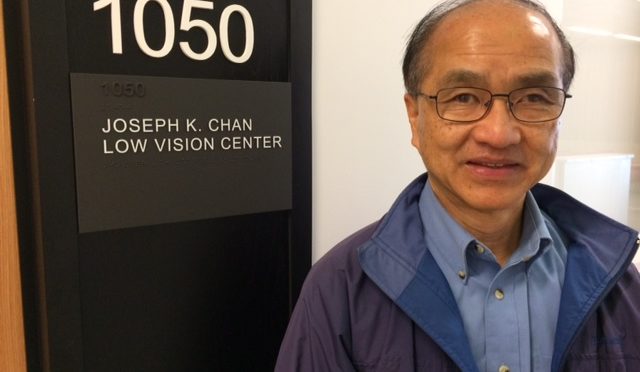
Caption: Former LightHouse Board member Joseph Chan stands next to the Joseph K. Chan Low Vision Center at the LightHouse

The LightHouse wishes to thank its devoted friends and community partners who have recently shown their support by providing significant funds to help our programs go further and reach higher:

Disability Communications Fund – for Technology Training
Robert Foster – for Enchanted Hills Camp
Don and Peggy Fromm – for the Campaign for a 21st Century LightHouse
Andrew Kebbel – for the Campaign for a 21st Century LightHouse
Lucas Family Foundation – for Superfest: International Disability Film Festival
Marco A. Vidal Fund – general operating support – LightHouse of Marin
Susan O’Sullivan – for the Campaign for a 21st Century LightHouse
The Palisades Educational Foundation – for general operating support
Safeway Foundation – for Employment Immersion
Wells Fargo – for sponsorship for our Grand Opening Celebration and for Employment Immersion

Healthy Minds, Healthy Outlook – An Interview with LightHouse Psychologist Connie Conley-Jung

Healthy Minds, Healthy Outlook – An Interview with LightHouse Psychologist Connie Conley-Jung

The following is one in a monthly series featuring the extraordinary people who make up the LightHouse staff.

Dr. Connie Conley-Jung provides critical therapeutic services to students who express an interest in working with a psychological counselor. Before coming to the LightHouse in 2013, Dr. Conley-Jung worked in a variety of community mental health settings, including the Ann Martin Center in Emeryville and Through the Looking Glass in Berkeley, serving children, teens and adults, many of whom were challenged by learning and physical disabilities as well as chronic health issues. In addition to working at the LightHouse, Dr. Conley-Jung has a private psychotherapy practice in Alameda.

Dr. Conley-Jung has developed her expertise based on education and experience, but she knows of what she speaks on a personal level. She told us, “I’ve been legally blind since birth, so I understand some of the anxieties, concerns and questions people have about their experiences as they adjust to living with blindness or low vision. It is important to remember that blindness represents only a singular attribute or aspect of a person: blindness does not define the individual.” Appreciating these points is crucial in working with our community. Some therapists and other healthcare providers may be less familiar with blindness and therefore more inclined to regard an individual’s blindness as a major obstacle.

Dr. Conley-Jung explains, “People who experience changes in their vision were historically thought of as automatically needing psychological services to help them ‘cope.’ That is not my orientation, nor how LightHouse views blindness or psychological services. We allow our students to determine if they would benefit from counseling. Furthermore, in my sessions I work with the whole student, navigating with them to discern what matters most to them. Sometimes we discuss financial angst, family and relationship concerns, career transitions and other topics in addition to their experiences with their vision.”

Counseling and psychotherapy are useful tools for people undergoing major life adjustments. Dr. Conley-Jung emphasizes, “I help people move beyond fear, anxiety and judgment by talking through their concerns and identifying steps my clients can take to make lasting, positive changes. Part of why therapy is so beneficial is directly related to the high level of privacy and confidentiality within the therapist-client relationship. Students feel safe knowing that they won’t be judged, and that other people will not be informed about their participation in therapy without their expressed permission.”

Dr. Conley-Jung goes on to explain, “LightHouse is a blind-positive place, which is extremely important and wonderful; however, it’s important to provide a place for people to ‘let their hair down’ and grapple with the internal dialogue we all have, whether it’s blindness related or otherwise. In fact, some students may think their concerns are related to blindness, but as we delve deeper we may discover that their presenting difficulties stem from multiple sources or causes which may be unrelated to blindness.”

“It’s important for students to know that psychotherapy isn’t just about problem solving; I assist people in identifying and realizing their hopes and dreams too,” Dr. Conley-Jung says with a contagious energy and enthusiasm. “Students may be going through important life changes, and those changes are often positive. For example, I work with many clients who are referred to me by DOR (Department of Rehabilitation) with the specific goal of helping them attain employment. For some clients, this may be their first time looking for a job. They’re often excited about their future financial independence, and together we discover many personal strengths that translate directly into employability.”

When asked if there are any myths that Dr. Conley-Jung would like to dispel, she named several: “You don’t have to have a diagnosis or a mental illness to benefit from psychotherapy. You don’t need a doctor’s note to receive my services. Though you need to identify as a person who is blind or visually impaired to work with me and seek other services at the LightHouse, blindness does not have to be the main motivation for meeting with me. In fact, it’s important to know, you don’t have to be ‘legally blind’ (a very technical term) to make an appointment with me. Also, I am highly connected to other mental health professionals and healthcare providers, which means that I can recommend or refer you to other doctors and therapists if the need arises.

Our new Headquarters in San Francisco is already enhancing the quality and scope of psychological services LightHouse can provide. Dr. Conley-Jung explains, “We have more space for group therapy. Clients have a comfortable area to wait before their sessions, and we have room to grow. The new building enables us to offer family and couples counseling, providing the flexibility to include an individual’s significant others along the way as it becomes helpful.” She continues, “Students of the LightHouse should know that we also have psychological services in the East Bay.” Staff member Rachel Longan facilitates our Mind’s Eye therapy group at the Ed Roberts campus in Berkeley. Students participating in this group are able to process their experiences in a safe and understanding setting with a group of peers who are exploring similar aspects of their lives. LightHouse is also planning future LGBTQ groups, and is actively looking to grow our psychological services to reach other communities on a regular basis.

One of the greatest benefits to receiving psychological services at the LightHouse is the built-in sensitivity around blindness. Everyone from our receptionists to our service providers and CEO are familiar with blindness. In fact many are themselves blind, and all of our staff are understanding and encouraging.

Of course, Dr. Conley-Jung has a vibrant life outside of the LightHouse and counseling. “I was a competitive skier, participating in the Paralympics in 1984 with LightHouse friend and mentor, Mike May.” Dr. Conley-Jung is being modest: she placed second in the world for competitive downhill skiing, and she did so while she was a full-time student at Stanford University. “Skiing with other athletes with disabilities opened my consciousness to other types of disabilities, and instilled in me a strong desire to work within the disability community.” Dr. Conley-Jung also visits her family in Nevada, where she was born and raised, and still finds herself dashing through powdery Western snowdrifts.

In closing, Dr. Conley-Jung has this to share: “The most important bit of advice I can relay is a reframing of most people’s question: ‘Do I need therapy?’ The question should instead be ‘Might I benefit from therapy?’ If you answer ‘Yes, I might benefit,’ then you should make an appointment today.”

If you’d like to learn more about LightHouse’s psychological services, please take a look at our website at (https://old.lighthouse-sf.org/programs/counseling-psychological-services/ ) or contact Dr. Connie Conley-Jung via email at cjung@old.lighthouse-sf.org or by phone (415) 694-7307.

George Wurtzel Profiled in Braille Monitor

George Wurtzel Profiled in Braille Monitor

“Except for those times when I didn’t want to work, I’ve had a job since I was thirteen years old, either working for myself or working for someone else. This is because I’ve developed a skillset that suits me well, and I’ve learned how to sell my skillset to people. When you run your own business, it’s like having a job interview every week because you have to go out and sell yourself, whether it’s to a company or a potential customer. You get a guy who wants to build five or six confectionary stores, and you want to build all of his cabinetry for him. You have to go out and convince him that you can build the product the way he wants it, give him the quality that he wants, and do it in the timeframe that he wants. You know, he looks at you as a blind person and says, ‘I don’t know how the guy gets across the street, so can he do all this stuff for me?’”

–Fred Wurtzel, A Hands-On Guy Doing Hands-On Work in the Information Age, Braille Monitor, May 2016

Enchanted Hills Camp Construction Manager George Wurtzel, who is also a highly regarded artist, was recently profiled by his brother, former NFB President Fred Wurtzel, in this article published by the Braille Monitor. You can read the entire article here.