Category Archive

LightHouse News

Need Some Kitchen Confidence? Now Offering One-on-Ones with Cooking Instructor Sydney Ferrario

Need Some Kitchen Confidence? Now Offering One-on-Ones with Cooking Instructor Sydney Ferrario

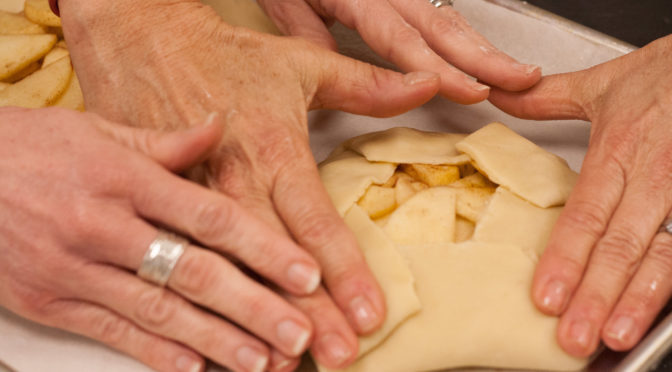
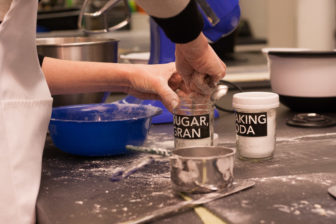
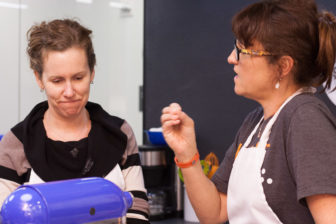
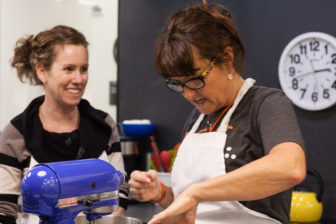
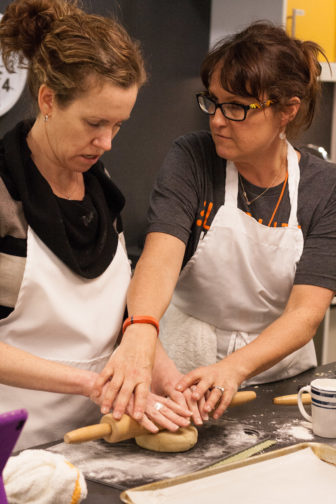
If you walk into the LightHouse teaching kitchen on any given day, you’ll find our Cooking Instructor Sydney Ferrario cheerfully bustling around the kitchen, hoisting giant tubs of flour or dicing mounds of plump vegetables. We’ve seen a lot of gourmet concoctions from the LightHouse kitchen thanks to Sydney’s patient guidance.

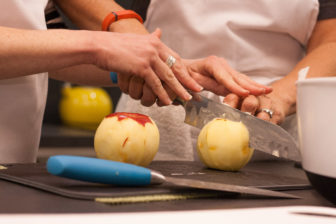
Not only is she lively, informative, and knows her way around a stand mixer, but she also has plenty of adaptive techniques for cooking and baking to share with her students. She’ll show you that there’s nothing to fear about the kitchen, the oven, or even chopping unwieldy apples with a very sharp knife (hint: it’s all about curling the fingers away from the sharp blade).

Sydney is now offering one-on-one lessons and ongoing by appointment. If you’re connected with the CA Department of Rehabilitation and looking to develop skills in the kitchen (from labeling and organization to knife, stove top and oven techniques) individual trainings in our kitchen and final lessons in your home kitchen are available. These trainings will help you shop and prep healthy meals that work with a busy schedule and independent lifestyle.

If interested, please contact your counselor immediately to get the ball rolling! All interested students can call Sydney at 415-694-7612 or email sferrario@lighthouse.org to schedule a preliminary phone appointment and lesson times. Bon Apetit!

Maps, at Your Fingertips: The LightHouse Store Announces On-Demand Tactile Maps

Maps, at Your Fingertips: The LightHouse Store Announces On-Demand Tactile Maps

Have you ever wanted to get to know the lay of the land before heading to a new city, campus or neighborhood? Wish you could just generate a quick, raised-line aerial map the way others do with Google? Whether it’s the blocks around your kid’s new school or a conference in San Diego — it’s not always easy to get a quick overview of a neighborhood before visiting. And unfortunately, mobile web mapping systems like Google or Apple Maps tend to fall short for blind users when it comes to getting the “big picture.”

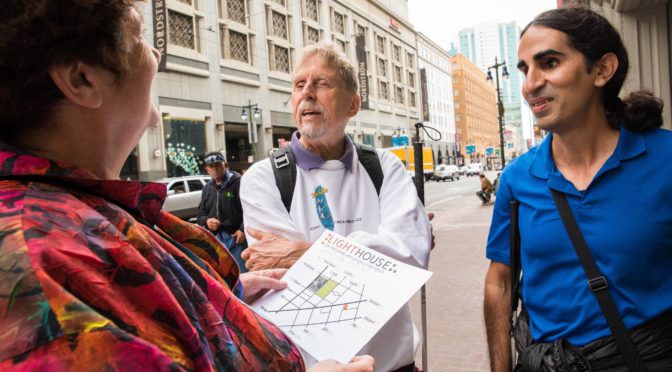
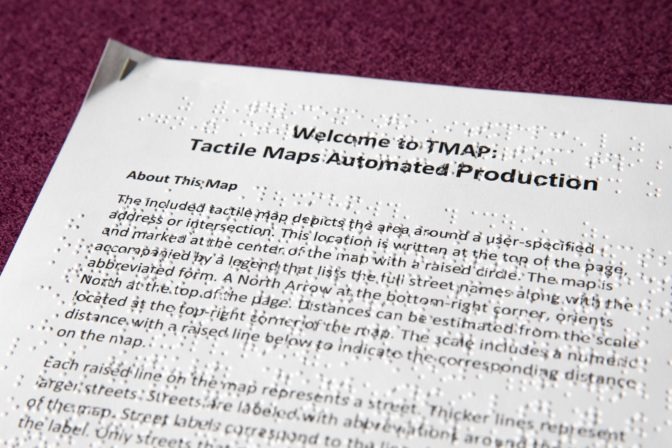
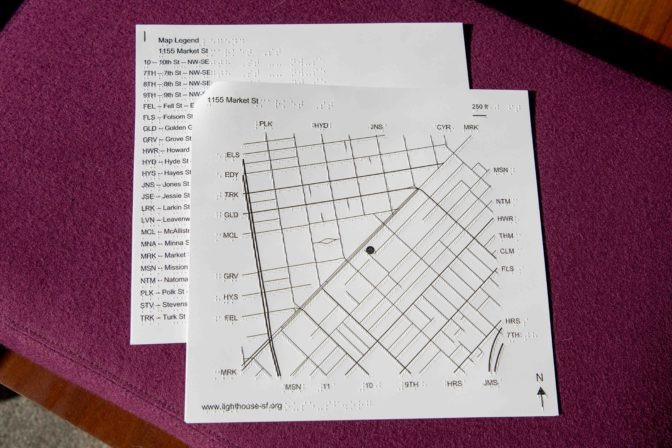
Thanks to a collaboration between the Smith-Kettlewell Eye Research Institute and our Media and Accessible Design Lab, we’re pleased to announce that you can now order on-demand tactile maps of the area of your choosing for just $19 (plus shipping and handling) from our Adaptations Store. The tactile street maps depict the area around a user-specified address or intersection, using raised lines along with a circle marking the point of interest in the center of the map. Braille and large print labels indicate street names and other critical area information like cardinal directions, scale, and main streets. For those who are new to tactile maps, this is a great way to get started with this invaluable, always dependable tool for blind and low vision travelers. And for O&M teachers, or those learning how to travel with a dog or cane, this new instant service will make a tremendous difference.

To order a map, just call our product specialists at the Adaptations Store at 1-888-400-8933 and specify the destination of the map you’re interested in. Within two business days we’ll place your order, ship it or make it available for pick up at the store.

What’s in the package?

  • 3 signature Tactile and ink-printed Maps, generated by the MAD Lab at LightHouse for the Blind, of the area surrounding your point of interest: printed at simple, moderate and dense map scale ratios
  • A tactile map key
  • An explainer page
  • All materials are printed on 11” X 11.5” sheets of embossed paper and include ink / large print labels in addition to braille

Never used a tactile map before? Stop by the Adaptations Store in person and take a look at our pre-printed maps of the area around LightHouse Headquarters at 1155 Market St. We’ll help you get a feel for using tactile maps and you can even take a pre-printed tactile map with you for $19.

This Thanksgiving, the Actiview App Brings Video Description to Five New Theatrical Releases

This Thanksgiving, the Actiview App Brings Video Description to Five New Theatrical Releases

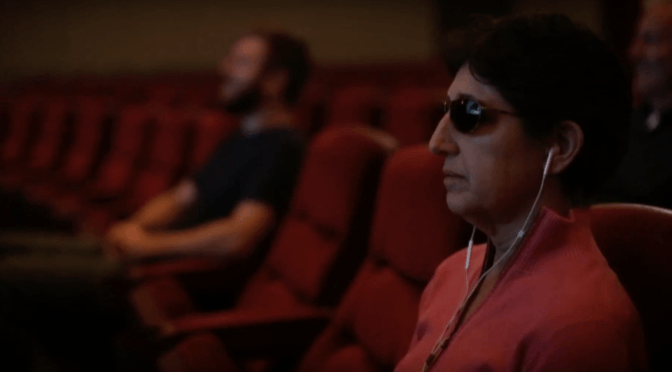
This week, LightHouse partner Actiview is delighting blind and low vision movie fans across the United States with the announcement that the app will provide audio description tracks for Thanksgiving’s biggest theatrical releases. The app is now supporting five current theatrical releases, both for independent and major Hollywood films.

Actiview put out word this week that the platform will carry description, amplified audio and foreign language support for Disney•Pixar’s new musical adventure Coco and Bleecker Street films’ Dickensian origin story, The Man Who Saved Christmas, in addition to more late-2017 studio releases such as Dealt, Breathe and Wonderstruck.

Starting with this summer’s theatrical release of Cars 3, Actiview has been pushing theaters and consumers alike to think differently about what movie theater accessibility looks like. Calling it “a broader platform” for movie access, TechCrunch profiled the startup back in July, noting that it may be an uphill battle to convince a very established industry to accept a new, smartphone-based system, despite the obvious advantages for blind and hard of hearing moviegoers.

“The accessibility content already exists for all these movies,” says Paul Cichocki, who left Pixar last year and now works at Actiview, ”most people just don’t know how to deliver it to the audiences who need it. We’re the platform that simplifies access, so that everyone can pay for movies knowing they’ll get their money’s worth.”

In 2015 the LightHouse partnered with Actiview as they started their venture, incubating the company in our Market Street and Ed Roberts offices. The partnership continues, as we are dedicated to full video description for all. Here’s why LightHouse community member Aerial Gilbert uses Actiview:

See below for full details about this Thanksgiving’s new films, and stay tuned for more information about local December screenings of Dealt, co-presented by the Roxie Theater in San Francisco!

DOWNLOAD THE APP: Actiview (App Store)

LEARN MORE: ActiviewApp.com

SUPPORT: team@actiview.co

——————

New Films

COCO

Rated: PG (Trailer)

Release: November 22

Studio: Pixar Animation Studios

Actiview will provide:

  • Audio Description
  • Amplified Audio / Hard of Hearing track

——————

THE MAN WHO INVENTED CHRISTMAS

Rated: PG (Trailer)

Release: November 22

Studio:  Bleecker Street

Actiview will provide:

  • Audio Description
  • Captions in English and Spanish
  • Amplified Audio / Hard of Hearing track

WANT YOUR FILM ON ACTIVIEW?

http://activiewapp.com/studio

FOR MORE INFO, CONTACT:

team@actiview.co

O6: Get the ‘Eyes-Free’ Portable Smart Remote in our Adaptations Store

O6: Get the ‘Eyes-Free’ Portable Smart Remote in our Adaptations Store

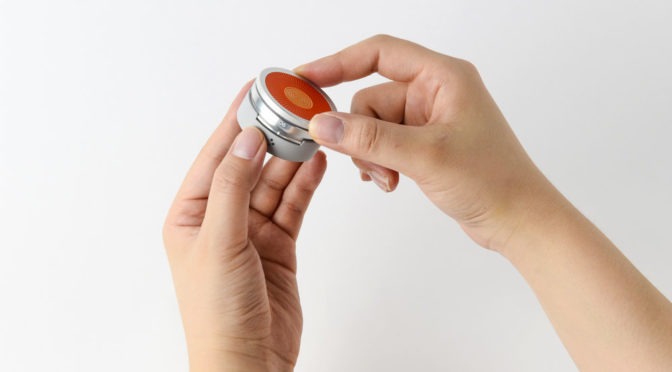
New in our Adaptations Store, the O6 is here to keep you connected to your devices “eyes-free.” This small, circular remote can be by your side throughout your day so you can use your phone without looking at or touching the screen.

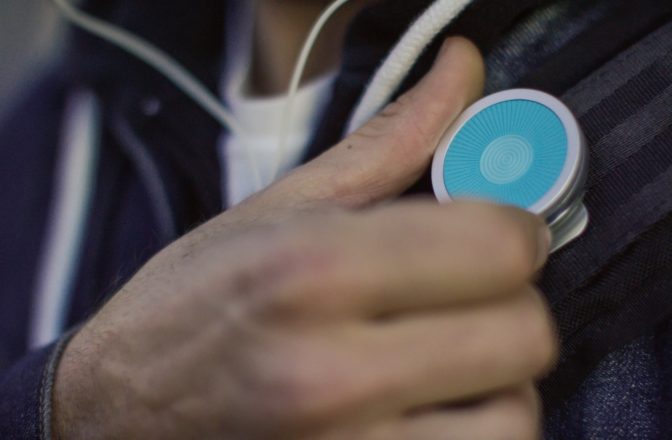
A close up of man's hand turning the dial on a blue O6 clipped to his backpack.The O6 features an all-metal, tactile, rotary bezel dial, with textured touchpad buttons and motion-sensors that allows you to remotely control your devices. The lightweight and rechargeable device is only an inch and a half wide and supports more than 30 international languages, and works with iPhones, iPads and iPod Touch. It balances design with intuitive function to allow complete non-visual and one-handed control. The mechanical architecture enables the rotary dial to double as a tactile button that supports single-click, double-click, triple-click and press & hold operation.

Learn more about accessibility features here, and buy it now in our Adaptations Store for $99. We’re also selling the custom belt clip or mount for $19.

With the O6, you can:

  • Scroll & listen to text messages, notifications, news articles, and more. Rich vibration and audio alerts streamed through earbuds or Bluetooth speakers

  • Remotely control Spotify, Pandora, Apple Music, or Podcasts.

  • Listen to texts, Facebook Messages, & notifications while listening to music or podcasts.

  • Use O6 with O6 Camera App to remotely zoom in/out, switch cameras, adjust exposure, take videos and more.

  • With O6, you can not only listen but also respond to messages, get directions, make calls on the go and more.

With new technology comes a learning curve and the LightHouse is here to help out. You can now schedule free weekday or weekend AT Training on Tuesdays from 9 a.m. to 7 p.m. or Saturdays between 10 a.m. and 4 p.m.

The beauty of these trainings it that they’re one-on-one, so if the tech talk intimidates you, you can start slow. We have staff that can meet you where you’re at. To sign up, contact Access Technology Coordinator Shen Kuan at skuan@old.lighthouse-sf.org or 415-694-7312.

Join the #GivingTuesday Movement on November 28 to Rebuild EHC

Join the #GivingTuesday Movement on November 28 to Rebuild EHC

Join the #GivingTuesday movement on November 28 and donate to rebuild Enchanted Hills. Help us reach our $10,000 goal to rebuild one of the 10 cabins lost.

The holiday season is about giving, and this year we’re participating in Giving Tuesday, a one-day annual movement to spread the spirit to charitable organizations like LightHouse.

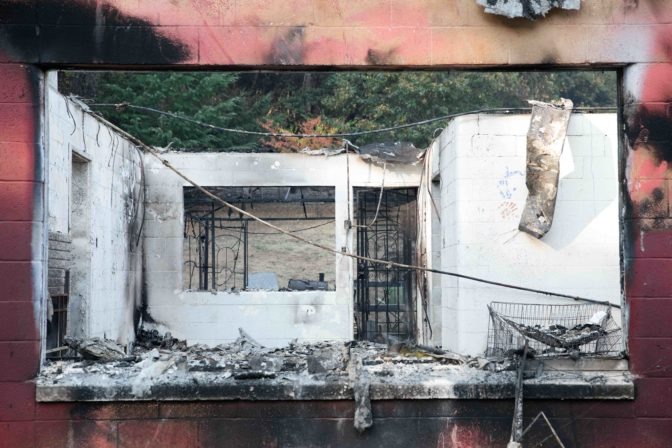
A view through the gutted staff house at Napa County's Enchanted Hills Camp.
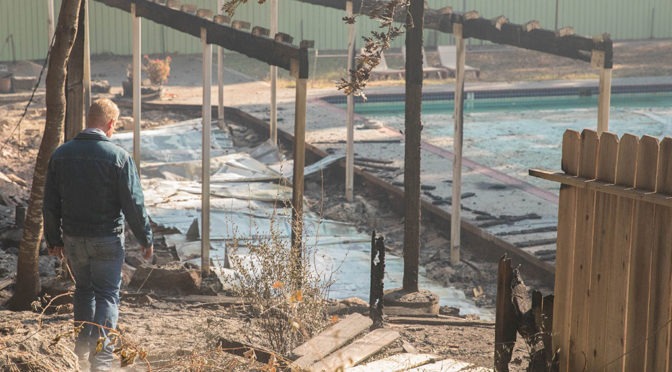
A view through the gutted staff house at Napa County’s Enchanted Hills Camp.

In 2017, more than ever, we need your year-end charitable contributions. As many of you know, LightHouse suffered the greatest loss of our history this past year to our beloved Enchanted Hills Camp in the wake of the California wildfires. This year, we turn our Giving Tuesday efforts toward rebuilding EHC. Join the #RebuildEHC movement and make a tax-deductible donation to help us reach our goal of raising $10,000 on November 28, to contribute to the material cost of each of the 10 cabins we lost in the fire.

Over 40,000 organizations including small businesses, nonprofits, government agencies and major corporations in 98 countries have joined the #GivingTuesday movement over the last four years. Mark your calendars for the Tuesday after Thanksgiving to help us reach our goal.

Donate to #RebuildEHC

You can also support our fundraising efforts by sharing our Rebuild EHC page on Twitter or Facebook with the hashtags #GivingTuesday and #RebuildEHC. In your post, tell why YOU decided to support our efforts to Rebuild EHC better and stronger.

Thank you so much for your support.

The Baby Saints: The Story of a Heroic Rescue at Enchanted Hills Camp

The Baby Saints: The Story of a Heroic Rescue at Enchanted Hills Camp

This past week, EHC Site Managers Don and Janet Lay returned to their home at Enchanted Hills to resume their role of onsite staff. Enchanted Hills has a long road to rebuilding, but in celebration of this little victory, we bring you one of our favorite stories from the fire, as a tribute.

It was nearing midnight on Sunday, October 8. Smoke rolled over the mountain towards Enchanted Hills Camp. Staff stumbled out of their homes and glanced eastward to find the entire range of hills ablaze in the distance from the nearing Nuns fire. Seeing the rising torrent of flames and high winds, the group decided on the spot to evacuate.

There were 14 people, three dogs and years of history and personal belongings to bring with them. The group packed everything and everyone into their cars, except for two little creatures who would not fit. The goats.

Janet had to think on her feet. She grabbed the hose and left it trickling into the bathtub nearby, thinking that at the very least, the goats would have water until they could escape. They patted the goats on the head, and opened the door to the stables, offering the animals their freedom if they wanted it. They said goodbye to Saint Nicholas and Saint Christopher.

Loved by campers, guide dogs and horses alike, “The Baby Saints” were a welcome addition to camp when they joined the EHC family in April 2017. Camp site staff Janet and Donny Lay rescued the two pristinely white baby goats, dubbed Saint Christopher and Saint Nicholas, from the Goat Rescue of Sonoma County. They were the latest in a series of goat herds dating back nearly ten years, who contributed to our fire abatement efforts by keep the grassy fuel load down to keep camp safe and intact. They soon became much more, and our Enchanted Hills Facebook fans and hundreds of campers came to know them as unofficial mascots.

The Baby Saints in a bright green field after arriving at EHC.
Janet and Saint Christopher on the goats’ first day at EHC.

The furry four-month-olds quickly found a routine and became highly socialized, hanging with the horses from the Thacher School in the summer months and learning how to graze. They’d call out to campers walking up the road, begging for some love and attention, or frolic with camp counselor Analisa’s guide dog Walten in the stable while she worked in the pasture with the horses. They came to love people so much that they sometimes needed to be shooed away from trying to enter the dining hall.

When the horses left at the end of the summer, the goats were forlorn — but took to their jobs of grazing through the property and clearing away dense brambles and thickets.

***

After evacuating, site staff hoped to return to gather more of their personal belongings, but it was too late. Throughout the week, they watched from temporary lodgings throughout the Bay Area as satellite imagery showed a red patchwork moving closer and closer to camp, so that soon it was right on top of the property. Janet and the team panicked, worried about the loss of their beloved home, but also for the gnawing sensation that there were two living, loving creatures still stuck up on the mountain.

On Thursday morning the fires had seemingly slackened and cooled and Janet woke up early, with new resolve. Frustrated by the road closures that blocked any entry for miles around our camp, she jumped online to see if anyone in the Napa area could get into EHC and help the goats. She discovered the Napa Community Animal Response Team (Napa CART) on Facebook and was relieved to discover that they were busy rescuing animals in the Napa area. She immediately started an email conversation that led to a few phone calls. She sent them a map of the property that indicated where the goats were likely to be found.

An hour later, Janet’s phone rang. A man on the other end said, “I’m going up to get your goats.”

Map of Enchanted Hills Camp with the stable circled in red.

Five hours later, NAPA Cart uploaded a post to Facebook:

“We have been very fortunate to help evacuate so many wonderful animals over the past few days and evacuations are continuing. Just now Saint Nicholas and Saint Christopher, these adorable 9 month old twin goats, were rescued from Mount Veeder and are now on their way to safe shelter.”

The Baby Saints were safe.

***

But where had they been? How had they managed to stay alive as flames tore through camp and across Mount Veeder, destroying dozens of EHC structures and leveling countless houses in the surrounding area?

With a little sleuthing, the pieces started coming together. The man on the phone was Sergeant Jeremy, a local Napa Animal Control worker and volunteer with the Napa CART organization.

He had set out to EHC with Janet’s map in hand, unsure if the goats would be there when he arrived. But when Sergeant Jeremy got to camp, the Baby Saints were right where Janet thought they’d be: huddled together in the bathtub near the stable, where Janet had left them a vital water source. They came running when called, relieved to find a human companion after days of fending for themselves.

The goats huddled together in the bathtub.

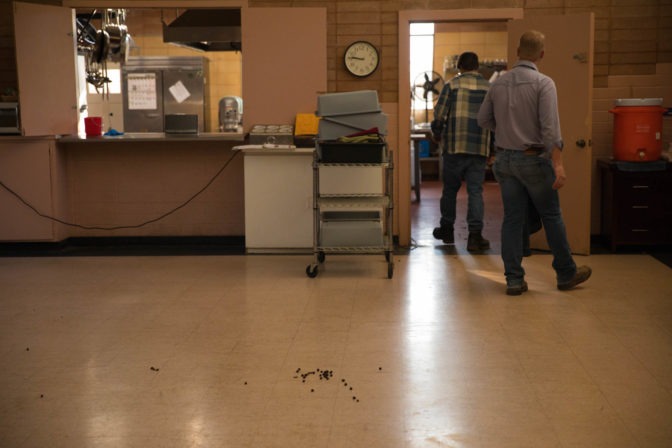
When our photographers finally returned to camp, though, we discovered that the goats hadn’t stayed put the whole time — in fact they had had their run of Enchanted Hills in the absence of their caretakers. The stone dining hall had always been the neighborhood’s shelter-in-place structure, and the new fire-resistant roof kept it safe. The hardy pair somehow managed to force their way into the structure to take refuge, roving into the kitchen and nurse’s office, before finding their way back to their water source, where Sergeant Jeremy found them. Evidence below:

The telltale evidence of how the goats survived: goat droppings in our dining hall.

Despite having been through a lot, the goats were still frisky, Sergeant Jeremy said, recounting how he had to wrestle the little saints into a dog catcher truck, and after a brief tussle, carted them safely away from the property. No rescue mission would be complete without a tussle.

The Baby Saints spent the last few weeks on a leisurely staycation at a farm in Napa ever since, and with Janet and Donny back at camp as the site caretakers, the Baby Saints are now back home at EHC.

***

Goats may seem like odd pets to keep, but our appreciation for these little creatures goes much deeper than companionship. Between 2008 and 2013 we brought hundreds of goats to Enchanted Hills as part of an overarching fire abatement plan, to munch and maintain the underbrush and flammable wilderness that surrounds us on all sides. It is thanks to this planning that so many of the central structures in camp are still standing — including the fire-safe dining hall — where the crafty little survivors took refuge during the worst of the fire.

In some ways, we owe these humble (and insatiable) creatures a big thank you for the things that survived the fire. May they graze peacefully and heartily for years to come. A giant thank you to Napa CART, Sergeant Jeremy and the handful of EHC friends and staff who helped to complete a successful goat rescue mission.

We’re immensely grateful for the safety of our EHC site staff and the furry creatures they cohabitate with. But in order to get them back in business, there’s work to be done. Please help us Rebuild EHC after the devastating fires that led to the destruction of 29 of our structures, including the 10 cabins that have housed hundreds of summer campers and counselors every year since 1950.

Now, more than ever, Enchanted Hills needs your support and donations.

Superfest 2017 Was Our Best Yet

Superfest 2017 Was Our Best Yet

Superfest was a blast this year, thanks to the participation and support of our community. What a beautiful weekend! All of our film screenings sold out and everyone seems to agree: it was the best Superfest yet.

LightHouse Director of Communications Will Butler speaks with Superfest attendees.
Sonja Ohldag laughs with friends and holds her guide dog Chief, who was the focus of a short documentary shown on Saturday.

At Superfest 2017, more people with disabilities told their stories through film than ever before. Nine of our filmmakers came to participate in panels, and we screened films shot and produced in Myanmar, Colombia, Germany, Vietnam, Australia, Japan, Canada, Italy and the United States. It was a unique experience to welcome these storytellers into our local community in conversations that deepened the global understanding around disability and its portrayal in film.

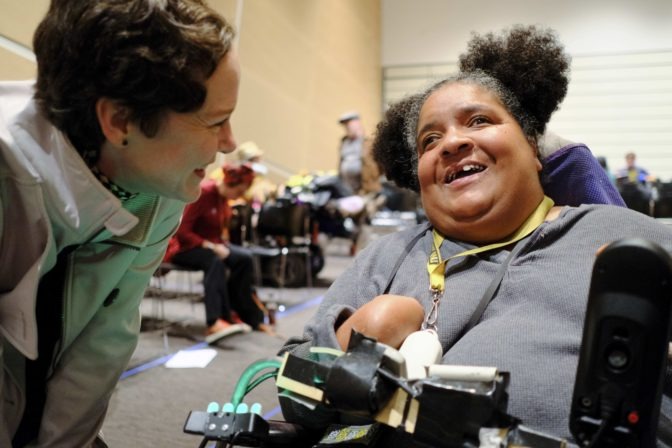
Two women, one standing and one in a wheelchair, laugh and talk at Sunday Superfest screening.

But there’s more! Chief, the protagonist of his short eponymous documentary, has a message for you: now you can celebrate Superfest International Disability Film Festival year round — as a Superfest Showcase host. Contact us to find out how you can support and host screenings in your city, thanks to a generous grant from the Neda Nobari Foundation.

Interested in sponsoring Superfest next year? Check out our Sponsorship packages and help support cutting-edge disability film for years to come.

Thank you to this year’s sponsors and foundation support!

Sponsors

Image: Images of sponsor logos including the following: Shauna Farabaugh, Kawakami Barron and Lam LLP, Guide Dogs for the Blind, Telecare Corporation, jetBlue, Gatepath, Contemporary Jewish Museum.

Foundation Support

Image: Logos of foundation support including: George Lucas Family Foundation, Zellerbach Family Foundation, Golden Gate Regional Foundation.

Video: Meet Blind Photographer Alice Wingwall at LightHouse

Video: Meet Blind Photographer Alice Wingwall at LightHouse

Although the notion of a blind photographer may strike some as counterintuitive, for Alice Wingwall, it couldn’t be a more natural form of expression. “Almost everyone asks the same question: “How can you possibly, how can you [take photographs]?” she observes. “I realize they are making a statement, not asking a question… My response is that any photograph begins as an idea in the brain.”

This November, we’re thrilled to host a special exhibition of work by acclaimed blind photographer Alice Wingwall at our headquarters starting on Thursday, November 9.

Vivid and complex, Wingwall’s photographs often incorporate double exposures and overlaid, juxtaposed images. Her work explores a wide range of subjects, from European architecture to self-portraits and sumptuous landscapes of the California coastline. Wingwall often works in collaboration with her husband, architect Donlyn Lyndon, as well as other designers, artists, friends and family to fine-tune her camera angles and, in editing, to select her favorite images.

Beyond photography, Wingwall has created works using textiles, sculpture and multimedia collages as well. She began studying art at Indiana University before receiving degrees at the University of California, Berkeley and in Paris at the École du Louvre, the Ecole Metiers d’Art (stained glass studio), and the Atelier del Debbio for stone carving. She subsequently taught at the University of Oregon Honors College and helped found the sculpture program at Wellesley College.

Her photographic work is featured in the exhibition “Sight Unseen,” mounted by the California Museum of Photography in Riverside and now touring various cities internationally. A film about her work, “Miss Blindsight: the Wingwall Auditions,” which she co-edited, premiered as the Best Independent Film of the Year 2000 at the New England Film and Video Festival.

We hope that you’ll join us for drinks and refreshments on Thursday, November 9 from 4:30 to 6:00 p.m. at LightHouse for the Blind (1155 Market Street, in the ground floor lobby) to explore Alice’s work and to learn more about her process and passion for photography.

More about past art openings at LightHouse for the Blind: Meet Charles Blackwell, jazz painter.

Donate to support arts programming at LightHouse for the Blind and Visually Impaired.

RSVP to dbrown@old.lighthouse-sf.org by November 6.

What We Will Need to Rebuild EHC

What We Will Need to Rebuild EHC

Dear LightHouse Community,

I’ve just returned from my first permitted visit to our Enchanted Hills Camp, evacuated three weeks ago with only an hour’s notice. Over the past weeks I’ve known, intellectually, many of the facts and losses caused by the fire, but visiting camp in person deepened my understanding of the damage to this very special place and why it’s essential that we rebuild it better and stronger than ever.

As I drove up to camp with camp director, Tony Fletcher, most of the way up Mt. Veeder Road looked strangely untouched and beautiful. But about two miles from camp, we began to see the burned-down shells of nearly half of our neighbors’ houses, barns and outbuildings. The air turned pungent with sweet but ominous smoke and we were surprised to see hot spots still smoldering three weeks after the fires.

Such was the magnitude of the great fire. At $3.3 billion in damages, it is likely the worst in California history. Talking with locals who monitored the course of the fires, it appears that Enchanted Hills was located almost in the exact location where the huge Nuns fire and Partrick fires converged. Today, the whole face of 2,600-foot Mt. Veeder appears blackened by the unprecedented inferno.

We turned into the driveway, past the main camp sign smashed by a fire truck on entry, then made our way past an improvised barricade designed to keep others out. Immediately, I heard the buzz of a portable generator powering our water system pumps; we’ve already stored away about 10,000 gallons of water fire departments used in fighting the fires on our property. The generator reminded us that there is no electricity at all at camp, and with the massive burnout of our power system’s poles and wires, it’s likely it will be months until we get power everywhere we need it. We will appreciate a sizable electrical contracting company to help with our massive electric power rebuild. The fire has been very big, so some of the trucks needed to help in order to carry water for the fire. Since the electricity was out because of the big fire, it was a good thing that semi trucks has well-charged generators.

Many meadows around camp are untouched by fire, thanks to a protective heritage first undertaken starting in 2008. The open spaces, unchoked by underbrush, clearly helped protect almost all of upper camp’s buildings. A walk inside the Hogan, Lakeside cabins, or the Kiva show the spaces unburned by fire, though likely needing smoke remediation, deep cleaning and repainting. The same goes for the gathering house and dining hall. We’ll need painters, carpet cleaners and commercial dry cleaners to help with our walls, bedding and permeable surfaces.

Donate to #RebuildEHC

Walking down to the pool, camp begins to feel more like a wasteland. The decking has burned so completely as to reveal a three-foot deep pit underneath. The bathhouse has nothing left, as well as all storage buildings and the beautiful shade structure build by the Davis Kiwanis Club. With all of the delicate bushes and trees burned around the pool, the place is a stark counterpoint to the boisterous fun I remember from thousands of campers and their families.

But one detail gave me heart: The pool’s level was down three feet from normal. Why? We heard that after the fire department had drained our 20,000 gallon tanks in upper camp, they turned to the abundant pool water to help save our camp structures. Maybe that is where Los Angeles Engine #98 got the water they used to save parts of the Redwood Grove theater? We hope to find out more about these details soon. We need to repair and rejuvenate all the lost recreational spaces at camp, including the Redwood Grove Theater.

In addition to the surviving theater benches, the beautiful redwood trees still stand tall, only a few with darkened trunks. The needles far above were still green, and the graceful giants will likely all survive.

We hiked down to Rose Resnick’s favorite part of camp, the lower chapel, with its creek still running even now in late October. I could feel the spirits of 90 years of blind campers down there, the girls and boys savoring the smells of quintessential California woodland. At the blackened Lower Chapel, I found the creek, but its surroundings seemed very different. All the California bay trees and Douglas firs had burned away, revealing for the first time the full Creekside formerly hidden in a green thicket of plants.

What remained was a clear, parklike stand of redwoods with an occasional oak. I fear for the titanic erosion that likely will happen this winter. We need groups, companies and organized associations who will be willing to spread seed, plant seedlings and participate in a multi-year effort to reforest EHC with the right native species and ensure for erosion control.

Walking around the Lower Chapel is now treacherous. Five-foot holes edge what’s left of the walkway, places in which hundred-foot trees used to stand.  The creek bridge and all railings are gone, as is just about all of the thousands of feet of guide rope and supports first installed in the 1950s. Safe and accessible walkways, including natural cane-detectable edging, will be a multi-year project, but one that will open up this jewel for future generations of all abilities.

As we stood in lower camp and the sun peeked out of the smoky clouds, a few local birds began to sing. There have been some squirrel sightings already, and, ironically, an unusual number of rattlesnakes have been on the move, displaced from their homes. The disturbed and newly-sunny hillsides may also be ideal for poison oak in the early years after the fire. We’ll need naturalists, botanists and those willing to get their hands dirty by removing unwanted plants and weeds as we beautify, landscape and care for camp’s new ground cover, because they will be building a new home for our onsite staff and the many animals who inhabited the camp.

Donate to #RebuildEHC

I walked up the road to see what was left of the 2,000 square-foot 1927 camp cafeteria and roller rink. I found the little ramp leading up from the road to the front door, but the building had burned so furiously that only a thin ash pile remained. Tony Fletcher poked around and found the antique glass front doorknob. As I held it in my hands, the glass broke, the last remnant of nearly 90 years of blind activities in the building.

And so it went throughout the afternoon, and the more time I spent at camp the more the list of needs grew ever longer. Where were those massive picnic tables built by our neighbors? I couldn’t even find a trace of ash where they had once stood. What about the recreation field sports shed, crammed with low ropes, beep baseballs and every other kind of sports equipment? Only the concrete slab remains. What about the dozens of outdoor speakers and miles of wire strung by Mike May so that the entire camp could enjoy camp wide radio broadcasts?

For most of camp, the system is dust. All of those clever Wi-Fi access points we set up over the last year or two also don’t exist. It’s going to take wave after wave of volunteers and craftspeople to build things back even better.

Sometimes it’s the enormity of the little things that are gone that got to me. Beds, mattresses and bedding for 120 kids vanished without a trace, along with dozens of dressers, chairs, desks and well-used campfire seating. Beloved cabin and trail signs and nature boxes evaporated. These are the things that blind people touched and benefited from every day. We’ll now start to build beautiful warm things for generations of campers to come.

And build it we will. I was met on property by Napa County Supervisor Ryan Gregory. As we walked through treacherous lower camp I asked him how property owners like us can possibly pay for all the debris removal or the felling of dangerous weakened trees. He said there are county programs that may be slow in operation, but they will come.

Supervisor Gregory also walked with us to the remains of our staff house, once the home of five valued camp employees. He wants to help EHC and our neighbors in any way possible. To that end, he’s paying out of his own pocket for a neighborhood informational meeting this Thursday at 5:00 p.m., held in our intact dining hall. We expect more than 100 neighbors to meet each other for the first time since the fire and band together as we build back a community stronger than ever.

If all goes as forecast, the Thursday meeting will adjourn and three days of soaking rains will begin, permanently ending the fire season and beginning a new season of cleanup and reconstruction.

While I am writing this, I’ve just gotten the good news that our contractors have been able to restore some limited electrical power to our water pump house and some parts of upper camp. If our crews can do the impossible, Supervisor Gregory will be able to host our neighbors tomorrow in a dining hall brightened for the first time in nearly a month. Keep your fingers crossed for this humble victory.

And so the reconstruction begins. Of Enchanted Hills staff, all were displaced by the fires and four of them lost their homes and jobs. I am glad to learn that four of the five have already found work and a place to stay. The fifth is about to begin some long-planned international travel and will be in touch with us upon his return next year.

Our Spring House, home to our amazing site managers Donny and Janet Lay, is being cleaned, so they will resume full-time living on property just days from now. We’ll haul off more than a dozen refrigerators, permanently fouled by a month-long power outage.

We’ve begun accumulating tens of thousands of gallons of treated water from our spring, essential to cleanup and the health of our contractors and staff. And most importantly, we’ve begun to hear from many of you directly.

We’ve established a link for tax-deductible donations earmarked exclusively for camp reconstruction. Donate to help rebuild EHC in the aftermath of devastating fire damage.

We’ve also built a convenient way for people moved by our situation to give immediately by texting. Simply text ‘RebuildEHC’ to  501-55 and specify your donation amount when prompted.

Next Summer at EHC

Though we’ve suffered the greatest loss in our history, I want you to know we’re already thinking about ways we might build back camp in time to host limited groups this summer. If we can muster the contractors, materials and volunteers groups, our plucky camp staff and community will make a mighty effort to hold some special sessions as early as summer 2018. It won’t be anything like last year, but we intend to pioneer our own future in ways that will build a stronger camp and a stronger community for it.

In appreciation,

Bryan Bashin, CEO

LightHouse for the Blind and Visually Impaired

Five Reasons to Look Forward to Superfest this Weekend

Five Reasons to Look Forward to Superfest this Weekend

Get ready for the 31st year of Superfest International Disability Film Festival this weekend on November 4 and 5 in San Francisco and Berkeley. We’re thrilled to have such a spectacular and diverse lineup, co-produced with our friends at the Paul K. Longmore Institute on Disability at San Francisco State University.

November 4, 2017, 2 p.m. & 6 p.m.

The Magnes Collection of Art and Life, Berkeley

Buy tickets to Saturday’s Superfest showings.

November 5, 2017, 1 p.m.

The Contemporary Jewish Museum, San Francisco

Buy tickets to Sunday’s Superfest showing​.


Why are we excited for Superfest this year?


1) This will be our 31st year!  

Superfest first debuted in a small showcase located in Los Angeles and is now co-hosted by San Francisco’s Lighthouse for the Blind and Visually Impaired and the Paul K. Longmore Institute on Disability at San Francisco State University. We are proud to be the longest running disability-related film festival in the world.

2) Leaders from local disability organizations will introduce each film!

Not only does Superfest have a great selection of films, but it is also a chance to learn more about leaders and organizations making a positive difference in the Bay Area.

3) This year we received over 160 submissions, a new record in both numbers and geographic diversity.

Learn why Deej received our Best of Festival – Feature award, a refreshing look at autism told with the autistic person and documentary subject getting the final word.

While we cannot feature each and every film, the 15 selected films have been shot and filmed in nine countries and represent an important array of issues and perspectives. There will also be nine filmmakers, a festival record, joining us from all over the world to preview their work.

4) Free access tours at The Contemporary Jewish Museum

Arrive early on Sunday for described and ASL interpreted tours of the museum!

5) Superfest is as accessible as it gets!

Access is always a process, but we are proud that Superfest models what access can look like for film festivals internationally. We provide open captioning, audio description, integrated seating for wheelchair riders, a scent-free zone, ASL interpreting, and more.

Our decision to use open audio description has been core to our festival. At the same time, we understand that it creates a barrier for some festival goers. Thanks to our community’s support, this year we are introducing a second screening room on Saturday to provide another form of access. Since space is limited and available on a first come first serve basis, please contact Emily Beitiks to reserve a spot at beitiks@sfsu.edu. Read more about audio description on the Longmore Institute’s blog.

To buy your tickets today, check out www.superfestfilm.com.