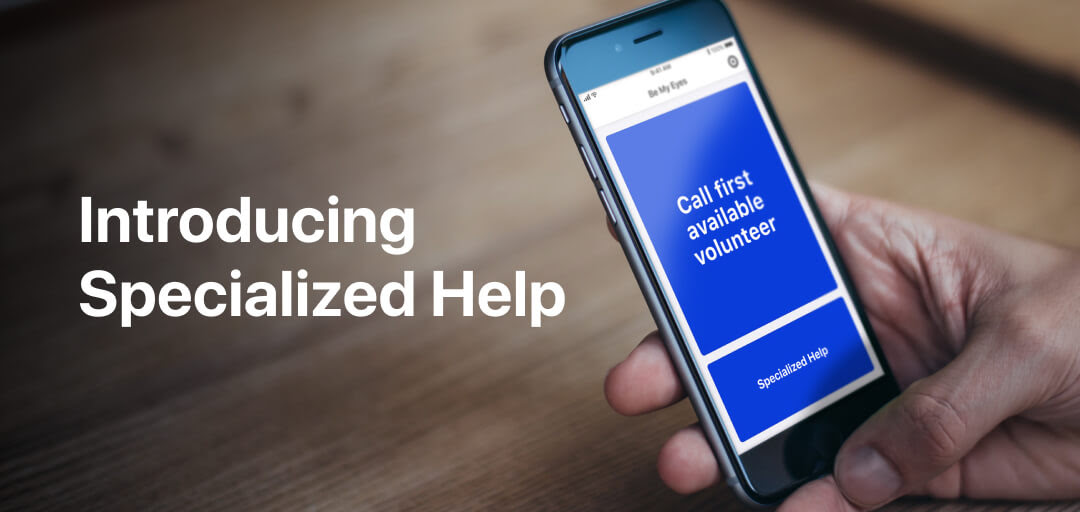
Today, Hans Jørgen Wiberg, the founder of Danish startup and longtime LightHouse partner Be My Eyes, sent a proud message to the network’s nearly 50,000 blind users. Starting today, the startup will sign on brands to a new area of the app called “Specialized Help.”
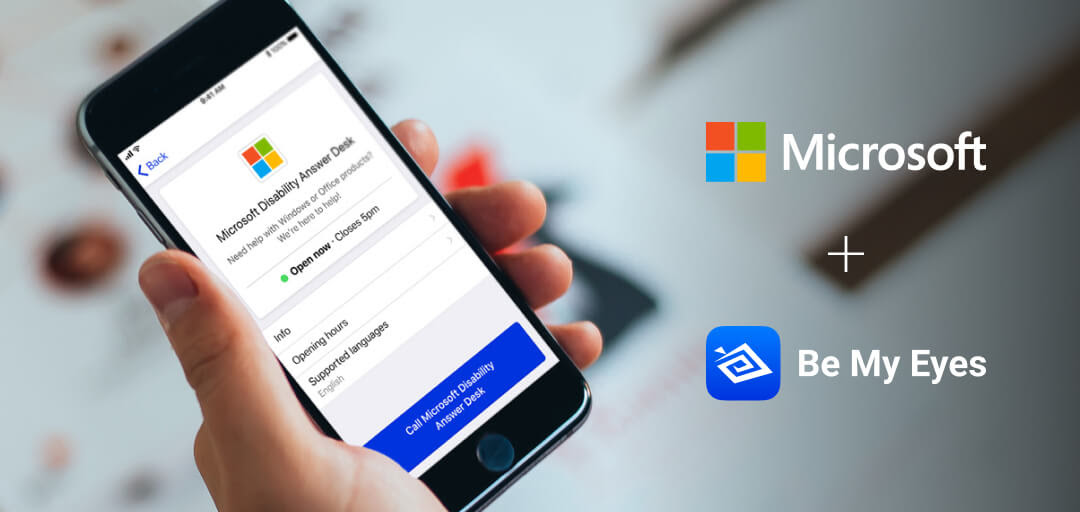
Beginning with Microsoft, who will route all their Specialized Be My Eyes calls to their dedicated Disability Answer Desk, Be My Eyes is making its foray into high-end customer service. But rather than pass the cost on to its blind users – one of the largest user bases of blind people worldwide – the enhanced customer service will be provided by brand partnerships, ad-free and with no strings attached for users.
“We love to see Be My Eyes trying new things,” LightHouse CEO Bryan Bashin said Wednesday, “and we love that, almost five years since we met them, they are continuing to grow in ambition and scope. It’s imperative that blind users have the best customer service possible, and Be My Eyes has just given blind people worldwide a powerful new tool.”
We are thrilled to announce the newest feature in the BeMyEyes app: Specialized Help – a better way to connect with businesses and organizations when you need assistance with their products or services.
To all our Be My Eyes users,
As you know, BeMyEyes is here to help you tackle a wide range of visual challenges as you go about your day. Until today, BeMyEyes has randomly connected you to a volunteer to solve daily tasks. Some tasks, however, require specialized assistance.
Contacting customer support through email or by phone isn’t always ideal. Direct communication with a business’s customer support agent could be a more vision-friendly alternative and less time consuming for you. If someone from the company could see the issue in real time, issues with their products or services could be resolved more efficiently.
So we’ve strategized a way to better assist you: enlisting the help of representatives from companies whose products you use all the time. It’s our sincere pleasure to introduce Specialized Help. This new feature means that a trained company representative is available to answer questions or help you tackle issues with speed and in-depth solutions. Maybe you need help figuring out how to use an unfamiliar product, or you might want to interact on a company’s app or website while on the phone with their representative. With Specialized Help, it’s easy to get in touch with businesses and organizations when you encounter a challenge with their products or services. And as always, it’s completely free.
The next time you update your BeMyEyes app, there will be a second button added to the main screen to take you to the Specialized Help Menu. Clicking “Specialized Help” will lead you to the list of companies with representatives available to answer your call and assist you through a live video connection. Each business profile will include descriptions of their services, hours of operation, and supported languages.
Microsoft is first to join
Microsoft is the first company joining our platform to offer Specialized Help and maintains their mission to empower every person on the planet to achieve more. Included in that mission is a program aimed at offering free technical support to the disability community – Microsoft Disability Answer Desk.
“BeMyEyes provides a new and innovative way for our customers to get technical support,” said Neil Barnett, Director Disability Answer Desk, Microsoft. “With a simple tap, customers can access the Disability Answer Desk from their phone to get the help they need with Microsoft products and services.”
BeMyEyes is on a journey with Microsoft to help more people utilize technology as a means of empowerment to achieve more in their daily lives. Starting today, Microsoft agents will be available through BeMyEyes Specialized Help to users in Australia, Canada, UK, Hong Kong, Ireland, India, Malaysia, New Zealand, the Philippines, Singapore, South Africa and the United States offering assistance in English. If you need help with Windows or Office products just give them a call.
Who Would You Like Us to Bring Onboard Specialized Help?
At the present moment, you have the option to contact Microsoft. Improving the customer service experience takes time, rest assured, but more companies from a variety of fields will join the Specialized Help platform soon. Your feedback is of tremendous value to us. If there are businesses and organizations that you may seek assistance from and would like them to a part of the Specialized Help platform, please let us know, and we will do our best to include them. You can simply respond to this email or write us at info@bemyeyes.com. It is our hope that Specialized Help will provide a better way to connect you with businesses and organizations.
LightHouse Staff1 Commenton Essay: A Google web developer on how EHC awakened her to the importance of accessibility
By Raisa Cuevas
I was 11 years old when my uncle asked me to accompany him to Enchanted Hills Camp for the Blind. I would be one of few sighted individuals at this gathering, and I wasn’t really sure what to expect. I grew up assisting Uncle B while walking around the city or doing small tasks around the house, but this was the first time I would be the minority amongst dozens of visually impaired attendees. I was a bit nervous, but I knew that my companionship would mean a lot to Uncle B.
At the camp, I spent much of my time joining my uncle in outdoor activities. One of the first things I remember is him suggesting we go pedal-boating in the lake. “But Uncle B, I can’t swim,” I anxiously warned. The thought of getting on the water terrified me. What if my uncle steers us into a rock and the boat tips over? How will I save him, much less save myself? “We’ll be fine,” he reassured us. I had no idea where he got this confidence, but I trusted him and helped us put on our life jackets.
We pedaled away for a good hour or so in the warm California sun. The water was so calm that I realized how irrational my fears were. Just as were my initial fears of attending the camp in the first place.
Throughout the day, I was challenged with interacting with the other attendees. I was already a shy kid to begin with, so it wasn’t easy reaching out for a chat with people who I wasn’t sure I completely understood. Most of the time I spent silently observing the laughter and happy conversations going on around me. People were making jokes, singing campfire songs, and living completely in the moment. I envied their ability to be fully present and uninhibited while my own mind was busy trying to take everything in.
I looked into the eyes of kids my age and wondered what different challenges they faced in their everyday lives. I looked at the older men and women, noticing their wandering eyes and bright smiles that carried a confidence and wisdom which truly fascinated me. This camp created a beautiful sense of community between people of all ages and abilities.
I didn’t think of it this deeply as the naive preteen at the time, but looking back, I’m so grateful to have experienced this at such a young age. Through this and other life lessons from my Uncle B, I’ve developed a stronger empathy for others and appreciation for my own abilities. I’ve opened up my mind to new experiences, trying my best to immerse myself in them completely.
Building websites for accessibility
More recently, I’ve realized how strongly my firsthand experience with the blind has helped me advocate for accessibility in my everyday work. As a web developer at Google, I carry a massive responsibility to build websites that are accessible to people of all abilities, languages, and network conditions. It’s not easy to address all these needs at once, but it’s important not to leave out any set of users when your audience is in the billions. Thankfully, my close relationship with Uncle B has helped me understand the needs of visually impaired individuals and to think critically about the experiences of other marginalized groups, as well.
For many years, Uncle B has been an active member of LightHouse for the Blind, the nonprofit organization that runs Enchanted Hills Camp. Since 1902, they have provided education, training, advocacy, and community for blind individuals like him. Through LightHouse, Uncle B learned much of his professional skills that allowed him to start his own business. This was five years after our experience at Enchanted Hills Camp. And when Uncle B asked his favorite niece to come work for him, of course I said yes.
I was employed as the bookkeeper, and I assumed this meant being his personal assistant as well. Although I didn’t mind bringing him tea and coffee, ordering books on Amazon, paying his bills on the phone, or whatever random task he’d ask of me, I continually found myself fascinated by how much he was able to do on his own. I often watched in amazement as he navigated the computer with special techniques like zoom software, a screen reader, inverted high contrast, and handy keyboard shortcuts. For quick personal notes that he didn’t want to keep in a Microsoft Word document, he typed them speedily on his old-school braille typewriter. He labelled buttons on his telephone, keyboard, and other electronic devices with textured stickers to help identify the keys. He read books at his desktop magnifier, which zoomed very closely and presented the inverted image on a high-contrast screen. His level of vision was very low, but fortunately he learned to be effective in an office environment through the help of LightHouse.
Through most of my bookkeeping responsibilities, I spent a lot of time at the computer with Uncle B at my side, and he instructed me to write Excel formulas for his monthly operating reports and inventory records. He would walk me through the steps as if he was looking at the screen with me. On breaks, we discussed our love for technology, his admiration for Warren Buffett, and other topics that enlightened and inspired me.
The lessons I learned from Uncle B have truly influenced the way I approach accessibility in my work. By observing the unique ways that he interacts with technology, it’s now second nature for me to think of the needs of different audiences when it comes to building a website or other digital experience. I proudly speak up for these users when stakeholders or team members overlook accessibility requirements for a project. It’s rewarding to share this knowledge with my colleagues and see them start to understand the importance of accessibility, thinking about it at earlier stages of projects.
It’s easy to overlook the needs of visually impaired users if you don’t have firsthand experience, but it’s not hard to learn ways to be more inclusive of everyone. There are millions of technology users across the world with various disabilities, including visual, hearing, motor, and cognitive. These people are using your products, and many are intelligent, committed business owners like my uncle.
Rebuilding Enchantment Hills
I feel passionately for the services that LightHouse for the Blind provides, and how they helped my uncle succeed. I admire their commitment to providing valuable resources to the blind community in California and around the world. When I found that Enchanted Hills had been burnt down in the Napa fires, I was devastated. That’s why I donated to #RebuildEHC, in hopes of restoring this unique and empowering place of retreat. And in my daily work, I continue to advocate for an inclusive and accessible web.
The truth is, the Enchanted Hills Family could not allow the tragedy of the Napa fires to rob our community of the experience of having a place for fun, understanding, family, independence and a place to unplug, tune into the joys of nature and gain confidence like nowhere else. Enchanted Hills is an experience that so many look forward to having every year — and though our camp is now operating only in upper and middle camp, we’ve taken steps to enrich this summer so that all campers will still enjoy the beauty of our location safely and with a supportive staff.
This weekend, EHC will reopen to the community that makes it what it is. There are still lots of ways to help, and we know you’ll have lots of questions, so please read on, and enjoy this special issue of LightHouse Lately in celebration of what will no doubt be known as a landmark summer for Enchanted Hills Camp. You will note that our offerings in 2018 will be almost exactly the same as we offered last year, thanks to our dedicated staff and community. Visit our website for expanded descriptions of each session.
EHC Summer 2018 Schedule
Cycle for Sight – April 21 Blind Babies Family Camp – June 15 to June 17 Adult Session – June 22 to June 27 Adults w/ Developmental Disability Session – June 28 to July 3 Family Camp I – July 5 to July 8 Youth Session – July 9 to July 15 Teen Session – July 19 to July 28 Family Camp II – August 1 to August 4 Music Camp – August 6 to August 12 Woodworking for the Blind: Fundamental/Beginner – August 13 to August 18 Woodworking for the Blind: Advanced – August 20 to August 25
What to expect
Below, we’ve answered some basic questions about what to expect in 2018 and how the summer camp season will be different, including answering your questions about health and safety.
Q: How is camp going to be different?
A: With the old cabins and bathhouses in lower camp gone, all campers will spend the session in housing closer to upper camp, which provides safe and easy access to facilities as lower camp is in the process of being rebuilt.
We’re hard at work with some delightful and surprising options for our overnight campers. Some may rival our old 1950s cabins in beauty and cleanliness. Upper camp remains in great condition, and we’ll do all we can to maximize the camp experience in the areas that were not burned by the fire. Thanks to the hard work of Americorps and EHC site staff, a large portion of camp is not only usable, but in great shape and ready for summer activities.
Q: Is it safe to be at camp?
A: Yes. Over the past three months, we have taken every precaution to ensure that the camp environment is safe and healthy to inhabit. Working with PG&E, FEMA, Army Corps of Engineers and the EPA, we have removed burned structures, hazardous materials and continue daily work to return camp to its natural state. We’ve received sign-offs on our water supply, ttree program and smoke remediation. Every guest will sleep on new beds, mattresses and linens and camp is in process of being repainted and upgraded. We are proud to be able to offer a contiguous camp season in 2018 without compromising the health and safety of our community.
Q: Does camp have a reduced capacity due to the fire?
A: Slightly – but we will make it work. We are taking every step necessary to reapportion staff and students such that priority is giving to summer 2018 campers. You may want to get your registration in early, though, because with all the attention on Enchanted Hills this past fall, camp may be even more popular than ever. We expect to host the same number of campers in 2018 as we hosted last summer.
Q: Where will I sleep?
A: For adult sessions and family camps, your regular accommodations in the lodge, lakesides or 11a and B will be exactly the same, though with brand-new beds and other amenities. For many of our youth, we will also utilize upper camp to help with our housing needs. Several dozen youth may get to experience some luxury lodging in the form of ‘glamping’ yurts set in nature in mid-camp.
Q: I’m not a camper – but I’d like to help! What can I do?
A: Financial donations are still our greatest need [link] at Enchanted Hills. We estimate that our insurance will only pay 30 to 40 percent of the eventual cost of a rebuilt Enchanted Hills. There are many expenses that go into putting on a modified camp season, including scholarships and financial aid for students, which can greatly benefit from your donations. If you’d like to support us as we prepare to get camp back up and running, please donate to our Rebuild effort.
We anticipate that we’ll need waves of volunteers to help with environmental restoration of our beautiful camp. Everything from removing invasive post-fire weeds to replanting with native species, from beautifying trails to general carpentry. Contact Allyson Ferrari at aferrari@old.lighthouse-sf.org if you’re interested in helping out. If you’re interested in contributing in other ways, please contact camp director Tony Fletcher tfletcher@old.lighthouse-sf.org or development director Jennifer Sachs at jsachs@old.lighthouse-sf.org.
After the fires at Enchanted Hills Camp, we were flooded with kind words and fond memories from campers throughout our 68 years of operation. In honor of the many memories we all share from Enchanted Hills Camp, as we get ready to rise from the ashes, we’ll be publishing regular stories from campers and members of the EHC Community on our blog. Here’s the first in a series of three, by longtime camper Maycie Vorreiter.
Summer’s Finest Moments: An EHC Reflection
By Maycie Vorreiter
“I want to wake up at Enchanted Hills, where the songbird sings “hello”. And the sun comes a creepin, into where I’m sleepin’, and the redwoods whisper low. I wanna wander through the wild woods, where the rippling waters flow. And come trickling back to Enchanted Hills, to the camp that we love so!”
– Enchanted Hills Camp theme song
My introduction into the world of Enchanted Hills camp, (EHC) began at the age of six, when I attended my first family camp. It was my first time meeting other blind people, kids and adults alike, though at that time, I only remember the kids. The first activity I did was boating. My Dad, brothers and I all got into a paddle boat and paddled around the pristine lake. I didn’t know then how big a part of my life EHC would become. Every year I was pulled back, both by my excitement to see everyone I’d met the year before, to meet new people and to do so many of the activities I enjoyed; arts and crafts, boating, horseback riding, swimming, and later, OJ Radio.
EHC is where many bonds have been created, and today, those bonds are stronger than ever. I met my best friend of twelve years at my second family camp. At first she didn’t want to talk to me because she thought that I was a boy, but that’s another story for another time. We used to love running up and down the ramps of the Lakeside cabins, mostly because of the clattering sound our canes made as they rattled over the planks.
In 2007 at the age of nine, I attended my first youth camp, along with my best friend, who was scared initially. Somehow, I managed to talk her into going, and I will never forget that first no parent camp experience because it was my first time being away from home by myself. Two memories from that week stand out to me. The first happened one night when all the counselors in our cabin (we were in the Shoshone cabin) left for what was probably a staff meeting. I was attempting to fall asleep, but I couldn’t. It was too quiet, and something about how silent it was just made me start laughing. I tried to stop because I knew someone would tell us that we needed to be quiet, but I couldn’t. Soon, the rest of my cabin mates were laughing, and I’d say we laughed for a good five minutes before a counselor came in and said, “You’d better stop, or I’m gonna put you all in separate cabins.” Instant silence.
The second memory from my first youth one session took place near the end of that week. We were all gathered near where the campfires were held, and we were told we would be making a time capsule. A Perkins brailler was passed around, and we were given sheets of paper. What I wrote that night I cannot recall, but I know that whatever it was was a page long. Many years from now, I hope to read that again.
Every year new memories were made, every year new counselors came and went. Every year new activities were added, such as woodworking, new people were met and EHC found it’s way into my heart, where it always will be. What makes EHC special are the campfires, hay rides, (typically at the end of family camp) talent shows (where I performed many times) campers, staff, activities. What makes EHC the place to be is the laughter, the music, hanging out with new friends and old friends, and the wishes that everyone makes at the end of a youth session closing campfire.
I’d like to conclude with a memory that, as of this writing, happened just a few months ago. Just two months before the fire. In August, I attended Music Academy for the first time, and this was one of the best sessions I’ve attended. On the evening of the EHC performance, I stood on the stage at the Redwood Grove theater, and as I was getting ready to sing, I was asked to talk a little about Music Academy. As I talked, I could feel my nervousness for the performance I knew was about to happen, but I also felt contented. Everything at that moment was so peaceful around me, and the sense of togetherness was in the air. It’s a moment I will carry with me forever. It’s a moment I will keep as EHC begins rebuilding. It’s a moment I look forward to experiencing again when I return.
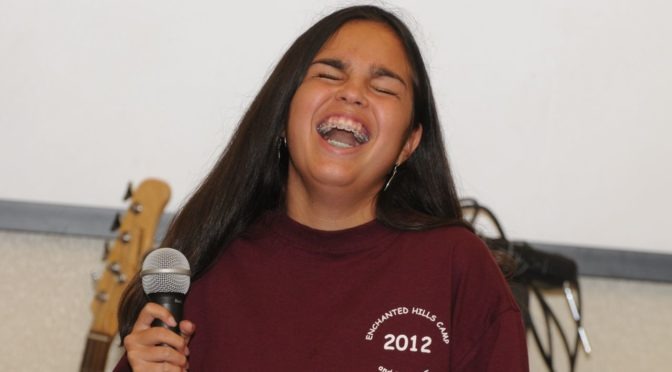
Maycie performs ‘Doctor My Eyes’ at Music Academy 2017 on the Redwood Grove Theater stage.
Maycie Vorreiter is a student at Santa Rosa Junior College and EHC camper from Northern California. You can also read about Maycie’s braille yearbook.
Want to share your story? Head to the Enchanted Hills’ Facebook page and comment or post a picture of your favorite EHC memory.
This weekend marks our very first session back up at camp since fires destroyed a large portion of Enchanted Hills Camp in Napa. Thanks to the hard work of the firefighters up at camp, our Tactile Art Barn survived and continues to be a venue for workshops and camp sessions. From February 1 through 4, we’ll be joined by students and woodworking hopefuls from all over, who will learn from internationally renowned woodworker Jerry Kermode and blind woodworker and construction manager George Wurtzel. George works up at camp year round, and in addition to his woodworking expertise, he has plenty to teach us about a life well-lived:
This session is all booked up, but if you’re interested in taking part in future woodworking or tactile art workshops, please contact EHC Program Coordinator Taccarra Burrell at ehc@old.lighthouse-sf.org or 451-694-7310.
One year ago, we launched the first annual Holman Prize for Blind Ambition, and embarked on a journey to change the public face of blindness and empower people worldwide to challenge the status quo and reject naysaying narratives around blindness. It’s been an incredible year getting to know and following along with our 2017 prizewinners, Penny Melville-Brown, Ahmet Ustunel and Ojok Simon.
James Holman was not your average nineteenth-century blind explorer. Safe to say, “nineteenth-century blind explorers” is not really a reliable dataset. Traveling the world alone is not unusual for blind people today, so today we view James Holman as an outlier—a sign that we’ve made some progress in these couple hundred years. In the future, the strivings of today’s outliers will seem similarly achievable, and we will thank them for breaking the mold. This year, we saw the launch of The Holman Prize, dedicated to pursuing and promoting the passions of blind people everywhere, and it’s my pleasure to introduce you to the prize’s first three winners. First, though, you need to know a bit about James Holman.
James Holman was born an unremarkable middle-class baby in Exeter, England, in 1786. The second son of a local merchant, he was more or less expected to lead an unsurprising life, making himself a career in the British Navy, and like a dutiful second son of the time, he eventually set about doing just that. That was just about the last unsurprising event of his life. He first surprised himself in 1812 by becoming very ill and later going blind. Later, he surprised the rest of England (and possibly himself again) by ignoring the usual sorts of restrictive expectations placed on blind people and setting out to do marvelous things. After recovering from his illness, he wriggled out of a stultifying religious order for disabled military men (which was supposed to keep him safely at home and out of trouble) and set forth on a series of solo adventures. He began by booking passage for himself on a ship, not worrying much about where it went. From there, in a time before paved roads and reliable vehicles, he traveled alone through Europe, was run out of Russia (suspected of being an international spy), and returned to England to publish his first set of detailed books describing his adventures. He later circumnavigated the globe, noticing everything, restlessly trying to be everywhere and to do all there was to do. Holman’s fame spread; eventually Charles Darwin himself referenced observations of the natural world made by the “blind traveler.”
You can (and should) read about him in the exquisitely detailed biography by Jason Roberts (available on both NLS and BookShare). I sincerely promise that it will reshape your assumptions about what blind people could accomplish in the early nineteenth century.
So when the Lighthouse for the Blind in San Francisco announced a competition for the first annual Holman Prize at the beginning of this year, they must have known they were setting a pretty high bar.
It was a prize clearly intended to reward the doing of splendid things: audacious things that startle, delight, and challenge.
As hoped, the announcement brought forth a glorious deluge of entries literally from around the globe. Asked to submit ninety-second YouTube videos describing an ambitious project on which they would like to spend $25,000, over 200 blind people responded with entries which ranged from the adorable to the impressive and from the truly beautiful to the unapologetically weird.
Once you finish reading the Holman biography, I heartily recommend that you spend a long, fascinating evening streaming some of those videos. We are, it turns out, a pretty audacious group of people.
But, in the end, only three could be chosen: the “Holmanest” of this year’s “Holmanesque” entries, if you will. It is my delight to introduce them to you here:
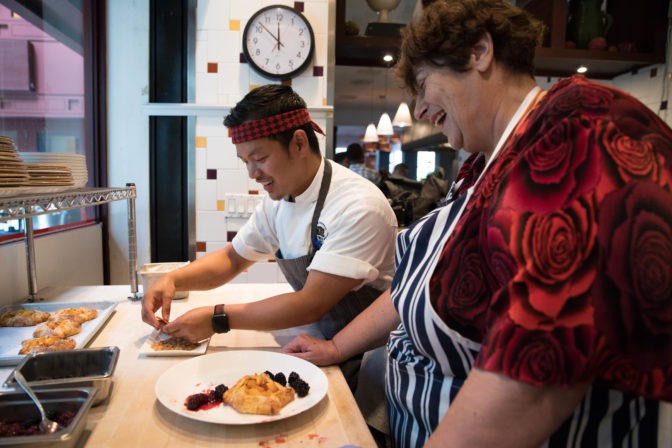
Penny laughs in the One Market Restaurant kitchen with pastry chef Mac while plating a peach galette.
Let’s begin with Penny Melville-Brown. You would know immediately if you were in a room with Penny, the mastermind behind the “Baking Blind” project, because you would hear her signature laugh. Gregarious and confident, Penny has no doubt about what she wants to do. Like James Holman, she is a native of Great Britain, and like James Holman, Penny went blind while serving in the British Navy. She also shares Holman’s urge to travel. Penny intends to conquer the world kitchen by kitchen, exploring the cuisine from Costa Rica to China and filming cooking shows with local chefs as she goes. But this isn’t only about, maybe isn’t even mostly about, adaptive cooking techniques.
Penny’s project is about community and about the generous and welcoming spaces that open out when people share food. Penny’s positive nature and her humor draw people around the dining table where she presides, and the gastronomic wonders she creates make them sit down and stay put. As people break bread together, (and such bread you have rarely tasted) barriers fall, and they talk. With her recipes in hand, (and perhaps wielding a wooden spoon if necessary) Penny will weave these communities together as she goes. The chefs will learn from the blind cook, the blind cook will learn from the chefs, and everyone at table and watching on the videos will learn to trust one another just a little bit more.
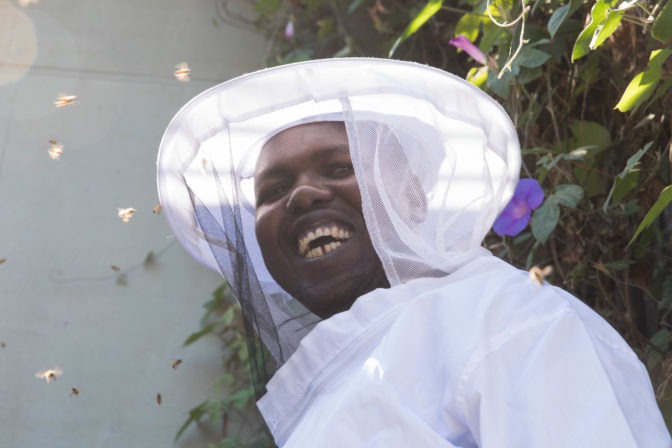
Ojok smiles with his white bee hat and net catching the light, while bees fly around him.
Ojok Simon is a gracious, dignified man from Uganda whose gentleness and soft-spoken demeanor at first seem strangely at odds with his project. Ojok is a bee keeper: not just any keeper . . . Ojok Simon is a keeper of Africanized bees. Where many of us skitter anxiously away at the near approach of even a single honeybee, Ojok regularly sinks his hands and arms into billowing swarms of them, moving them about, adjusting their hives, and deftly making off with quantities of their honey. When I asked (admittedly in some alarm) about how this was done, another blind bee keeper from Northern California, Aerial Gilbert, helped make sense of it for me. Bee keeping, she explained, is a gentle endeavor; the keeper becomes known to his bees and learns to move deliberately and easily among them. It’s not a contest; it’s a dance. Ojok does wear protective gear and he does get stung, but he explains that he is not afraid of his bees because they have no desire to hurt anyone. If approached calmly, they will react calmly. This is remarkable enough, but Ojok’s Holman Prize was not awarded because of how handy he himself is around an apiary.
In a country where jobs are hard for blind people to find, Ojok’s project is to teach other blind Ugandans what he knows. At this writing, he has thirty-eight blind students ready and willing to learn from him, and he has established a small foundation to help purchase the startup gear each will need to become his or her own boss, selling beeswax and honey. Ojok nimbly avoids the problem of convincing Ugandan employers to hire blind people by setting these blind people up as their own bosses. In what has become the Holman tradition, his method is both startling and extraordinarily clever.
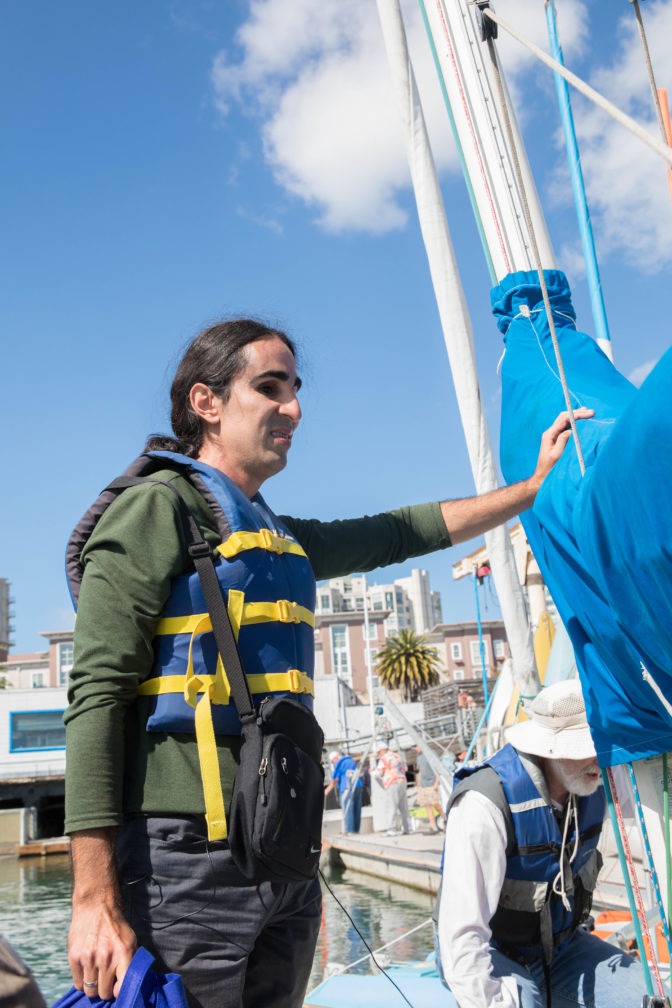
Ahmet stands up in the boat while preparing to set out to McCovey Cove.
The third Holman prize winner, originally from Turkey but now living in San Francisco, is a special education teacher named Ahmet Ustunel. Ahmet is that high school teacher who wins the kids over with a combination of steady confidence and a touch of playfulness: the kind of teacher who’s cool without making too much of it. He exudes an insuppressible, quiet joyfulness. Still, because he is actually a little bit shy, you might walk right by him at a party without knowing he’s there. If you want to draw him out though, I suggest leaning over and whispering “ocean!” or “fishing boat” or better still “pirate,” and you’ll have his full attention.
He becomes very animated quickly, and will delight you with his stories about his times on, beside, in, and (sometimes temporarily) underneath various kinds of boats. Ahmet happily tells the story that his first career choice as a child was to become a pirate. When his parents described the standard eye-patch-sporting pirate to him, he was delighted; to quote four-year-old Ahmet: “If this is a successful pirate, and he has one blind eye, I’m going to be the best pirate ever . . .because I have two blind eyes!”
Ahmet’s project involves a kayak, a ton of very cool high tech equipment, and the Bosphorus Strait: a narrow body of water that separates Europe (on the west) from Asia, on the east. Ahmet plans to paddle his kayak solo across the strait: no mean feat when you consider the currents, the wildlife, the traffic buoys and, not to put too fine a point on it, but also the merchant ships (which are larger than most houses) that thunder along the Bosphorus on their way to the Black Sea. Ninety percent of his project, he says, undaunted, is in the preparation: the physical training, the testing of the technology, and working out logistics.
His kayak will be outfitted with all the cool gear a geek could dream of: GPS, radio, and all manner of obstacle detectors. That along with his sense of the sea, his hands in the current, and his knowledge of the wind direction will guide him safely across. And, if our own cool tech doesn’t let us down, we’ll get to follow along when he makes the crossing in July 2018.
The thing that distinguishes this first set of Holman Prizewinners is not their jobs or mastery of blindness techniques or their eloquence in discussing philosophy of blindness. Like all the rest of us, they sometimes drop things or come up short when a stranger on the street asks them some ridiculous blindness-related question. The spark that they all share is their conscious, enduring belief in blind people and their willingness to share that belief as part of their community, offering and accepting strength along the way. They reminded me that we all have a bit of James Holman in us. Over the next few months, we’ll cheer them on as they embark on their adventures. Next time, it will be someone else.
So, heads up, all blind adventurers, inventors, dreamers, artists, musicians, scientists, builders, healers, troublemakers, and all the rest of you daring, merry, audacious believers: it’s not too early to start thinking about next year. Applications for the 2018 Holman Prize open on January 16, 2018. Visit www.holmanprize.org to learn how to apply.
Sheri Wells-Jensen is a linguistics professor at Bowling Green State University, a curious connoisseur of insuppressible blind living, who served on the judging committee for the inaugural Holman Prize for Blind Ambition, held in San Francisco in June 2017. The Holman Award is granted to those who have an idea that, if funded, will expand the possibilities for blind people. Submit your pitch video starting January 16.
Yet a good part of camp did survive, thanks to the courage of Los Angeles Fire Engine #98. These firefighters risked their lives to save as much of camp as they could and are now, as we write this, in harm’s way as they fight the treacherous fires in Southern California.
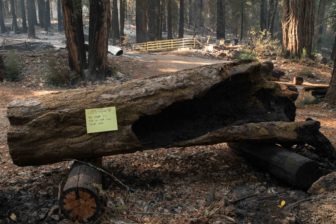
A note on the back of the partially charred Redwood Grove sign, which was hand carved by blind woodworker George Wurtzel, reads: “LAFD Engine 98. We saved this, wish we could have saved more.”
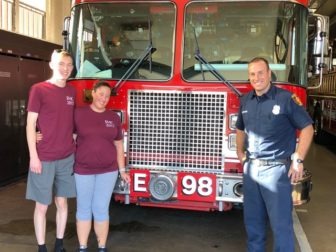
We can never thank these brave firefighters enough for the perilous work they did to save Enchanted Hills for blind campers. But in mid-November, we tried. Camp staffer Chris Lawyer and his partner, Jessica Marenoff visited LAFD #98 to give thanks in person on behalf of the LightHouse. The couple’s feelings for Enchanted Hills Camp run particularly deep: not only did they meet at the camp, but, tragically, they lost their onsite home and all their possessions in the fire.
“It was very important for us to thank them, not only on behalf of the LightHouse and Enchanted Hills, but for me and Jess personally, for saving the camp we love so much, that has so much meaning to our story,” says Chris, who has since relocated to Fairfield with fellow EHC site staff member Matt Beard and their partners.
They arrived at the Los Angeles fire station with hearts full of gratitude for what was saved and had an eminently satisfying conversation with Alexander Hermann, one of the first responders at EHC. Hermann told Chris and Jess about the fire crew’s efforts to save EHC, describing the first thing the crew saw when they arrived: the Staff House (Chris and Jess’ home) had already burned down and was still smoking.
He recounted how the crew worked their way through the camp, extinguishing as many flames as possible, despite obstacles like large trees blocking the road that had to be cut up and removed. They got to the Redwood Grove Theater just as fire was destroying the stage, but were able to save the hand-carved benches made by blind woodworker George Wurtzel. Alexander felt compelled to leave a touching note at the entrance to the theater: “We saved this, wish we could have saved more.” Alex wrote the note himself and went to post it on the sign, to which his fire chief laughed and said, “You can’t leave that with the bad handwriting.”
As Chris told him of camp’s history and founder Rose Resnick and described all the site staff do at Enchanted Hills, Alex and his team were amazed by everything that camp offers and symbolizes for the blind community. They expressed to us their sadness for what we lost: “We really wish we could have done more,” he said, echoing his sentiments from the handwritten note.
Chris Lawyer and Jess Marenoff, wearing their maroon EHC t-shirts, pose with firefighter Alexander Hermann in front of the grill of a giant red firetruck. Chris and Jess gave Hermann EHC t-shirts for the heroic crew.
We’re so thankful for the work of these valiant firefighters, for everything they fought to save and everything they succeeded in protecting. Now it’s our turn to do the work. So many of you have expressed your sorrow for the destruction at camp. So many have asked what you can do.
p.s. Every dollar donated is tax-deductible and will go to ensuring that the coming years will bring new growth and opportunity for blind campers. Donate or contact Jennifer Sachs at 415-694-7333 or jsachs@old.lighthouse-sf.org and tell her you want to help “Rebuild EHC.”
This past weekend, we hosted one of the largest Youth Employment Series programs ever, with 23 blind and visually impaired youth from throughout the Bay Area and California. It was a packed couple of days, with students arriving on Friday evening and many staying in our guest residences until the weekend wrapped up on Sunday.
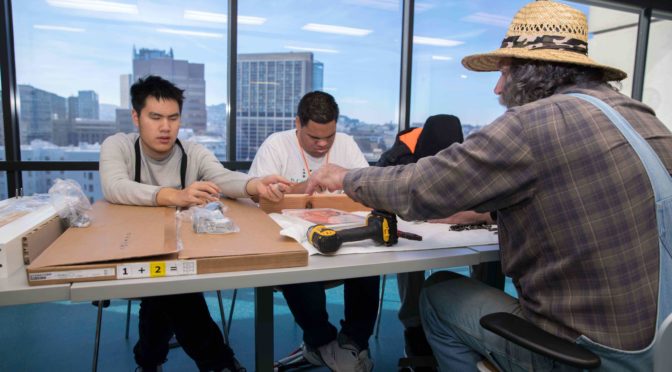
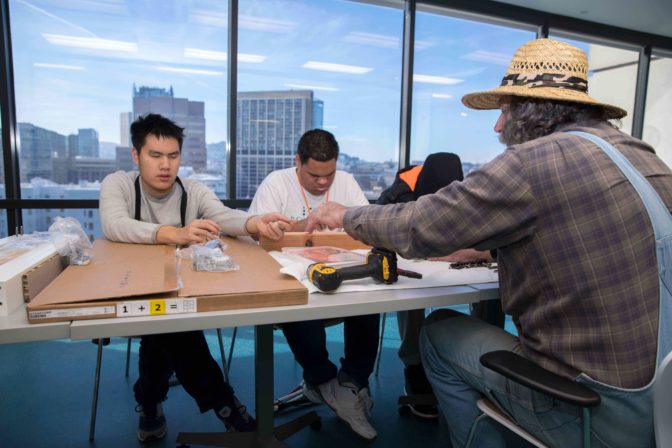
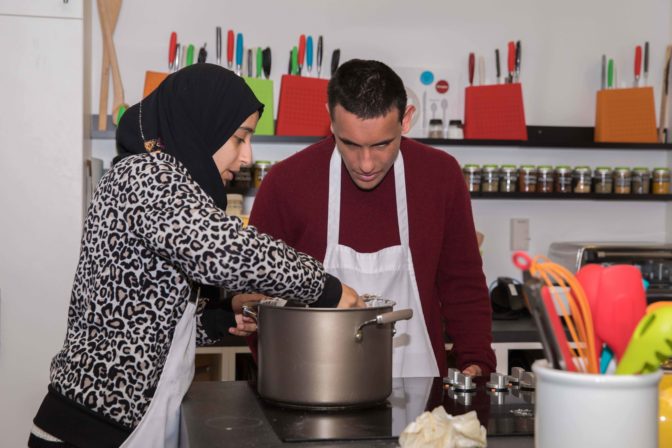
Starting Friday night, the students ventured out into San Francisco to visit this year’s Rainbow World Tree of Hope at San Francisco city hall and get in the holiday spirit. Saturday was a packed day of Construction and Maintenance Basics with Enchanted Hills Construction Manager George Wurtzel, who gave students a detailed run down of household tools from wrenches to screwdrivers to hammers, and how to use them. Many of the students got the thrill of building a piece of furniture for the first time. Later, students delved into hospitality and how to organize and host an event by decorating and preparing food for our YES Mentor Appreciation Dinner, covering the basics of food safety and handling.
Students also had opportunities to practice adaptive techniques, problem-solving skills, independent travel methods, literacy and organizational and household management, with time to socialize and reflect on some of the lessons about teamwork and self sufficiency learned throughout the day.
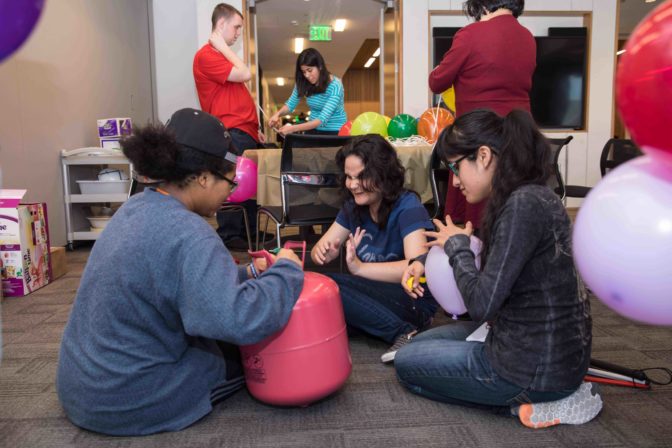
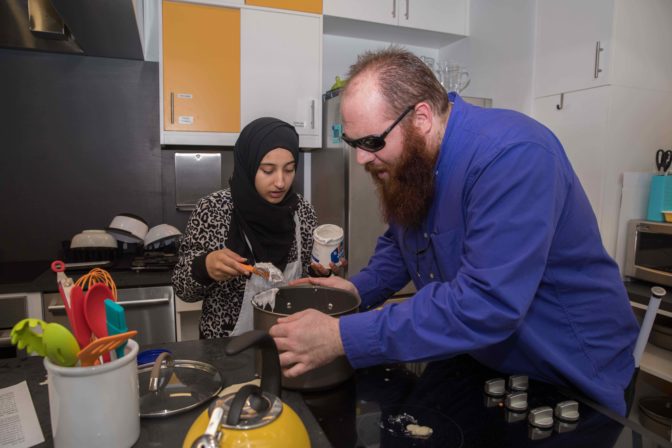
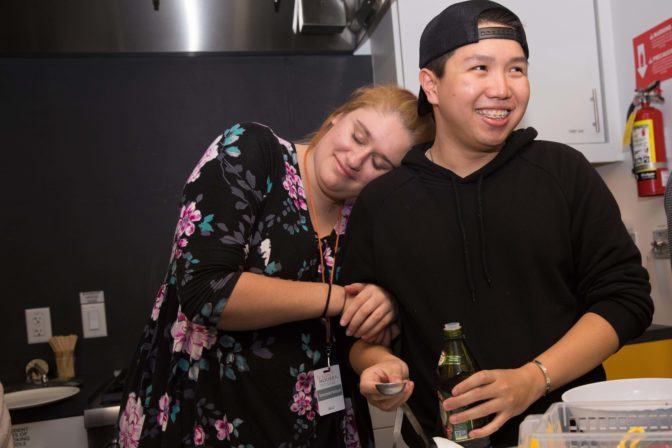
But it’s not all business: thanks to the fun-loving spirit of Youth Services Coordinator Jamey Gump, YES is full of fun, laughter and experimentation. This weekend, that included students trying their hands at Jamey’s family’s famous fudge recipe, with Jamila mixing in the Marshmallow fluff a little too soon and Andy making it clear that he would be the one licking the spoon when the time came. The students also had a good laugh at the several helium balloons that floated just out of reach while they were trying to prepare for the Mentor Appreciation Dinner. Check out photos from the weekend in the gallery below:
George Wurtzel shows two male students the difference between Phillips-head and slotted head screwdrivers.Students sit on the floor of the Multipurpose Rooms at LightHouse while laughing and working together to fill up balloons from a helium tank.Jamey and Jamila add Marshmallow fluff to a large vat of fudge.Sarah leans against Chester laughing, while the two friends work on a meal for the Mentor Appreciation dinner.Jamila and Andy mix the fudge in a pot while waiting for it to heat.
Each YES workshop offers an array of vocational, transitional and enrichment curricula empowering students to strive toward future employment, post-secondary educational success and full independence. The YES Program provides direct access to successful blind and low vision mentors and incorporates structured lessons in self-advocacy, adaptive technology, career exploration and daily living.
We’re thrilled to announce the return of the Holman Prize for Blind Ambition, our annual $25,000 award for blind adventurers and creators.
In 2017, the Prize’s inaugural year, we received more than 200 applications from two dozen countries. We couldn’t be prouder of our three winners, who encompass a wide range of ambition, daring and creativity:
Ahmet Ustunel is training to kayak Turkey’s Bosphorus Strait, completely solo; Penny Melville-Brown is taking her YouTube baking show to six continents; Ojok Simon is teaching his fellow Ugandans to become self-sustaining beekeepers.
Named after the 19th century blind world travelerJames Holman, the Holman Prize empowers blind men and women from around the world to complete the journeys and projects of their dreams.
What would you do as a Holman Prizewinner?
Applications for the prize open on January 16, 2018.
We encourage you to start planning ahead! The initial application is a quirky one: we ask that you send us a 90-second YouTube video explaining what you would accomplish as a Holman Prizewinner (as well as a brief written questionnaire). Once applications close, a select group of semifinalists will be chosen to submit in-depth written proposals, and later, finalists will be interviewed by LightHouse staff. Check out last year’s finalists’ video proposals to get acquainted with the types of projects you can pitch.
To learn more about the prize, and whether your idea qualifies, please visit ourwebsite.
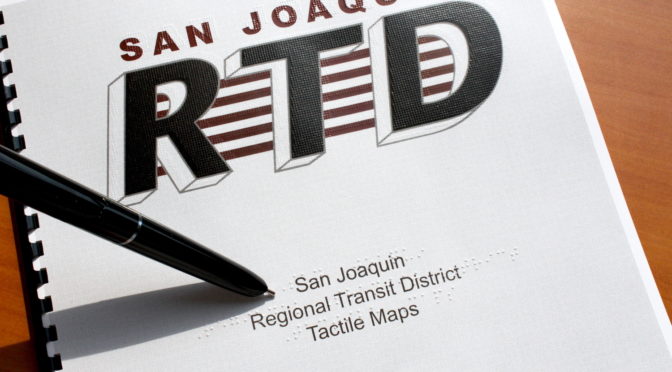
Just last week, San Joaquin Regional Transit District (RTD) launched Talk to Me Maps, a set of audio and tactile maps of transit boarding areas, in hopes of increasing access to the local transit system for people who are blind and low vision.
With money from a state grant, San Joaquin RTD collaborated with Community Center for the Blind and Visually Impaired (CCBVI) and LightHouse’s Media and Accessible Design Lab to produce large map books that not only share details of the region’s major bus stations in braille, but can be read by a “smart pen.” When moved around the tactile map, the pen speaks to the user to audibly share information about the physical layout of each station and which buses are going where.
The program will be yet another tool in the toolbox for people who are blind or low vision to easily get around town on RTD. It’s a step toward independence and self-reliance for thousands of San Joaquin County residents who are blind or have low vision.
“I’m just unbelievably grateful,” says Joni Bauer, a mobility specialist at CCBVI and a board member at the San Joaquin Regional Transit District. “I’ve been around a long time, and none of this was in anybody’s vision 40 years ago. It’s really amazing.”
The “Talk To Me Maps,” as they’re known, have been in the works for a couple of years. Bauer had heard about our accessible maps for BART stations in the Bay Area, so she met with experts from our Media and Accessible Design Lab, who put their heads together to create the maps over the course of nine months.
“For those with low or no sight, taking steps into new areas requires a high degree of confidence and is often daunting,” says MAD Lab Director Greg Kehret. “Access to information about the streets and paths around public transportation hubs is exceptionally useful. One methodology that has proven useful are tactile maps.”
For braille readers, the talking aspect of the map is extra, but serves as a helpful tool for non-braille readers who are blind or have low vision. Manufactured by Oakland-based Livescribe, the pens include cameras that capture information from the books and share it out loud through a speaker. It’s just a matter of holding the pen at an angle over the book and tapping.
“Everyone at RTD is thrilled to work with our friends at CCBVI, LightHouse for the Blind and Visually Impaired, and our sister transit agencies to make life a little easier for those traveling throughout San Joaquin County,” says RTD CEO Donna DeMartino. “This program will make ‘The Places You Can Go on RTD!’ even more accessible than before.”
RTD Talk to Me Maps are available for checkout at multiple transit hubs in San Joaquin County, including:
Development of RTD Talk to Me Maps was a collaboration among the following: Community Center for the Blind and Visually Impaired (CCBVI) proposed the project. RTD Director Joni Bauer spearheaded the project. San Joaquin Regional Transit District developed and implemented the project. The LightHouse MAD Lab is available to produce similar maps for governments, transit districts, schools or any other place where tactile maps would help the blind traveler. Click here to learn more about our MAD Lab’s braille and accessible design services or contact our specialists at madlab@old.lighthouse-sf.org.
For additional information regarding Talk to Me Maps, including a video of a map in use, please visit www.sjRTD.com/TalktoMeMaps.