Category Archive

LightHouse News

LightHouse is featured in the Cooper Hewitt Museum’s new exhibition, The Senses: Design Beyond Vision

LightHouse is featured in the Cooper Hewitt Museum’s new exhibition, The Senses: Design Beyond Vision

This month, The Senses: Design Beyond Vision launches at Cooper Hewitt, Smithsonian Design Museum in New York, to explore how multi-sensory design amplifies everyone’s ability to learn, explore and satisfy essential human needs and experiences.

The exhibition, which runs from 13 April until 28 October, explores design through all the senses with interactive installations, created in collaboration with more than 65 contemporary designers in the fields of product, interior, graphic, and interaction design, data visualization, scent design.

Many of the designs were created to promote independence for people with disabilities. The diverse lineup includes several designs by the LightHouse’s MAD Lab including TMAPs of the area surrounding the Cooper Hewitt Museum, our Talking BART Maps and two DCS printed floor plans of LightHouse to showcase how tactile design contributed to Chris Downey’s architectural process.

The exhibition was organized by Andrea Lipps, Cooper Hewitt’s Assistant Curator of Contemporary Design, and Ellen Lupton, Cooper Hewitt’s Senior Curator of Contemporary Design around several key concepts:

  • Design is multisensory, engaging the whole body
  • Senses interact and transform each other
  • Materials have sound, temperature, weight, and other tactile qualities
  • Sound is a vibration that can be felt on the body and skin and trigger mental images
  • Language and past experiences influence perception making each person’s sensory experience unique

“Across all industries and disciplines, designers are avidly seeking ways to stimulate our sensory responses to solve problems of access and enrich our interactions with the world,” says Cooper Hewitt’s Director Caroline Baumann. “The Senses shares their discoveries and invites personal revelation of the extraordinary capacity of the senses to inform and delight.

“Within the inclusive environment created for the exhibition, there will be over 40 touchable objects, as well as services, such as audio and visual descriptions of the works on view, to ensure the exhibition will be welcoming to visitors of all abilities, an important step forward in our ongoing commitment to making Cooper Hewitt accessible to everyone.”

The Senses: Design Beyond Vision will launch at Cooper Hewitt, Smithsonian Design Museum in New York on 13 April and run until 28 October 2018.

To contract for custom tactile maps of your neighborhood, workplace or university or propose a project, visit https://old.lighthouse-sf.org/braille-and-accessible-design/.

Safe Streets: Our new campaign strives to educate about cane laws, eliminate traffic deaths

Safe Streets: Our new campaign strives to educate about cane laws, eliminate traffic deaths

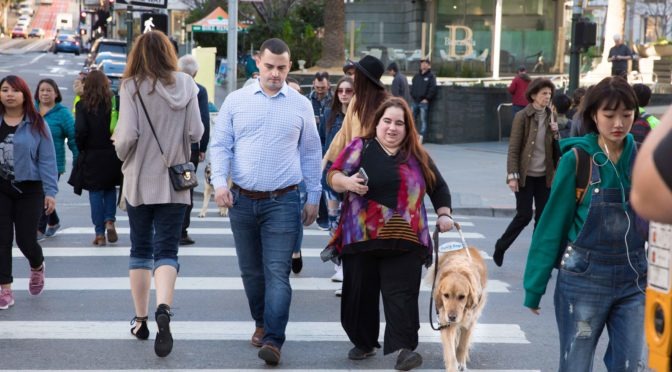
Did you know? Pedestrians using guide dogs or white canes with or without a red tip must be given the right-of-way at all times.

This spring, we’ll be out in the streets wearing bright orange shirts and teaching drivers and pedestrians about traffic laws and best practices when it comes to blind or low vision pedestrians. Thanks to a Vision Zero SF Safe Streets For Seniors grant, we’re joining the community effort led by the City and County to eliminate all San Francisco traffic fatalities by 2024.

On March 28, we’ll kick off our efforts in Civic Center Plaza from 11 to 1 p.m. Our senior ambassadors will be out in the streets demonstrating safe pedestrian practices including street crossing and human guide. We have several events scheduled throughout the spring, so be sure to mark your calendars for April 25, May 9 and May 30 if you can’t make the kickoff.

Attention drivers and cyclists! Blind pedestrians using white canes or dogs guides have the right-of-way AT ALL TIMES, according to law. Please follow the California DMV rules below to keep pedestrians safe:

  1. White cane users have the right-of-way – always.
  2. Stay off the crosswalk, but don’t stop more than 5 feet away. We listen for cars.
  3. Don’t shout, honk or yell instructions to blind pedestrians. It’s confusing!
  4. Don’t block sidewalks, alleys or park across driveways with your cars.
  5. Stop at ALL crosswalks where pedestrians are waiting.
  6. Quiet cars: keep a safe distance from all pedestrians.
  7. When you turn right, always watch for blind pedestrians.
  8. Trust our mobility skills. We’ll stay in our crosswalk as long as you stay in your lane!

Vision Zero SF is the City’s road safety policy that will build safety and livability into our streets, protecting the one million people who move about the City every day.

Why do we need it? Every year in San Francisco, about 30 people lose their lives and over 200 more are seriously injured while traveling on city streets. These deaths and injuries are unacceptable and preventable, and San Francisco is committed to stopping further loss of life.

What does it mean? The City and County of San Francisco adopted Vision Zero as a policy in 2014, committing to build better and safer streets, educate the public on traffic safety, enforce traffic laws, and adopt policy changes that save lives. The goal is to create a culture that prioritizes traffic safety and to ensure that mistakes on our roadways don’t result in serious injuries or death. The result of this collaborative, citywide effort will be safer, more livable streets as we work to eliminate traffic fatalities by 2024.

Announcing the 2018 Holman Prize Semifinalists

Announcing the 2018 Holman Prize Semifinalists

Our 2018 Holman Prize applicants were met with a challenge in the first round: to create a 90-second video pitching a dream project, and giving us a taste of their motivations and personality. We received applications from every continent (except Antarctica), and have narrowed the field down to 42 worthy applicants.

The most important thing about the Holman Prize, though, is the entire group of applicants and the impressions they make on the world. Our 2018 candidates pitches were viewed thousands of times on YouTube: that’s thousands of people watching videos that chip away at stereotypes of blindness and offer a multifaceted view into the wide ranging and one-of-a-kind ambitions of blind people worldwide.

Below is the list of semifinalists for the 2018 Holman Prize. In June, their proposals will be reviewed by the 2018 Holman Committee — a fresh group of highly accomplished blind women and men from around the world, comprised of some returning judges and some new to the committee.

Click on each name to watch their original pitch video, share, and spread the word: This is what blind ambition really looks like.

The 42 Semifinalists, in alphabetical order:

Becky Andrews, a marathon runner and cyclist, would use the Holman Prize to implement a series of empowerment retreats for blind and visually-impaired women.

Manuel Aregullin, an assistive technology instructor who has also studied music in Cuba for more than twenty years, would use the Holman Prize to teach Cuban music to large groups of students, as well as upgrading the assistive technology he uses in his lessons and purchasing more instruments.

Michael Armstrong would use the Holman Prize to train for a triathlon, which he would complete using a non-visual technique called Vibravision that would enable him to compete without the aid of technology or a sighted companion.

Edward Babin, a songwriter, producer and entrepreneur who performs as Eddy Echo, would use the Holman Prize to organize a showcase for blind and visually impaired musicians in New York City.

Zeljko Bajic, a radio producer and host, would use the Holman Prize to create a podcast “for and about blind people living all over the world.”

Luanne Burke, a seasoned long-distance runner, would use the Holman Prize to educate rural visually-impaired communities around the world – including countries like Scotland, China and New Zealand – about the joys, and logistics, of guided running.

Stacy Cervenka, who works in the disability employment field, would use the Holman Prize to launch an accessible travel forum similar to Yelp or TripAdvisor, geared specifically towards blind users.

Peggy Chong, the “Blind History Lady,” would use the Holman Prize to conduct research into the Blinded Veterans of WWI through the Maryland Historical Society, Library of Congress, and more.

Jean Elston would use the Holman Prize to travel North America, creating small paintings and sketches that she will turn into larger pieces when she returns home. Jean would also create a video blog of her journey, to give her audience more insight into her process and challenges.

Matt Formston, a longtime surfer, would use the Holman Prize to teach his blind and low-vision community how to become surfers themselves and to “share the feeling of freedom” that surfing can provide.

Divyanshu Ganatra, an entrepreneur and avid paraglider, would use the Holman Prize to facilitate mountaineering, rock climbing, scuba diving, paragliding and more for both his visually-impaired and sighted peers, with the hope of creating a larger dialogue around disability.

Nathan Gibbs, a tech consultant and web developer, would use the Holman Prize to continue his “As Alexa Sees It” project, which is intended to make Amazon’s Echo technology even more useful for blind and low-vision consumers.

Leona Godin, an actor and writer, would use the Holman Prize to expand her magazine “Aromatica Poetica,” which is “dedicated to the arts and sciences” of smell. Furthermore, she would use the prize money to fund her own prize, geared in part towards visually-impaired writers.

Carol Green, a teacher of the visually impaired, would use the Holman Prize to teach Braille, in the Navajo language, to blind children and adults in the Navajo Nation during a summer program that would also include life skills training.

Andrew Hasley, a biologist and geneticist, would use the Holman Prize to facilitate a conference for blind scientists and students from across the globe, called “Scienc’ing While Blind,” where participants could network and exchange tips and tools.

Markus Hawkins, a long time practitioner of the healing arts, would use the Holman Prize to travel to China to study the healing art of chilel, and then incorporate it into his practice upon returning home.

Conchita Hernandez, who is currently pursuing a doctorate degree in Special Education, would use the Holman Prize to create a workshop in her native Mexico for professionals in the blindness field, and blind people of all ages.

Andrew Hesser, would use the Holman Prize to travel throughout the UK producing nature documentaries to facilitate the blind and low-vision community’s connection to the great outdoors, all in character, using an alter ego named “Bryan.”

Justin Holland, a bodybuilder and video blogger, would use the Holman Prize to travel the world and engage with blind and low-vision communities, encouraging them to get involved in adventures and athletic activities.

Georgina Hollinshead, who says she was “born a crafter,” would use the Holman Prize to launch a social enterprise called Hook and Eye Crafts, geared toward teaching blind and visually impaired people the joys of knitting, crochet and cross-stitch.

Alieu Jaiteh, the founder of the blindness advocacy organization Start Now, would use the Holman Prize to provide various skills, including computer literacy, cane travel and Braille, to blind and low-vision participants in rural Gambia.

Ambrose Lasoy would use the Holman Prize to develop a program to enable his fellow blind and low-vision Kenyans to become dairy farmers and entrepreneurs.

Rachel Longan, a psychotherapist and singer, would use the Holman Prize to travel both the United States, and around the world to countries like Russia and Tanzania, teaching pre-existing vocal choirs how to make their organizations more accessible and accommodating for blind and low-vision participants.

Rachel Magario, a seasoned traveler and video blogger, would use the Holman Prize to retrace the footsteps of James Holman’s first travels across Europe, for a video series called “In the Footsteps.”

Zahra Majid, who is currently pursuing a degree in media studies, would use the Holman Prize to travel and meet with visually impaired students around the world, in countries including Canada, the United States and Scandinavia, in order to gather a wealth of information for a database project she is calling VIAdvisor.

Dr. Sakui Malakpa, a university professor originally from Liberia, would use the Holman Prize to purchase laptops and other training tools for blind and low-vision communities in Liberia and Sierra Leone.

Michael McCulloch, a retired aerospace engineer, would use the Holman Prize to produce an audio described documentary film about his upcoming hiking trek to Machu Picchu, one of the Seven Wonders of the World. He would also write a book entitled “The Blind Man’s Guide to Machu Picchu,” containing hiking instruction, tips and more.

Louie McGee, an athlete and current high school senior, would use the Holman Prize to fund his training for the Iron Man competition, with a speaking tour to follow.

Francis Okello Oloya, a psychologist, would use the Holman Prize to create a guide dog program for his blind and low-vision community.

Joshua Pearson, an accessibility specialist and folk singer, would use the Holman Prize to record under-the-radar musicians around the world, in countries including the United Kingdom, Thailand, Vietnam and more.

Kellsea Phillips, a passionate athlete and aspiring competitor in the TV show American Ninja Warrior, would use the Holman Prize to train for, and attend, more competitions and auditions for the show.

Sandeep Kumar (People’s Choice Finalist), who has developed a tool called Eye Renk that allows the visually impaired to easily differentiate between various ocular medications, would use the Holman Prize to travel and teach underserved communities about Eye Renk.

Mariano Reynoso would use the Holman Prize to bring the sport of Beep Baseball to his home country of Argentina.

Maria Saavedra, a dance instructor originally from Colombia, would use the Holman Prize to launch a dance academy designed specifically for the visually-impaired community.

Marco Salsiccia, an accessibility specialist and self-proclaimed “hockey nut,” would use the Holman Prize to  travel for a full year with the San Jose Sharks hockey team, attending at least one game at each arena, in order to assess the accessibility of each rink and promote hockey to blind and visually-impaired athletes.

Nicole Schultz-Kass, a vocational rehabilitation counselor and YouTube blogger, would use the Holman Prize to interview and adventure with blind and low-vision people in 25 different locations around the United States, compiling the experiences on her YouTube channel,  “CraftyBlindChick.”

Matthew Shifrin, an actor and composer, would develop a multi-sensory comic book experience called “Hapticomix,” based on the Daredevil series, that incorporates surround sound, original music, a full cast, motion-simulation, and smell.

Red Szell, a writer and broadcaster, would use the Holman Prize to undertake an extreme sports triathlon to conquer Am Buachaille, one of the most remote rock pinnacles in the UK.

Aishwarya T.V., a filmmaker and rehabilitation counselor, would use the Holman Prize to create a training center for the blind and low-vision community to study elements of filmmaking like script writing, film editing, sound mixing, production and more.

Johnny Tai, a Martial Arts trainer, would use the Holman Prize to provide martial arts courses for the blind and visually-impaired community in his native Taiwan.

Danny Thomas Vang and Jeshua Gilbert Aveno would construct a multi-sensory “escape room” that enables visitors, and visually-impaired users in particular, to gather information and instructions from their environment.

Antyenette Walker, who performs under the name Young Ant, is a hip-hop MC who would use the Holman Prize to create more music and share it with her fans around the world.

Find the Holman Prize on Facebook + Instagram + Twitter

Join the Holman Prize community and make a tax-deductible donation to help fuel the dreams of blind adventurers and creators for years to come.

New in our store: Make raised line drawings instantly with the Sensational BlackBoard

New in our store: Make raised line drawings instantly with the Sensational BlackBoard

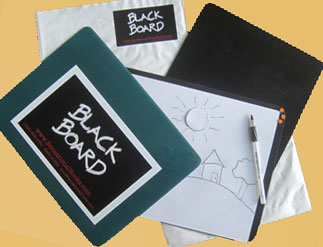
It’s not every day that you have access to a swell printer when you want to create tactile images or reference materials. But with the lightweight and portable Sensational BlackBoard you can instantly create raised-line drawings whenever, and wherever. All you need is the BlackBoard, a sheet of printer paper, and a ballpoint pen. Place the paper against the rubberized side of the blackboard and push down when you draw to perforate the paper. You can feel your drawing as you go, so there’s no need to flip your paper over or draw in reverse.

It’s a great way to make tactile images quickly, and a great tool for teachers interested in tracing copies from text book or reference materials. The Sensational Blackboard is:

  • Lightweight, at just 7 oz.
  • Flexible enough not to break in your backpack but rigid enough to draw on your lap.
  • Uses inexpensive materials: all you need is standard copy paper and medium ballpoint pen.
  • Smooth surface holds the paper in place. No clamps makes it easy to tuck into a briefcase or binder 11.25” x 9”.

It’s an elegant design that is simply sensational. Want to try it out? Stop by the Adaptations Store in person and we’ll give you a demo. Available now for $65.00!

10 Tips for Aspiring Blind Yogis

10 Tips for Aspiring Blind Yogis

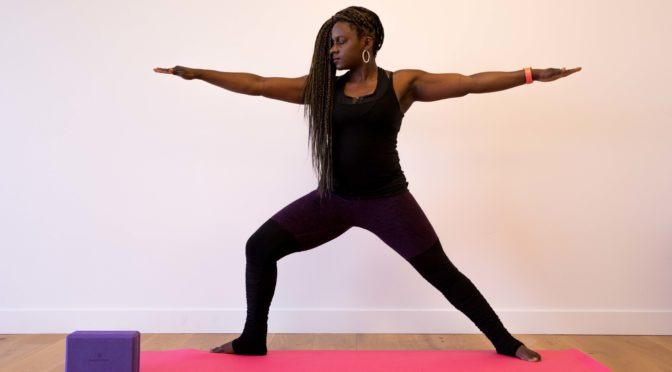
Yoga is a rewarding form of mental and physical exercise that can lead to less stress, better sleep, and an increase in overall health. Have you ever wanted to give yoga a try, but feel a little intimidated by crowded yoga classes and people bending themselves into pretzels? Have you ever wanted to know the exact yoga poses but didn’t have a non-visual way to find out?

We have yoga classes for students of all levels at the LightHouse. Join our regularly scheduled yoga classes with Kimm Ropicky on Mondays and Wednesdays at 5:30 p.m. in the Fitness Studio. We also have a new monthly Saturday workshop with Health and Wellness Coordinator Amber Sherrard, with each session focusing on a different aspect of practicing yoga. This month on March 24, join Amber for “The Art of Inversion: Getting Upside Down.”

Here are ten tips from Amber’s own experience as a blind yoga lover to get you started. She is a registered yoga teacher and loves teaching new students!

Be open to trying something new.

It was once said that “Insanity is doing the same thing over and over again and expecting different results.” Sometimes our biggest blessings in this life come from trying something we’ve never done before.

Simple does not mean easy.

Yoga is a simple practice. However, its simplicity is often mistaken for easy. Yoga is a challenging practice in many ways, but its benefits are limitless.

No need for fancy clothes. 

You don’t need fancy, name-brand clothes to practice yoga. It’s all about comfort. Wear clothes that make you feel comfortable and confident. You should also be able to sweat in your yoga clothes, so moisture-wicking material is recommended.

Be honest with your teacher.

Your teacher’s job is to make sure that you are practicing safely.  Be honest with them about how certain poses feel, how long you’ve been practicing yoga, and what previous injuries you may have. Your yoga teacher is trained to modify your yoga practice accordingly. Another great tip is to speak with your instructor before class. Let them know that you are blind and that you will need them to be very descriptive. Yoga teachers are naturally descriptive, however, letting them know your are blind will give them an extra reminder to choose their words wisely. Also, if you are okay with hands-on adjustments, let your teacher know.  Hands-on adjustments are a great way to understand how the pose should look and feel in your body.

Discomfort is good, pain is not.

Discomfort is good, pain is not: yoga is designed to drive us right past the place of comfort, which strengthens us physically and mentally.  Its apart of the challenge, charm, and, appeal of a consistent yoga practice. However, if you ever ever feel pain, always back out and let your instructor know. The good thing about yoga postures is that they can be modified in a variety of ways to make the benefits accessible to everyone.

Yoga teachers love questions.

People often feel afraid to ask questions before or after a yoga class. It’s perfectly fine to ask your teachers questions about anything that was covered in class. They will gladly give you clarification on anything that seems fuzzy or unclear, so ask away!

Give it another try.

Many people try yoga one time and make a decision right away to either continue their practice or never try it again. With the vast array of yoga types, styles, and teachers, its always worth giving it another try.

Resist the urge to compare.

Yoga is not a competition. Every practitioner is on their own journey. The more you practice, the more you evolve. A wise yogi once said, “Practice and all is coming.”

Be kind to yourself.

Yoga is different from any other type of exercise. It strengthens more than just the physical body. With that being said, it’s easy to forget that in yoga, pain is not gain. Be kind to yourself and take your practice one breath at a time. Which leads to my final tip…

Don’t forget to breathe.

Let’s be honest.  Sometimes not being able to see can be frustrating and sometimes trying something new can seem scary, but “without breath, there is no yoga” so just remember to breathe.

Questions? Feel free to send Amber an email at asherrard@old.lighthouse-sf.org. She would love the hear from you!

Mark Your Calendars for San Francisco PRIDE 2018

Mark Your Calendars for San Francisco PRIDE 2018

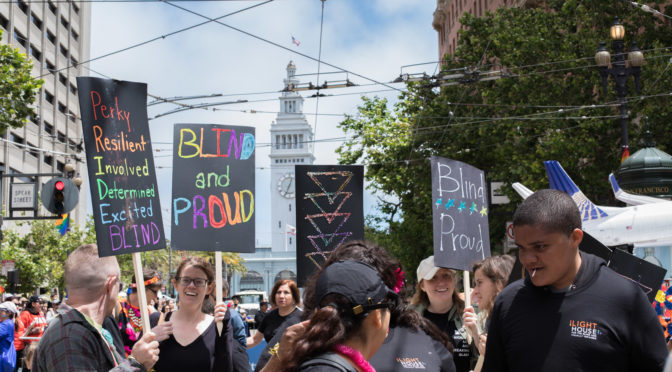
We are excited to announce that LightHouse will march in the 48th annual San Francisco Pride Parade on Sunday, June 24th! The San Francisco Pride Parade’s mission is to educate the world, commemorate LGBT+ heritage, celebrate LGBT+ culture, and liberate LGBT+ people. This aligns with LightHouse’s mission to promote equality and self-reliance for people who are blind or visually impaired, and promotes the visibility of LGBT+ blind and disabled people.

The LightHouse is committed to inclusivity. Blindness intersects with every single identity, and we recognize the need to amplify the voices of disabled LGBT+ people and our community members. LightHouse is proud to open our doors and extend an invitation to all disabled LGBT+ community members, their families, friends, allies and the organizations that serve them. Join us as we celebrate the intersectionality of people who are blind, have low vision, have other disabilities, and the many community members who identify with both communities or actively want to support LGBT+ visibility. It’s a central part of our blind experience to be seen, be heard and to be proud of who we are!

Find out the many ways individuals can participate by visiting our Eventbrite page and signing up today. The first 100 people who sign up will receive a free Be Seen PRIDE 2018 t-shirt, to be handed out the day of PRIDE. We would like to extend an invitation to community partners to join us to make this a collaborative cross disability experience. For community based organizations interested in partnering with LightHouse’s cross disability contingent, individual questions, or help signing up on Eventbrite, please contact Laura Millar, Sexual Health Services Program Coordinator at info@old.lighthouse-sf.org or 415-431-1481.

For all volunteer related questions contact Allyson Ferrari, Volunteer Engagement Specialist at aferrari@old.lighthouse-sf.org or call 415-694-7320.

Make sure you sign up today on our Eventbrite page and #beseen with us, as we celebrate diversity at this year’s 48th annual PRIDE parade!

Microsoft Soundscape is a new way to navigate

Microsoft Soundscape is a new way to navigate

“What is overwhelming about being a blind traveler? It’s not always what people think.” LightHouse Director of Access Technology Erin Lauridsen is passionate about this point: “Obstacle avoidance is not the problem, we have a dog, a cane and our blindness skills for that, The gap is knowing where things are and being able to decide what’s of interest.”

In her daily work, Lauridsen often has to shake her head at technology that misses the mark, but today is different. Today, Microsoft unveils a new free app designed not just for blind people – but by blind people.

In the video below, Erin Lauridsen explains the design thinking behind Microsoft’s new app. Click here to download Soundscape from the US App Store.

Lauridsen is one of the design minds behind Soundscape, a new Microsoft product which aims to empower blind people to not just get where they’re going, but to explore and learn their environment actively.

Read more on the Microsoft Accessibility Blog

Hired last year to start LightHouse’s Access Technology department in San Francisco, Lauridsen has built up a research and design consulting shop that leverages the blind experience to help mainstream companies optimize their products. One day it may be face recognition; another day, it’s designing a more intuitive interface or an advancement in ergonomics. In all cases, though, designing with the blind in mind yields a more competitive product.

Last fall Microsoft approached Lauridsen’s team with a product built upon an ambitious concept: a navigation app not based on turn-by-turn directions, but on dynamic, proximity-based landmarks and 3D audio beacons.

For Lauridsen, an app that promoted spatial engagement instead of rigid instructions and prescribed routes was a breath of fresh air. “The idea of having spatial and directional information floating on top, and taking some of that process load off of the traveler, that was intriguing,” she says. The next step was to find out if this technology would work in practice.

Download Soundscape from the app store

Microsoft brought the idea to a small group at a meeting of LightHouse Labs, Lauridsen’s monthly blind-tech meetup at LightHouse’s Market Street headquarters. Each month, Labs provides a venue for companies and individuals in the blindness and accessibility sphere to explore product-market fit, compare notes on emerging tech and express passionate, at times controversial opinions. It was agreed that the next phase of research and design was to get Soundscape into the pockets of real users, to turn the app from a good idea into an invaluable tool.

Today, Soundscape launches in the US and UK app stores on iOS for iPhones, and with it Microsoft has introduced a new 3D audio experience crafted specifically for exploration.

Soundscape, Lauridsen says, offers freedom for blind users: “It takes out the assumption that you’re following a proscribed route, fills in the information access gap, and allows for discovery and exploration. It’s not oversimplified or over complicated, as so much tech ‘for’ us often is.”

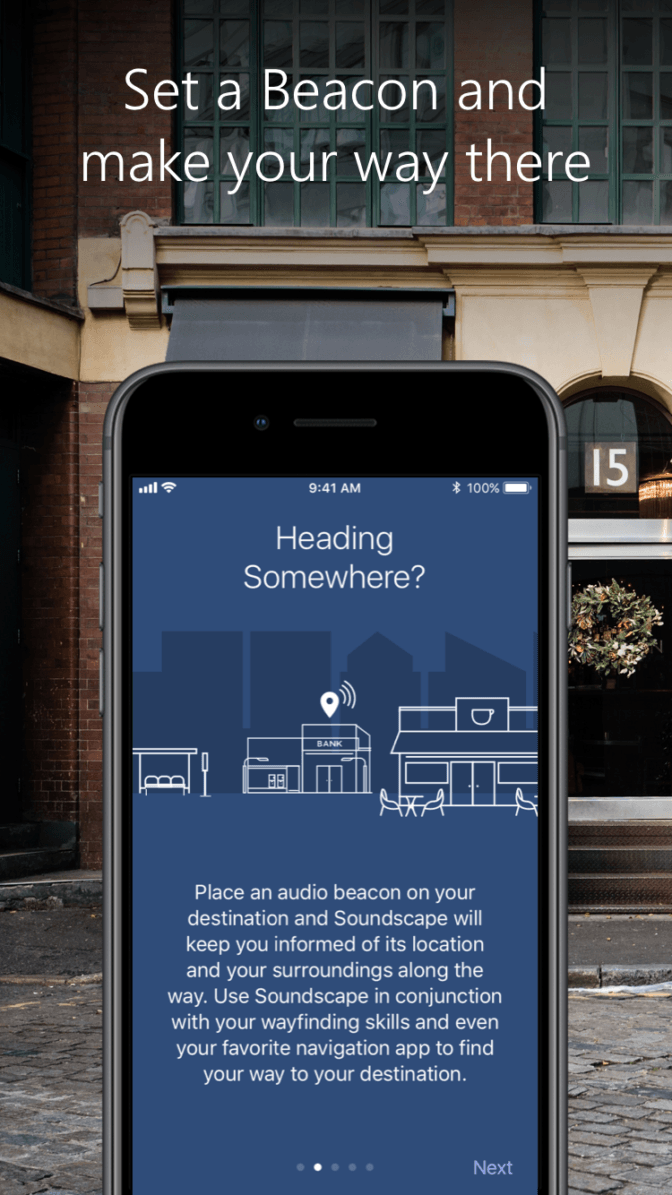
An image of a phone showing the Microsoft Soundscape app reads: "Set a Beacon and make your way there. Heading somewhere? Place an audio beacon on your destination and Soundscape will keep you informed of its location and your surroundings along the way. Use Soundscape in conjunction with your way finding skills and even your favorite navigation app to find your way to your destination."

Featuring an unobtrusive, roaming narrator reading the names of businesses, intersections, and points of interest in stereo, Soundscape is much more like browsing a neighborhood than any audio navigator that has come before. The Around Me and Ahead of Me features allow for more focused “looking around,” and audible beacons can be set to guide users gently toward a destination with intuitive auditory cues.

For Lauridsen and her department, this early stage design work is equally as important in making products both elegant and useful. “Our network at LightHouse is considerable – we have blind engineers, blind architects, blind coders – and what we like to build is ‘of’ those people, not ‘for’ them.”

Over the winter, Lauridsen’s team began putting the app through its paces, quite literally, with a score of blind user testers taking the app up and down Market Street and through the neighborhoods of San Francisco. Taking their feedback and synthesizing it, and delivering it in a series of intense meetings with Microsoft’s developers, Soundscape began to feel ready.

“Inventors often want to design things for us to be safer; I get that, but that’s design from a fear point of view. Microsoft designed this product out of an enthusiasm for learning, exploring, and finding joy in your environment. That’s the kind of technology that we like to see.”


Essay: A LightHouse staffer on what EHC means to her family

Essay: A LightHouse staffer on what EHC means to her family

By Lisamaria Martinez

Last summer, I had the opportunity to vacation with my family at Enchanted Hills Camp during a Family Camp session. This is the second summer my family and I were able to spend a few glorious days atop of Mt. Veeder, in Napa. We hope to make this annual trek to Napa a family tradition.

I’ve have a unique perspective of camp—as a camper and as an employee of the LightHouse for the Blind. I first started working at the LightHouse in December of 2008, but didn’t step foot onto EHC soil until the summer of 2010. I really missed out those first 18 months. Camp is beautiful and breathtaking and a wonderful place for blind youth and adults to experience life, gain confidence by doing activities they never thought possible, and of course, it is a wonderful place to make new friends.

I’ve been to camp for LightHouse sponsored programs like our 2011 employment summit or our youth leadership retreats. I’ve also been to camp to paint fences, make emergency kits, clean out buildings, and many other beautification projects. They all have been delightful experiences. However, going to camp as a camper beats it all!

I am a blind mom and wife. I have three lovely children who are six years old (Erik), two years old (Zakary), and seven months old (MacKenzy). They all love camp (well, the judgement is still out from the seven month old). Children plus blind person makes my family eligible for family camp, so last year, my husband and I made the decision to try it out. Erik cried when we left camp because he wasn’t ready to go back home.

I remember Erik’s first camp experience at 7 months old. I was there for an Employment Summit and I was lucky enough to stay the night with my family. My husband and I were so anxious about his cries during the night and how he might interrupt the sleep of others residing in the lodge. I also remember our second trip with him about a year later for Cycle for Sight, and how absolutely fascinated and enthralled he was at the frogs and their constant cacophony during the night. He couldn’t sleep because he was amazed at the sounds they made. Needless to say, my husband and I didn’t sleep much that night, but we rode just fine the next day.

Enchanted Hills is a place where new discoveries happen and memories are made. Erik discovered soy milk because a camp staff person told him it tasted like vanilla ice cream. Both Erik and Zakary have discovered foosball at camp. My boys have learned to play with blind kids their own age. They are both sighted but aren’t around many blind kids; adults, yes, but not kids. My children have become more comfortable and confident about swimming. They’ve learned to tie-dye, horseback ride, enjoy hiking in forests, pick wild blackberries, make zucchini pizzas in solar ovens, and they have relished in the freedom that my husband and I have allowed them to experience in a place where everyone is family and everyone looks out for each other.

As a blind mom, I’ve had the chance to talk to blind kids at camp about growing up and being a blind parent someday. They didn’t know that parenting was an option for them because they didn’t know blind people could be parents. I’ve met parents who have blind children and we’ve talked about expectations and raising blind children in a sighted world and I’ve become a resource for them. At camp, I’ve hung out with other blind parents and simply enjoyed the camaraderie while watching our children run wild.

Enchanted Hills Camp is one-of-a-kind and I’m lucky that I can experience it both as an employee and as a camper. As an employee, I have great pride in a world-class camp for blind youth and adults. As a camper, I’m proud to share it with my family and I’m proud to see firsthand the excellence of the camp staff. They are all caring and fun and dedicated to making EHC the place to be.

Now, more than ever, Enchanted Hills needs your support and donations. To give by mobile device, text REBUILDEHC to 501-55.

No amount is too small or insignificant, and every dollar donated will go to ensuring that the coming years will bring new growth and opportunity for our home away from home. Donate here or contact Jennifer Sachs at 415-694-7333 or jsachs@old.lighthouse-sf.org and tell her you want to help “Rebuild EHC” to learn more about providing dedicated funds to rebuild and re-open camp to the public.

Our Blood Drive was so successful – we’re having two more

Our Blood Drive was so successful – we’re having two more

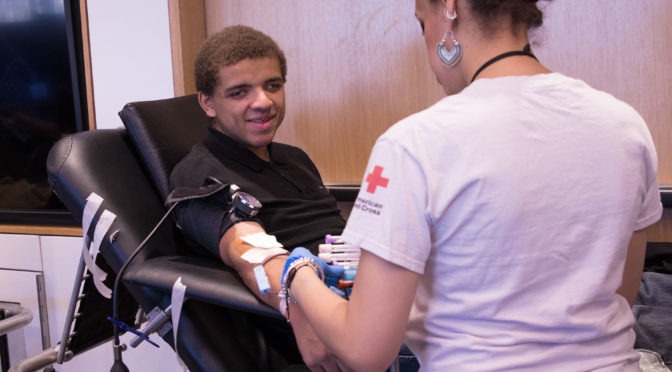
More than 60 gracious donors showed up at the LightHouse headquarters to give blood at our 6th Annual Bay Area Blind Community Blood Drive this month. We collected 56 total units of blood, which helps approximately 168 patients in need. We also welcomed cameras from ABC7 News, who did a terrific little story about the drive which you can check out below. Thank you to everyone who came out to donate and support!

Don’t miss our next blood drive on May 31.

Our annual blood drive is a much anticipated event each year, held in conjunction with the American Red Cross. We have so many eager participants that we often have to turn donors away when the slots fill up. Because of this, we’ve decided to hold two more blood drives this year, on May 31 and again in October. We hope you’ll join us!

The beauty of our blood drive is that blind and sighted donors are giving side-by-side, and all blood donated benefits anyone in need, regardless of sight. Though many don’t realize it, it’s a unique dynamic.

“The idea of a community of blind people rolling up their sleeves and giving back to a society that often thinks of them as charity cases, well, it’s just great to give back in such a life-affirming way,” said Martinez.

And though many don’t realize it, it’s a uniquely equalizing dynamic in a world that often stigmatizes blindness to the point of misinformation.

“In areas around the world, blind people would not be welcomed if they wanted to donate blood,” said Martinez. “We know that blind people are a cross-section of society and that blood coming from a blind person is no different than that of blood coming from a sighted person.”

A heartfelt thank you to the donors who came out this year, we hope to see you again in May or October this year!

Meet Amber Sherrard, our new Health and Wellness Program Coordinator

Meet Amber Sherrard, our new Health and Wellness Program Coordinator

“At the start of my childhood, I remember being happy, fearless, and free. But as I reluctantly grew up in a world designed for people to live with sight, I developed a deep fear characterized by tough questions with no answers.” Amber Sherrard has a knack for summing up the existential fear that can come with a major change in vision; and with Retinitis Pigmentosa setting in early in her life, Amber needed to develop a strong sense of who she was, outside of the level of her eyesight.

Before Amber began hitting the gym on a regular basis, finding dignity and self-worth through her ever changing situation at times felt impossible “I found bits and pieces of solitude in poetry, music, and theater,” she says, “but each time I was alone, the thoughts of ‘what if’ and ‘why me’ returned. Deep in my innermost being, I knew I was called to a higher purpose, but when the negative thoughts and intense fear were upon me, it seemed like ‘someday’ would never come.”

Today, Amber is a powerlifter, a yoga instructor, and an incredibly motivating person to be around. Amber might seem like she’s got it all figured out to other blind people who find just stepping foot in a gym a little intimidating – but she started from square one, like everyone else. Amber also knows that health and wellness is about more than pumping iron, which is why in her new role at LightHouse, she is hosting regular workshops on healthy eating, yoga and inner-body exercises to improve the health of the “whole you.”

Amber remembers her ah-ha moment well: Fresh out of high school and on the first day of her blindness training program, her travel instructor, Arlene, told her about the gym across the street – a place called Curves. Arlene showed her how to get there, showed her the ropes and in doing so, eliminated the anxiety Amber might have felt getting to know a brand new gym.

The result was what Amber calls a “frenzy of independence.” Within a few short weeks, she was hooked, suddenly taking joy in a body that she once thought of as ordinary, now amazing. “I can remember people walking up to me and asking if I was an athlete or what sport I played,” she recalls, “those were my favorite compliments. I felt unstoppable. I felt as if my mind and body were so sharp and strong, that I could handle anything in life with grace, dignity, and ease.”

After graduating her blindness training program, Amber had a new mission: helping people find complete freedom, independence, and self-worth through health and fitness, just as she had done.

Amber received her bachelor’s degree In Nutrition and Dietetics from Louisiana Tech University.  There, she enjoyed a vibrant new social life and joined the Powerlifting team, competing in two nationals and one world competition, “I was the only blind person on my team and at nationals, but that meant nothing to me,” she says, “I was out to author and create a life that I loved. My entire being radiated with freedom, joy, and happiness and people noticed. For a young, single, black woman, who was legally blind, my life was extraordinary.”

Going on to become a Registered Nutrition and Dietetic Technician (NDTR) and a Registered Yoga Teacher (RYT 200) Amber taught yoga full-time through grad school, eventually earning a masters degree in Health and Human Performance with a concentration in Health Promotion from Northwestern State University. Finally earning a credential as a Certified Health Education Specialist (CHES), Amber wanted to turn her education into a new opportunity to mobilize a community in a bigger way than she had before.

We are pleased to welcome Amber to the team at LightHouse, and hope that you’ll sign up for one of her upcoming classes. Check the LightHouse calendar for all Health and Wellness events!

Interested in learning more? Contact Amber at asherrard@old.lighthouse-sf.org or 415-694-7353.