Category Archive

LightHouse News

Ten things to know about tactile graphics

Ten things to know about tactile graphics

Here at the LightHouse, we’re determined to be at the forefront of tactile innovation, education and literacy. Thanks to the work of our Media and Accessible Design Lab (MAD Lab), we’re constantly generating new methods of conveying visual information in accessible and thoughtful ways, and working with organizations all over the world as consultants and educators. Just this month, we presented during San Francisco Design Week to a group of more than 40 designers from various industries about the value of tactile literacy. The follow tips are a great starter kit to understand the importance of accessible print design and way to approach its design:

Tactile graphics convey non-textual information to people who are blind or have low vision. These may include tactile representations of pictures, maps, graphs, diagrams and other images. A person who is blind can feel these raised lines and surfaces in order to obtain the same information that people who are sighted get through looking at pictures or other visual images.

  1. Developmentally, touch begins at birth whether sighted, visually impaired, or blind. Even sighted infants have low vision, so tactile stimuli is a huge part of early development.
  2. Tactile Graphics are vital to inclusion in education, employment, transit, and many other areas. As a highly visual society, we often convey useful and educational information visually. People who don’t have access to visual cues because of blindness get excluded from educational, practical and recreational information. It’s crucial to provide children accessible versions of visual information at the same time as their sighted peers.
  3. To interpret and understand a tactile graphic, the reader must have some experience with the object or concept being pictured. Background information and context are key. Take a map of a bus stop as an example — to interpret it you’d need to know enough about buses to know that they travel along streets. Building on an existing knowledge of a space or topic, a key identifies symbols or labels. Symbols and braille abbreviations are crucial when designing a tactile graphics, because they simplify information and make landmarks easy to identify and differentiate.
  4. Build on students’ own experiential knowledge and concrete understanding. Beginner tactile learners benefit from exposure to maps of a place they know well, like their bedroom, so they can make connections between their mental map and the physical space that the map represents. If you know it’s ten feet to the door from your bed, you’ll have a better sense of the relationship between the bed to door when observing a tactile representation.
  5. The key word of tactile graphics is simplify, simplify, simplify! When designing a tactile map, we always identify the most essential parts of the information being conveyed. We ask, “What are the essentials of moving through this space?” On a TMAP (the simplest of our maps) we don’t include buildings because they create clutter, and make the maps harder to decipher.
  6. There is more to making a graphic tactile than raising lines and adding braille labels. You can’t just raise the lines on a map as is — you have to leave white space, room for braille labels, create space, find the essentials, make sure the relationships between points of interest are preserved, and select the most important points to include. Again, simplify! Our maps may not be to scale, but we’re sure to preserve the necessary relationships between landmarks.
  7. Not everything that appears as a visual graphic needs to be a tactile graphic. Sometimes a picture is worth a thousand words, and sometimes the words are worth the words. Ask yourself, “What is the most useful way of conveying information?” Sometimes a sentence or a 3D object representation would be a more effective means of communicating information. It depends on the audience, their skill-level and what you’re trying to convey. If an object is too small, too large, too dangerous, then make a tactile graphic — but if you’re trying to show someone what a pine cone is, then bring them a pine cone.
  8. Reading and understanding tactile graphics is not as easy as it may look; do everything you can to make it easier. Reading tactile graphics is not an inborn skill, it’s a skill that needs to practiced. You can run your hands across lines and get nothing out of it if you haven’t been taught how to interpret that information. Tactile literacy comes with education, simplification and builds on existing knowledge. It’s not easy — but with some research designers and educators can make it easier on blind and low vision students.
  9. With good tactile graphics, great results are possible. With a good tactile graphic, a blind person can lead a sighted person around a space!
  10.  There are resources available! You don’t have to do this alone.

To learn more about tactile graphics, get in touch with the LightHouse Media and Accessible Design Laboratory (MAD Lab).

The LightHouse MAD Lab is comprised of a team of designers and consultants specializing in braille, tactile maps, accessible venues and alternative media of many formats. They’ll help you go beyond baseline ADA compliance to contextualize and innovate within the scope of your project.
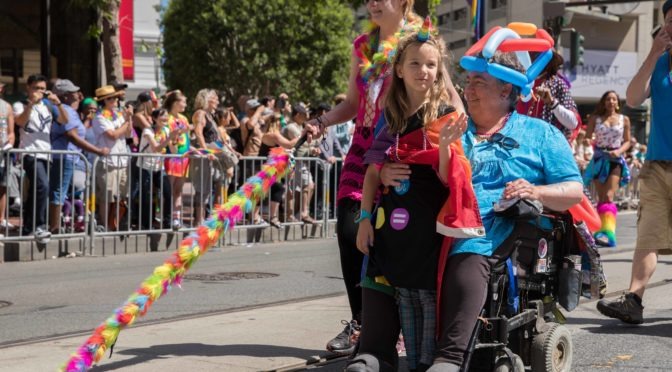
Photos: This SF Pride we made it clear that LGBTQ+ includes the blind and disabled

Photos: This SF Pride we made it clear that LGBTQ+ includes the blind and disabled

It’s not every day that we get to march freely down the middle of Market Street with our canes wrapped in multi-colored ribbon. But on Sunday, we took to the streets for the 2018 SF Pride parade with a rainbow-clad pan-disability contingent of more than 150 people with disabilities and our allies. To our knowledge this is the largest-ever group of disability supporters to march in San Francisco Pride.

This year’s contingent was a true testament to the shared experience of having a disability, whatever it may be, and the subsequent empowerment that comes with being seen and celebrating that identity. We’d like to extend a warm thank you to the staff, volunteers, community supporters and our sponsors, Mental Health Association San Francisco and The Arc San Francisco, who marched with us and made this a truly celebratory day.

We’re still selling our beloved SF Pride T-shirts in the Adaptations Store! Support LightHouse and pick one up for next year’s parade for only $20.

Three volunteers in rainbow spandex hold the LightHouse banner while marching at the front of the contingent.
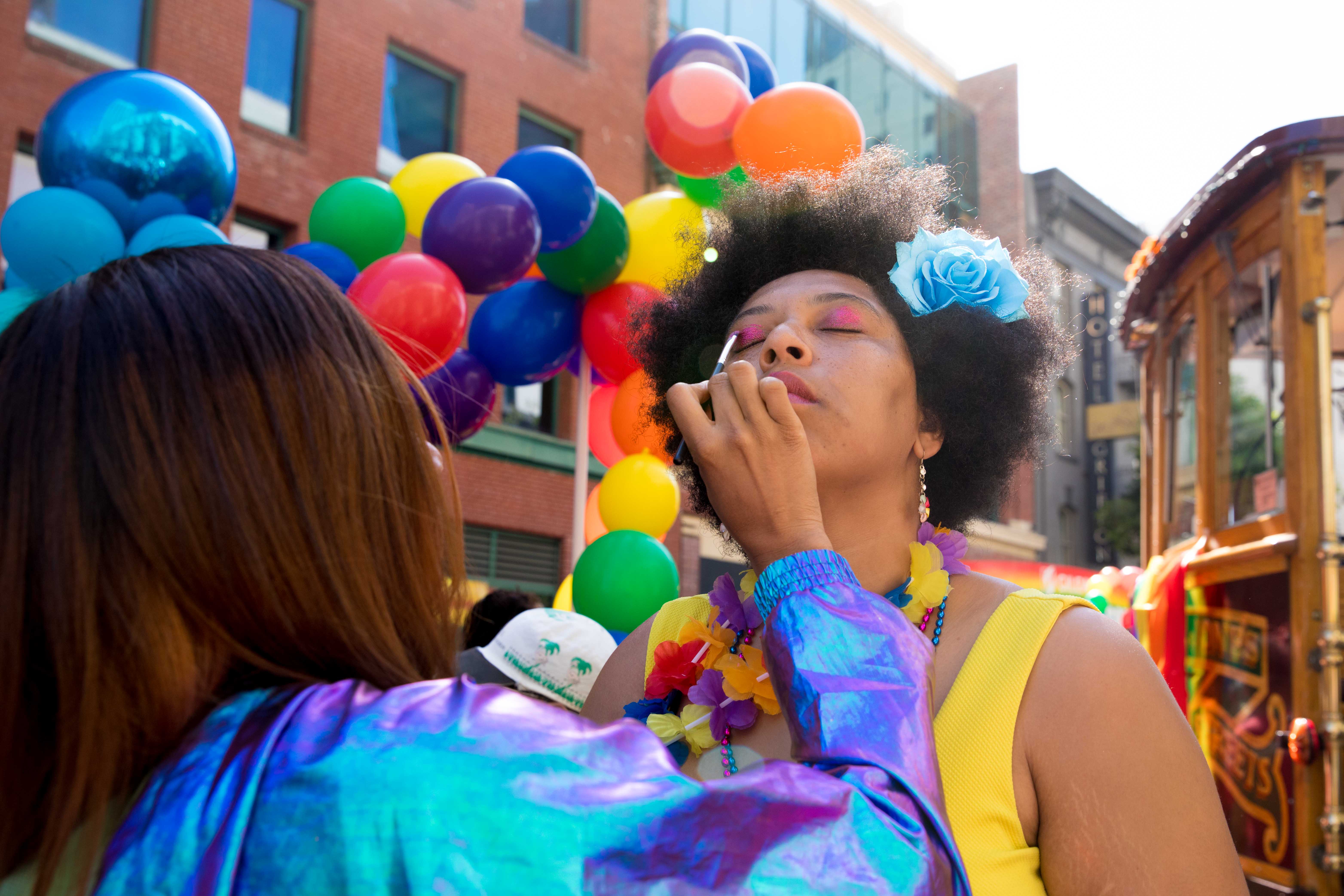
A woman applies eyeshadow to a LightHouse contingent member with rainbow balloons in the background.
A woman applies eyeshadow to a fellow LightHouse contingent member with rainbow balloons in the background.
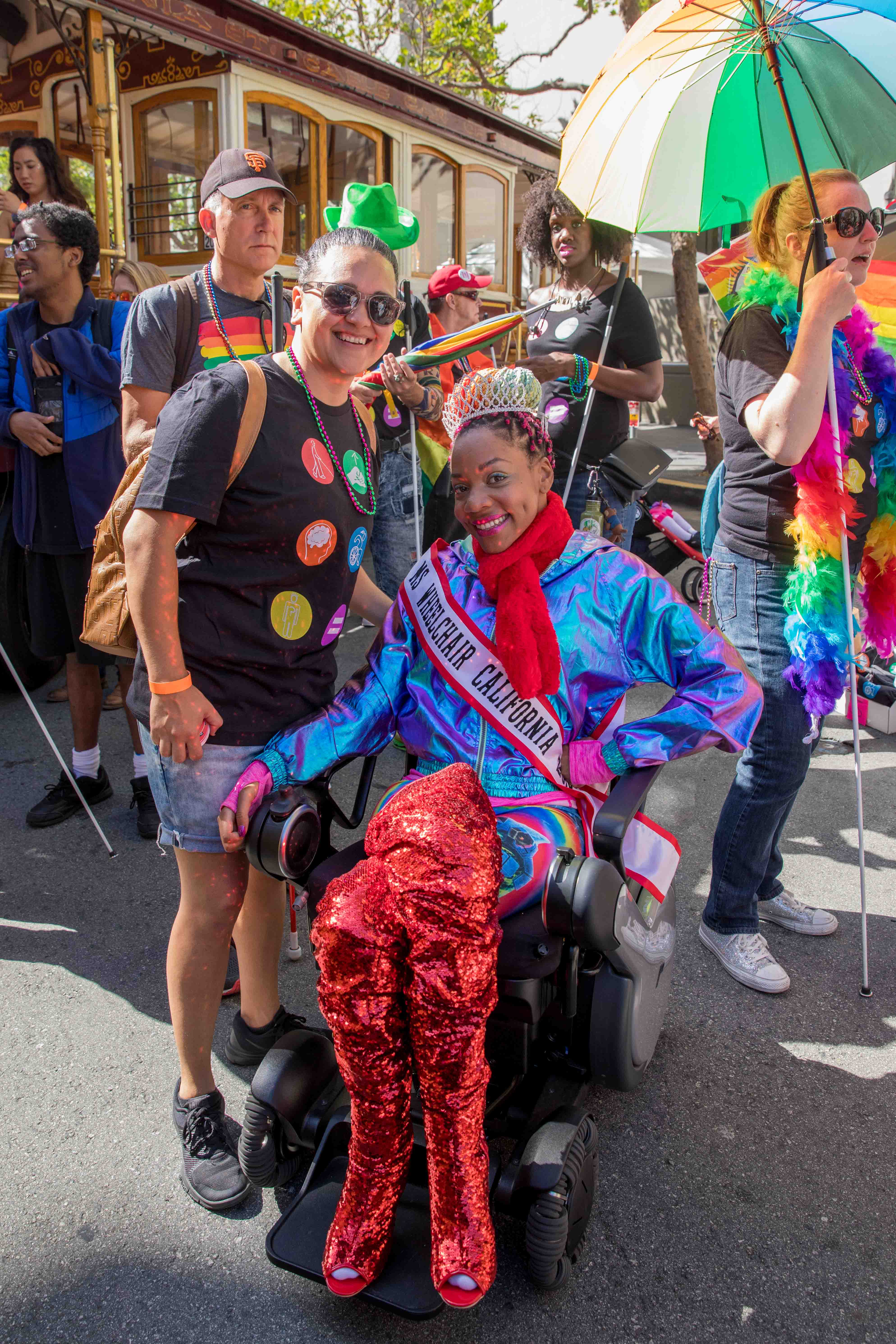
Two pride participants, one standing wearing the LightHouse shirt and wearing 'Ms. Wheelchair California' sash, prepare to march in the parade.
Two pride participants, one standing wearing the LightHouse shirt and the other wearing a ‘Ms. Wheelchair California’ sash, prepare to march in the parade.
A pride participant from Senior & Disability Action marches with our contingent, holding a 'Blind, Queer & Proud' sign.
A pride participant from Senior & Disability Action marches with our contingent, holding a ‘Blind, Queer & Proud’ sign.
Contingent members from The Arc San Francisco smile and pose before the parade begins.
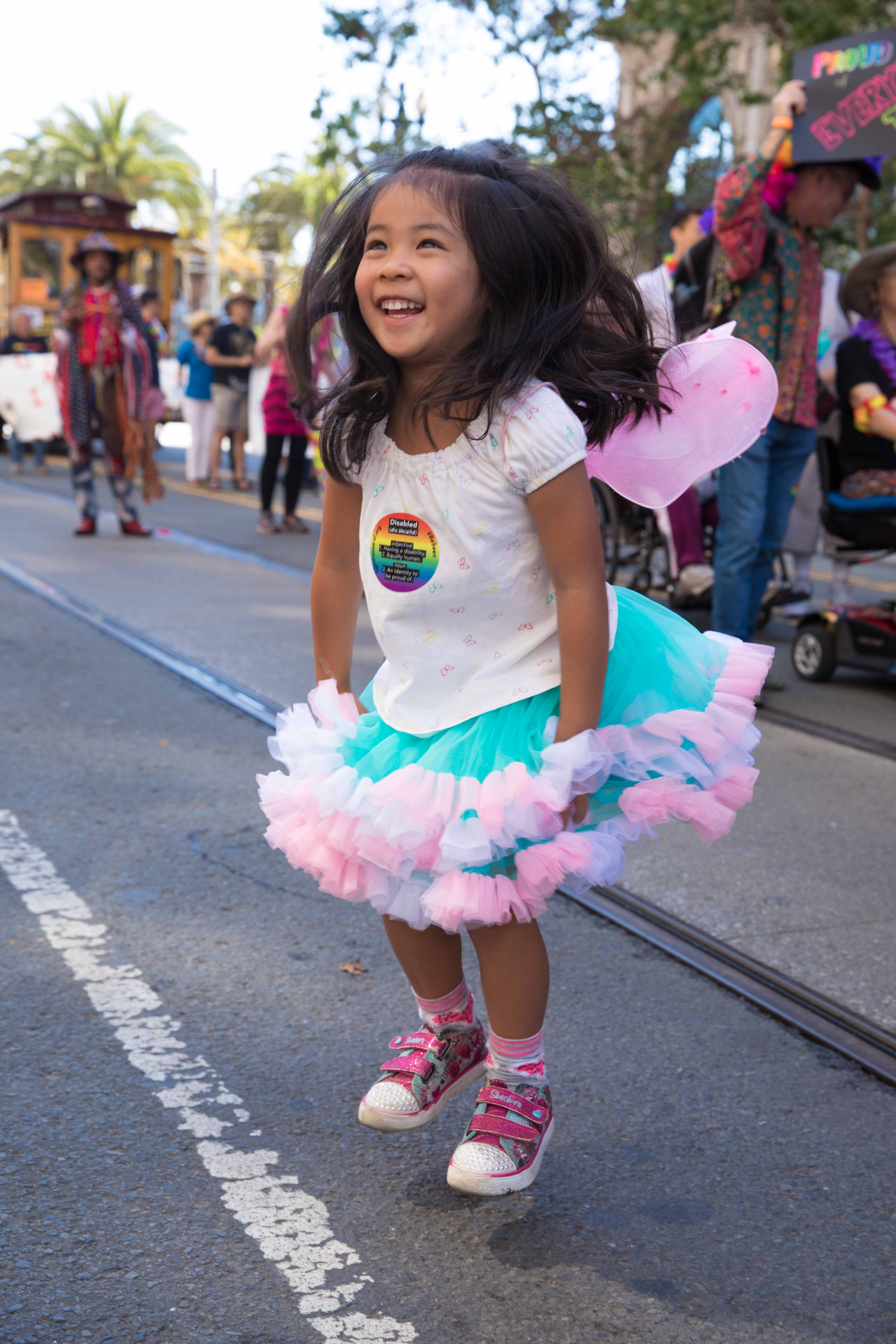
A little girl wearing a tutu and fairy wings smiles and jumps into the air.
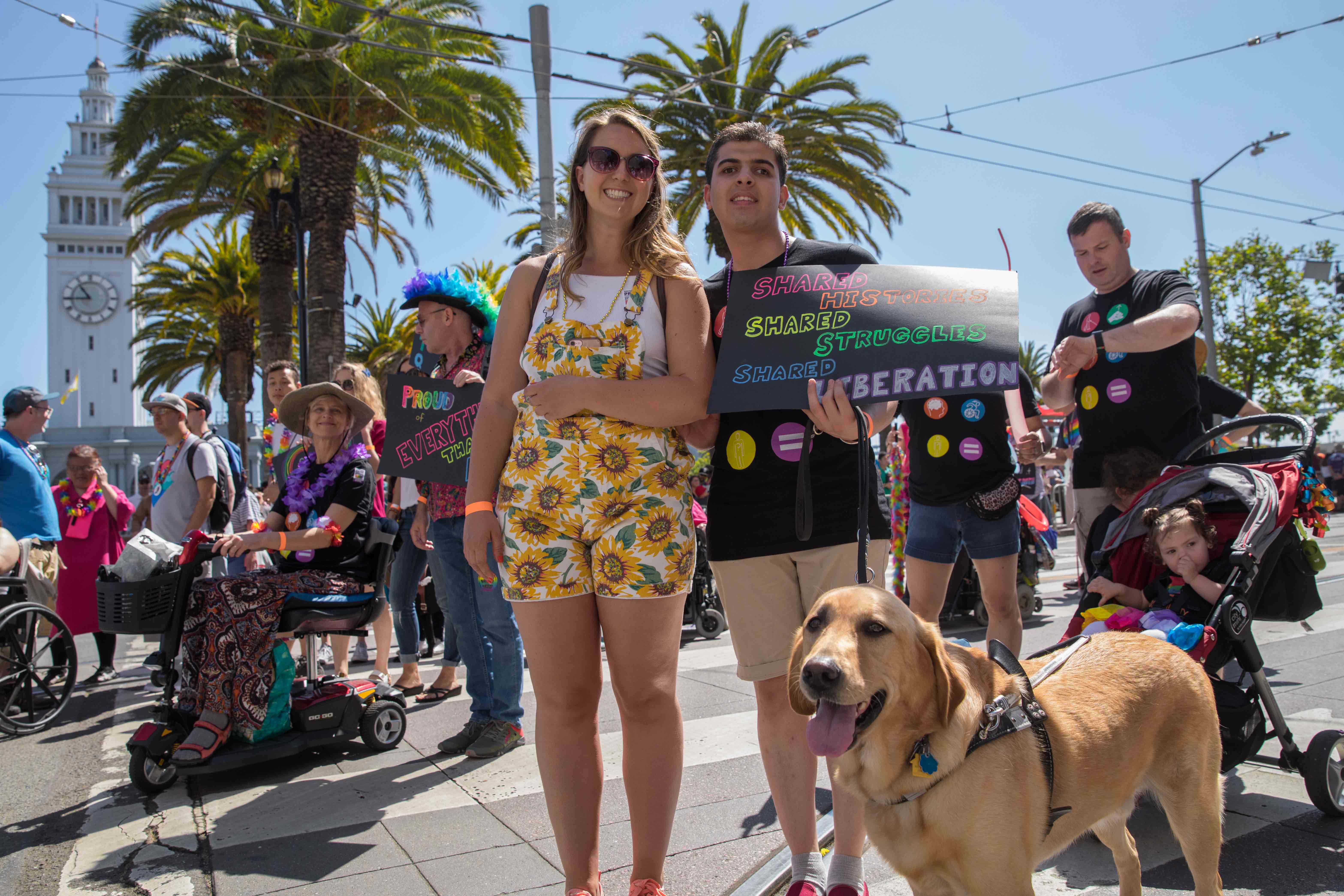
A LightHouse student stands with his guide dog and a volunteer holding a sign that reads, "Shared history, shared struggles, shared liberation".
A LightHouse student stands with his guide dog and a volunteer holding a sign that reads, “Shared history, shared struggles, shared liberation”.
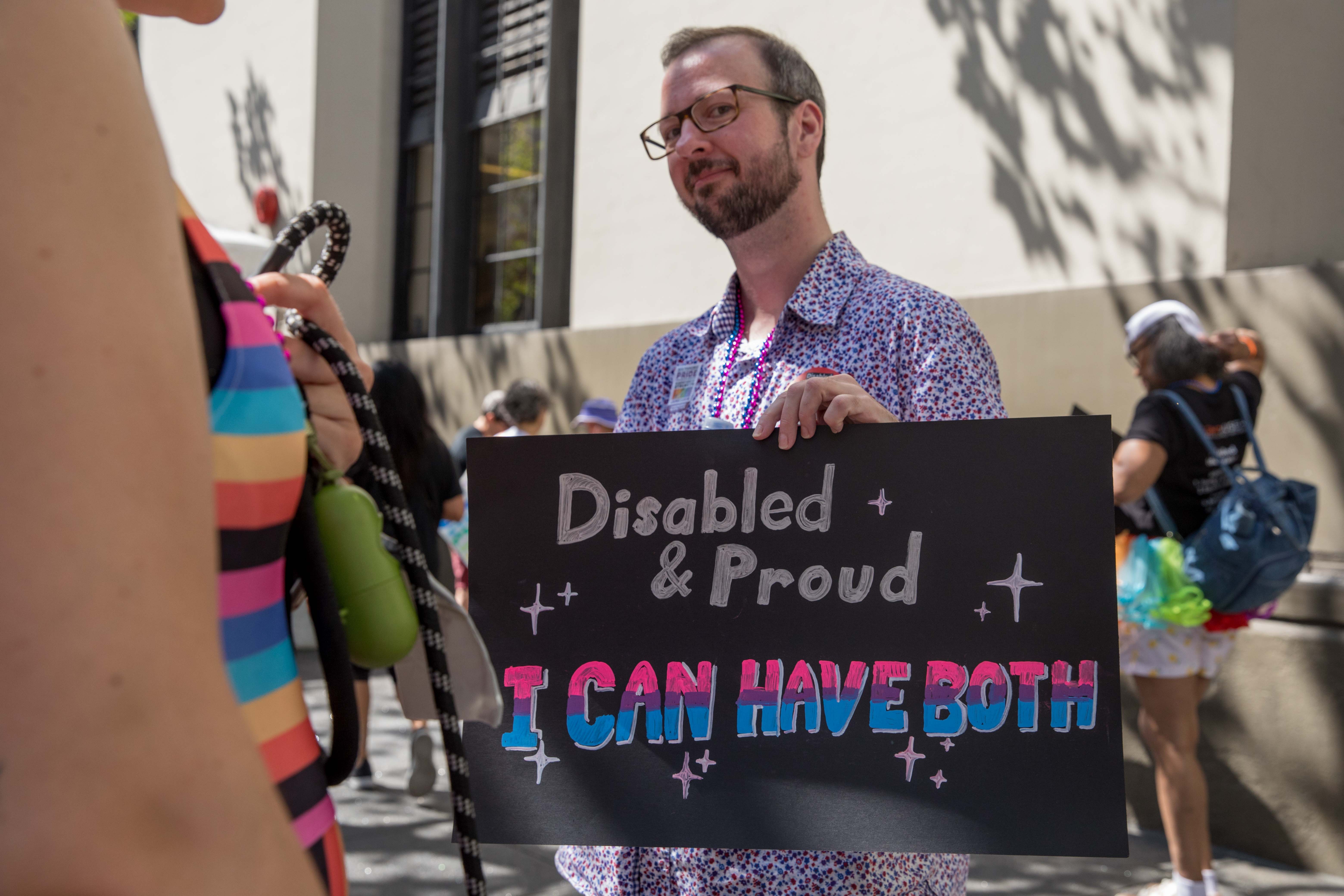
A contingent member from the Mental Health Association of San Francisco smiles and holds a sign that reads, "Disabled & Proud. I can have both."
A contingent member from the Mental Health Association of San Francisco smiles and holds a sign that reads, “Disabled & Proud. I can have both.”
A pride participant with a cane walk side by side in the midst of our large Pride contingent.
A contingent member marches with a sign attached to their wheelchair that reads "Free our people."
A contingent member marches with a sign attached to their wheelchair that reads “Free our people.”
Two Pride participants in wheelchairs laugh while marching down market street with the contingent. One holds a sign that reads "Proud to be here."
Two Pride participants in wheelchairs laugh while marching down market street with the contingent. One holds a sign that reads “Proud to be here.”
LightHouse Pride organizer Laura Millar smiles while marching, with her white cane wrapped in rainbow ribbon.
Two rainbow-bedecked pride participants march side by side, one holding a sign that says "Proud of everything that we are."
Two rainbow-bedecked pride participants march side by side, one holding a sign that says “Proud of everything that we are.”
A french bulldog smiles while his owner, a LightHouse volunteer, holds him before the parade starts.
The gift that took 42 years to arrive

The gift that took 42 years to arrive

Sometimes the most impactful act is to set an intention: “I want to support the lives of blind people,” for instance. And even if a gift isn’t given immediately, it can have a powerful effect. Last week, we were touched and honored to find out about an gift that was dedicated to the blindness community more than four decades ago – only to find its way to our doorstep this year.

Jessie Strickland wanted to leave a lasting impact – and so she planned a gift. Upon her passing in 1976, her estate plan outlined support for two causes: the well-being of her daughter, Jessie Marsh, and their family’s local blindness organizations (one in Ohio and the other in California). Strickland’s estate was considerable and the trust sustained her daughter, Jessie Marsh, beyond her lifetime – with some funds remaining to meet a second purpose upon Marsh’s passing in 2016.

A few weeks ago we got a call from a representative at the Bank of the West. They informed us that the original blindness organizations named in the estate plan no longer operated, and in fact had been out of business for years. In these cases, the bank has a fiduciary responsibility to select a replacement organization that carries out the same mission.

The bank had called to notify us that we, along with the Cincinnati Association for the Blind and Visually Impaired in Ohio, were the recipients of Ms. Strickland’s remaining estate. The funds, distributed evenly to the two organizations, amounted to a $412,513 gift for the LightHouse. This is an incredibly generous gift by every measure, and even more remarkable is the path it took to get to us.

This contribution, and others like it, will help the LightHouse and Enchanted Hills support programs that are otherwise hard to fund. Support for white cane travel, learning braille and other vital skills are scarce. The Strickland bequest will enable us to help people who are new to blindness, adapt to their changing vision, gain confidence to re-engage with the world and  meet a community of support. We did not know Ms. Strickland, but we thank her and her family with all our hearts and know that this bequest will live up to the original intention of so many years ago.

To learn more about leaving a legacy to the LightHouse or Enchanted Hills through your estate plans, please contact 415-694-7333 or jsachs@old.lighthouse-sf.org.

Who are our SF Pride sponsors and why do we march together?

Who are our SF Pride sponsors and why do we march together?

Thanks to the support of community sponsors The Mental Health Association of San Francisco and The Arc San Francisco, we have organized a pan-disability contingent for San Francisco Pride 2018 ready to make a strong statement about intersecting identities in the LGBT+ community. 

Learn more about their reasons for marching with us below:


Meet the Mental Health Association of San Francisco

The Mental Health Association of San Francisco LogoQ: What is the mission of the Mental Health Association of San Francisco?
A: The mission of the Mental Health Association of San Francisco (MHASF) is to cultivate peer leadership, build community and advance social justice in mental health.

Q: Why is the Mental Health Association of San Francisco a proud sponsor of the LightHouse Disability Pride contingent? 

A: MHASF is a proud sponsor of the LightHouse Disability Pride contingent because we care deeply about the mental health of the LGBTQ+ communities we serve. Many of us are LGBTQ+ identified ourselves and have personal experience of mental health challenges due to stigma, isolation, and discrimination. We support one another and we stand shoulder-to-shoulder with our community partners to raise awareness about disability pride, rights, and resources.

Q: How does the work your organization does connect with the work we’re doing here at LightHouse? 

A: Just as LGBTQ+ communities are not a monolith but a coalition of community partners with common goals and a shared vision, MHASF is a part of the larger community of disability advocates, including LightHouse. While the focus of our work may differ, our communities sometimes overlap, and MHASF is committed to promoting equality and self-reliance for people with mental health challenges, providing professional development and skills training, and amplifying the voices of people with lived experience.

Q: What does Disability Pride mean to you? 

A: At MHASF, Disability Pride means bringing our whole selves to all we do and celebrating all of what makes us who we are. For many of us, our mental health conditions and histories have played an important role in making us the amazing, compassionate, resilient people we are today. We are proud of all we’ve accomplished, alone and together, and we want to share that pride with our community.

A: The first Pride was a riot. How can we keep this activist legacy in Pride and stay true to the spirit of the event? 

Q: Our goal at MHASF is to advocate when possible — and agitate when necessary! Pride is a celebration of everything LGBTQ+ communities have accomplished, but now more than ever, we recognize that we can’t afford to be complacent, especially when it comes to our rights and our mental health. MHASF is proud to stand with LightHouse and other members of the Disability Pride contingent to support each other and call out injustice wherever we find it.


Meet The Arc San Francisco

The Arc San Francisco Logo

Q: What is the mission of The Arc San Francisco?

A: Our mission is to transform the lives of adults with developmental disabilities by advancing lifelong learning, personal achievement and independence. Our full name is The Arc San Francisco. The “arc” in our name represents the arc of achievement. We believe that with the right support, over time, people with developmental disabilities can fulfill their highest potential, achieving personal goals and lifelong success — however it is personally defined. Our vision is to foster an inclusive world in which all people with developmental disabilities can thrive.

Q: Why is The Arc San Francisco a proud sponsor of the LightHouse Disability Pride contingent?

A: We are thrilled to be partnering with another organization that believes in the absolute equality of people with disabilities, and recognizes the intersectionality of people who have disabilities and are part of the LGBTQ community.

Q: How does the work your organization does connect to the work we’re doing here at LightHouse?

A: We have clients with developmental disabilities who are blind or have low vision. Both organizations recognize the full humanity of the people we serve which includes sexuality and sexual and gender identifications.

Q: What does Disability Pride mean to you?

A: Like LGBTQ Pride, we recognize that people with disabilities have absolutely nothing to be ashamed of. People with disabilities are all born with unique gifts and talents to share, and have every right to fulfill dreams, achieve goals and participate fully in our communities.

Q: The first Pride was a riot. How can we keep this activist legacy in Pride and stay true to the spirit of the event?

A: It’s so important to recognize that The Stonewall Riots were a response by mostly drag queens, gender fluid people, and trans woman of color. They were what the police and US culture at the time thought were easy targets for bullying, harassment and abuse, and these revolutionaries had finally had enough. It’s a great story of how people who are ostracized, looked down on, shunned and seen as less than fully human can empower themselves, stand up, and demand justice and equality. By doing so, they not only liberate themselves, but all of us. People with disabilities experience so many of the same challenges that people who are LGBTQ face, and if you’re queer and disabled your challenges are even greater. By recognizing the true history of Pride we can learn from our achievements and empower everyone who is disenfranchised by our culture. We are not all free until everyone is free.

To sign up to march or learn more about our SF Pride Disability Contingent, visit old.lighthouse-sf.org/sf-pride-2018.

Announcing the 2018 Holman Prize Finalists

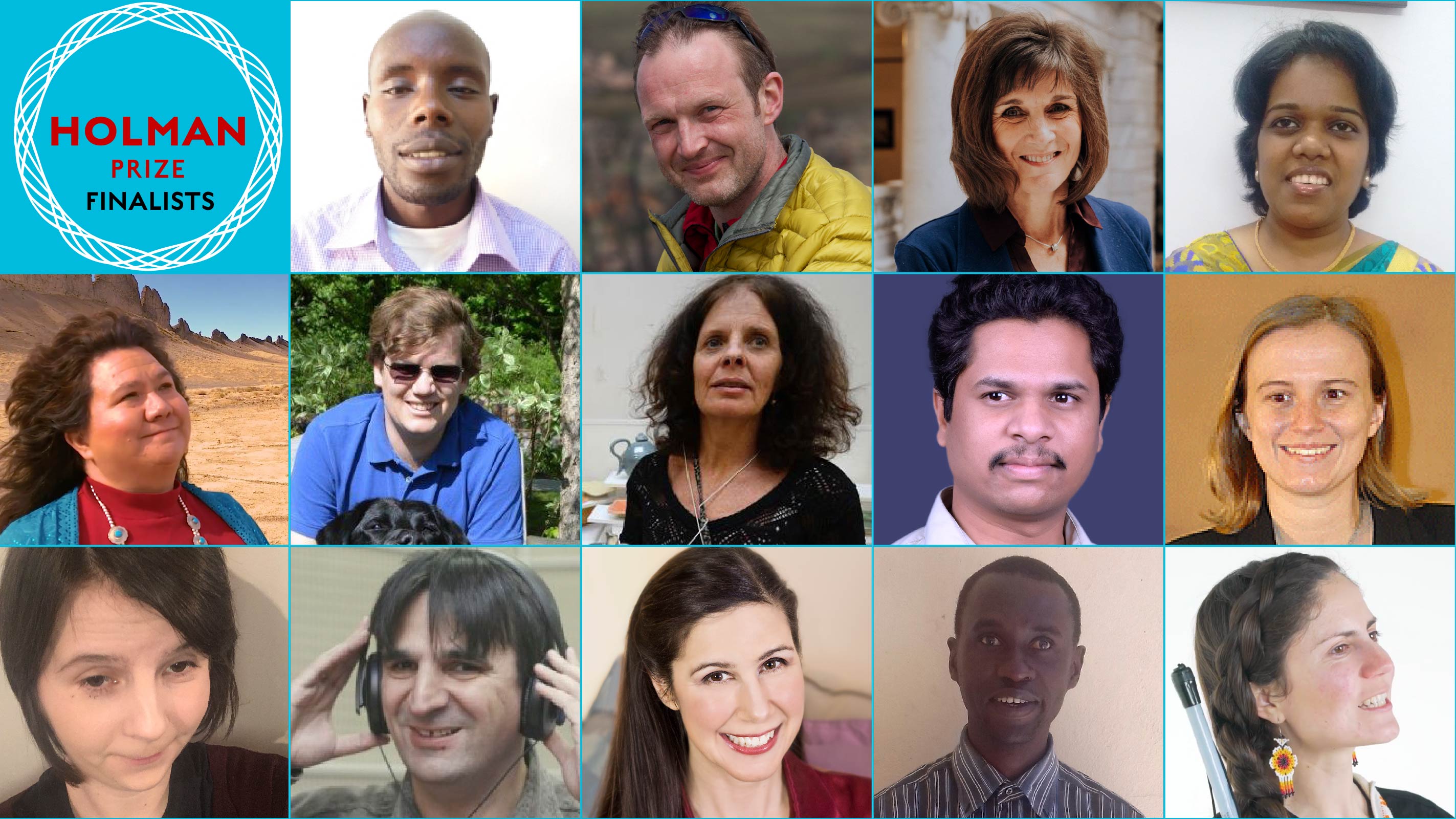
Grid of photos of the 2018 Holman Prize Finalists


Last year, we started the Holman Prize for Blind Ambition, a set of annual awards of up to $25,000 each for legally blind individuals with big ideas. In our second year, we received video applications from all over the world – including nine more countries we hadn’t heard from last year – all fascinating and compelling in their own rite. The Holman Team narrowed the pool to 42 semifinalists, all of whom submitted detailed proposals mapping out their dream projects.

This week, we’re proud to announce our elite group of fourteen finalists, including a “People’s Choice” finalist who we honor for receiving the highest number of YouTube ‘likes’ for his ambitious idea. These finalists will all be in the running to make their ambitions a reality when our Holman Committee meets in San Francisco this June.

The fourteen finalists are as diverse and dynamic a group as you could imagine, including those who want to give back to their communities, those who seek to push the boundaries of science and tech, and those with infectious enthusiasm for a particular or unexpected craft.

Over the next month, we hope you’ll sound off on which Holman Prize candidate you want to see take their ambitions on the road. Feel free to tag Holman Prize on TwitterInstagram and head to the LightHouse’s Facebook page for more updates.

Meet our 2018 finalists below: 

Becky Andrews

Bountiful, Utah, USA
Becky, a marathon runner and cyclist, would use the Holman Prize to implement a series of empowerment retreats for blind and visually-impaired women.

Zeljko Bajic

Sarajevo, Bosnia

Zeljko, a radio producer and host, would use the Holman Prize to create a podcast “for and about blind people living all over the world.”

Luanne Burke

Boulder, Colorado, USA

Luanne, a seasoned long-distance runner, would use the Holman Prize to educate visually-impaired communities around the world about the joys and logistics of guided running.

Stacy Cervenka

Sacramento, California, USA

Stacy, who works in the disability employment field, would use the Holman Prize to launch an accessible travel forum similar to Yelp or TripAdvisor, geared specifically towards helping blind users optimize their trips around the world.

Leona Godin

Castle Rock, Colorado, USA

Leona, an actor and writer, would use the Holman Prize to expand her magazine “Aromatica Poetica,” which is “dedicated to the arts and sciences” of smell. Furthermore, she would use the prize money to fund her own prize, geared in part towards visually-impaired writers.

Carol Green

Kirtland, New Mexico, USA

Having recently developed a braille code for the Navajo language, Carol would use the Holman Prize to launch a summer program to educate and share the code across the Navajo Nation. Her proposal also includes tactile interpretation of landscapes and critical features of the nation’s geography.

Andrew Hasley

Madison, Wisconsin, USA

Andrew, a biologist and geneticist, would use the Holman Prize to facilitate a conference for blind scientists and students from across the globe, called “Sciencing While Blind,” where participants could network and exchange tips and tools.

Conchita Hernandez

Washington, DC, USA

Conchita, who is currently pursuing a doctorate degree in Special Education, would use the Holman Prize to create a workshop in her native Mexico for professionals in the blindness field, and blind people of all ages.

Georgina Hollinshead

Matlock, Derbyshire, UK

Georgina, who says she was “born a crafter,” would use the Holman Prize to launch a social enterprise called Hook and Eye Crafts, geared toward teaching blind and visually impaired people the joys of knitting, crochet and cross-stitch.

Alieu Jaiteh

Banjul, Serrekunda, Gambia

Alieu, the founder of the blindness advocacy organization Start Now, would use the Holman Prize to provide various skills, including computer literacy, cane travel and Braille, to blind and low-vision participants in rural Gambia.

Sandeep Kumar

*People’s Choice Finalist*

Hyderabad, Telangana, India

Sandeep, who has developed a tool called Eye Renk, which allows the visually impaired to easily differentiate between various ocular medications, would use the Holman Prize to build a lab for further development of Eye Rank and other technologies for the visually impaired.

Ambrose Kiplangat Lasoy

Rift Valley Province, Kenya

Kiplangat would use the Holman Prize to develop a program to enable his fellow blind and low-vision Kenyans to become dairy farmers and entrepreneurs.

Aishwarya T.V.

Secunderabad, Telangana, India

Aishwarya, a filmmaker and rehabilitation counselor, would use the Holman Prize to create a training center for the blind and low-vision community to study elements of filmmaking like script writing, film editing, sound mixing, production and more.

Red Szell

London, UK

Red, an extreme sports enthusiast, would use the Holman Prize to undertake an extreme sports triathlon to conquer Am Buachaille, one of the most remote rock pinnacles at the Northwest tip of the United Kingdom.

Learn more about the Holman Prize for Blind Ambition at www.holmanprize.org.

Art Opening: Meet Deaf-Blind Mosaic Artist Mary Dignan

This June, we’re thrilled to host a special exhibition of work by Sacramento-based Deaf-Blind blind mosaic artist Mary Dignan at our headquarters starting on Friday, June 8. That evening, we will also be welcoming prominent blind people from across the country who have come to San Francisco to select the 2018 Holman Prizewinners – more info at www.holmanprize.org.

We hope that you’ll join us for drinks and refreshments on Friday, June 8 from 4:30 to 6:00 p.m. at LightHouse for the Blind (1155 Market Street, in the ground floor lobby) to explore Mary’s work and to learn more about her process and passion for mosaics.

RSVP and Invite Your Friends on Facebook

About the Artist

Mary Dignan was born with moderate to severe hearing loss, but her deafness was not diagnosed until she was almost 5 years old, after she had been diagnosed as having a cognitive disability. A routine eye test for reading glasses during her college years revealed the onset of retinitis pigmentosa (RP) symptoms. Eventually she would learn that she had Usher syndrome, Type 2, which is characterized by moderate to severe deafness at birth, and blindness from RP later in life.

She earned her undergraduate degree from Santa Clara University in 1976, and embarked upon a career that included newspaper reporting, legislative work for the U.S. House of Representatives and the California State Assembly Committee on Agriculture, public relations and governmental liaison work with one of California’s largest and most complex water agencies, and her own consulting business in the field of water and natural resources management policy.

In 1990, a year after she was certified legally blind with a restricted visual field of 8 degrees (a normal visual field is 180-150 degrees), she started law school. In 1994, she earned her juris doctorate with honors from University of the Pacific, McGeorge School of Law in Sacramento, was admitted to the California State Bar, and began practicing water and natural resources law with the Sacramento firm of Kronick, Moskovitz, Tiedemann & Girard. In 1997, she discovered she had a brain tumor and underwent surgery to remove it. The tumor and the surgery exacerbated and complicated her vision and hearing losses, and she has not practiced law since.

Instead, she practices healing and art and has a lot more fun. After ten years of increasing deafness, she received a cochlear implant in 2008 and is delighted to be back in the hearing world again.

Mary has shared her mosaic technique with blind and deaf-blind students in the US, Canada and India, and teaches mosaic classes in her home studio and through Creative Edge (www.creative-edge.org). Mary’s community service work includes six years on the Disability Advisory Committee to the Sacramento County Board of Supervisors, more than a decade of support and service to Bread of Life and Spirit in the Arts (www.breadoflife.org), and five years on the board of directors of the Sacramento Chapter of Foundation Fighting Blindness. She is presently a member of the Sacramento Embarcadero Lions Club.

Donate to support arts programming at LightHouse for the Blind and Visually Impaired. https://old.lighthouse-sf.org/donate

Meet the blind judges who will select the 2018 Holman Prizewinners

Meet the blind judges who will select the 2018 Holman Prizewinners

In its second year, the Holman Prize for Blind Ambition received almost one hundred applications from 19 countries and 22 American states. The semifinalists’ proposed projects are extraordinary – including bringing beep baseball to Argentina, creating the world’s first tactile Escape Room, launching a magazine dedicated to the art and science of smell and empowering people who are blind in rural Gambia. It won’t be an easy task to choose he three 2018 prizewinners from such a strong and diverse group.

The Holman Team is in the process of selecting finalists for the judging committee to select from, but in the meantime, we invite you to peruse the whole group of semifinalists’ Holman Prize submission videos to experience the diversity of people and proposals in the field.

In just a few weeks, we’ll welcome our judges in San Francisco to review the finalists’ proposals and select the 2018 Holman prizewinners. Learn more about the judges below and stay tuned for a forthcoming announcement of our elite group of Holman Prize Finalists.

Bryan Bashin Headshot

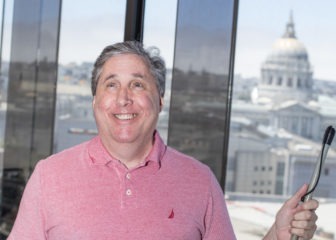
Bryan Bashin, CEO at the LightHouse for the Blind in San Francisco since 2010.

Don Brown Headshot

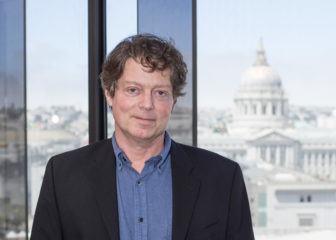
Don Brown, CEO of Access Work Systems, a HR compliance Management consulting firm, which he founded in 2000.

Dr. Wendy David headshot

Dr. Wendy David, licensed clinical psychologist in private practice in Seattle and published author of books including, “Sites Unseen: Traveling the World without Sight.”

Chancey Fleet Headshot

Chancey Fleet, assistive technology coordinator at the Andrew Heiskell Braille and Talking Book Library at New York Public Library.

Aerial Gilbert headshot

Aerial Gilbert, former outreach manager for Guide Dogs for the Blind in San Rafael. She is also an avid rower and has competed in the adaptive division of the World Rowing Championships.

Rosa Gomez, assistant deputy director of the Specialized Services Division of the California State Department of Rehabilitation.

Anil Lewis headshot

Anil Lewis, executive director of the NFB Jernigan Institute in Baltimore, MD.

Dr. Brian Miller Headshot

Dr. Brian Miller, U.S. Department of Education, Office of Special Education and Rehabilitative Services in Washington D.C.

Dr. Sile O'Modhrain Headshot

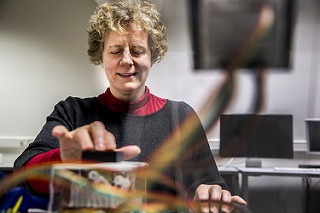
Dr. Sile O’Modhrain, professor in performing arts technology at the school of Music, Theatre and Dance at the University of Michigan.

Jason Roberts Headshot

Jason Roberts, an accomplished author, Roberts’ wrote “A Sense of the World: How a Blind Man Became History’s Greatest Traveler,” about the intrepid blind traveler (and namesake of this prize) James Holman.

Dr. Sharon Sacks headshot

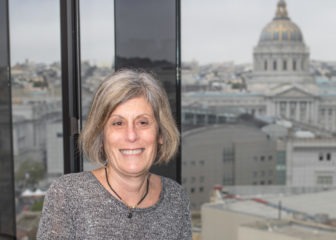
Dr. Sharon Sacks, former superintendent of the California School for the Blind. Sacks recently retired.

Victor Tsaran headshot

Victor Tsaran, technical program manager at Google, helping to make Android accessible for all.

Dr. Sheri Wells-Jensen

Dr. Sheri Wells-Jensen, associate professor in the Department of English at Bowling Green State University in Bowling Green, Ohio.

Gary Wunder Headshot

Gary Wunder, president of the National Federation of the Blind of Missouri and the editor of the Braille Monitor.

A touching way to tell your parents ‘thank you’, this Mother’s and Father’s Day

This Mother or Father’s Day, pick up a braille card made by the MAD Lab to express your appreciation for your mom or dad. The Adaptations Store is offering several designs, each with ink-print, tactile and braille designs on a white background.

The words 'Happy Mother’s Day’ in blue text and braille, in the middle of a red ink and tactile heart, made up of braille x’s and o’s.
The words ‘Happy Mother’s Day’ in blue text and braille, in the middle of a red ink and tactile heart, made up of braille x’s and o’s. Blank inside.
The words 'Happy Father’s Day’ in blue text and braille, in the middle of a red ink and tactile heart, made up of braille x’s and o’s.
The words ‘Happy Father’s Day’ in blue text and braille, in the middle of a red ink and tactile heart, made up of braille x’s and o’s. Blank inside.
  • Individual cards are $6, or you can purchase four for $20.
  • All cards come with an envelope.
  • All front covers of the greeting cards feature a combination of ink print and tactile graphic design.
  • The Adaptations Store and the MAD Lab will continue working together to design fun and creative accessible greeting cards that appeal to a wide audience, for all occasions.
  • We will roll out cards all-year-round. Stay posted for cards for all occasions!
  • If you have suggestions for cards we should make for upcoming holidays, please email adaptations@old.lighthouse-sf.org!

Adaptations is the only place in Northern California with a comprehensive offering of tools, technology, and other solutions for blind and visually impaired people. The store is located at our San Francisco headquarters at 1155 Market Street, on the 10th floor. Store hours are Monday through Friday, from 10:00 a.m. to 5:00 p.m., with extended hours on Tuesdays until 7 p.m. We are also open on the second Saturday of each month from 10 a.m. – 2 p.m.

Although we do not take online orders at the current time, we encourage you to call our staff at 1-888-400-8933 to inquire about item pick up or mail orders or email our store staff at adaptations@old.lighthouse-sf.org.

LightHouse Issues RFP for Comprehensive Program Evaluation

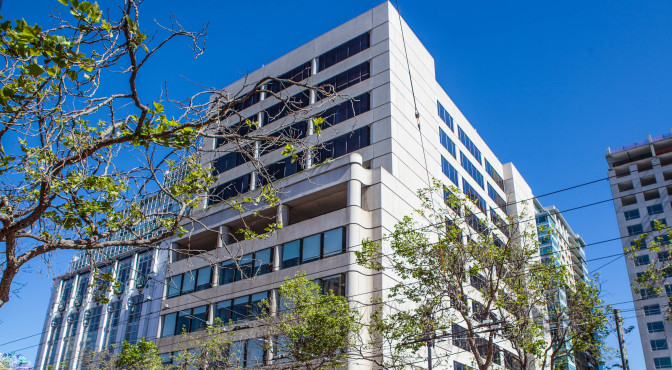
The front facade of The Lighthouse Building, our new headquarters at 1155 Market Street

Request for Proposals

LightHouse Program Evaluation RFP (.docx)

The LightHouse for the Blind and Visually Impaired in San Francisco is soliciting proposals to evaluate the efficacy of the organization’s student-facing programs.

The LightHouse embarked upon a three year strategic plan in 2017, and one of the core focus areas of the final plan is establishing an ongoing methodology for program effectiveness and evaluation. The LightHouse has more than 80 unique programs, spanning the breadth of the blindness experience, including skills training, community service and integration, innovation, and technology and employment services. We also offer robust programs at our Enchanted Hills Camp in Napa, three satellite training centers, and a direct-employment light manufacturing facility. Altogether we serve approximately 3,000 people who are blind or have low vision every year.  Our goal is to determine how effective our programs are and how to evaluate their scope and impact going forward.

The successful proposal will address two key needs. The first is to measure the impact and effectiveness of several dozen key LightHouse programs. The second is to develop an ongoing system for staff to continue internal program measurement and evaluation going forward.

The LightHouse seeks to work with an outside consultant to build a flexible mechanism for evaluating program effectiveness, both in the program development process and while programs are active. We wish to build a mechanism so that program directors and management will quickly know when programs are succeeding, and also help determine how we might wish to change or eliminate programs that exhibit limited effectiveness.

Download: LightHouse Program Evaluation RFP (.docx)

SUBMISSION DEADLINE AND PROCESS

Proposals are due no later than 5:00 pm PDT on Friday June 1st. Please see full RFP for submission guidelines and contact information.

An Enchanted Hills Camp Update: Get ready for Summer 2018

An Enchanted Hills Camp Update: Get ready for Summer 2018

At the beginning of April, our AmeriCorps Blue2 completed their 12 week service at Enchanted Hills Camp, leaving it in much better shape than they found it! This bright, talented, caring, energetic group left their mark — they renovated and cleaned all the Lakeside Cabins, dining hall, and kitchen, installed new windows in the Gathering House, removed Azola from the lake, worked on fire abatement, repaired smoke and heat damage, helped resurrect the pool area, mowed, raked, lifted, fixed, painted, hauled, polished and cared for Enchanted Hills in every way possible. We’re so thankful to Blue2 for serving with us and we salute them as they embark on their next assignment in Puerto Rico!

But the work’s not finished yet — so earlier this week we welcomed a brand new AmeriCorps Green4 team, who will finish what Blue2 started as we get ready for our campers to arrive in June! We’ll be constructing platforms for eight state-of-the-art Sweetwater Bungalows starting on May 5, which will house campers after our lower camp cabins were destroyed.

Meanwhile, our friends at the Kiwanis Club of Greater Napa helped seal the hand-carved benches in the Redwood Grove Theater and stopped by with some ‘Bat Hotels’ for our resident EHC bats. We also have two new furry camp residents: meet our new donkeys Citizen and Quill, who are seem to be getting along just swimmingly with the goats. And all the necessary tree work is happening as we speak!

EHC is coming back to life with the help of an entire community, and we’re so thankful for the care and support of our volunteers, donors, camp staff and many more. A huge thank you to Access Ingenuity, Miner Family Winery, the Yale Alumni Association, Salesforce, Sterling Vineyards, Wells Fargo, Osprey, XL Construction, BPM Accounting and Consulting Firm, and the Northern CA Association of the Deaf-Blind. If you’d like to join the EHC family, check out our current job openings; we’re still looking for summer camp counselors. You can also support us by donating to our Rebuild EHC fund or joining us in Napa on April 21 for our largest annual fundraiser, Cycle for Sight. Learn more at cycle4sight.com.  

Americorps Blue2 team builds a new foundation at Enchanted Hills Camp.
Our friends from the Napa Kiwanis Club put a protective coating on the benches in the Redwood Grove Theater to prevent rot. Some of the benches are charred, a reminder of the October fires in Napa.
The two goats and two donkey stand beside the barn at EHC.
Meet our new donkeys Citizen and Quill, who are seem to be getting along just swimmingly with the goats.
EHC Construction Manager George Wurtzel installs new windows in the Gathering House.
EHC Site Staff Janet Lay smiles with the donkeys, Citizen and Quill.