Tag Archive

Community

Cooking 101 Gets Blind and Low Vision Youth in the Kitchen

LightHouse staffer Molly Irish teaches sushi making to Cooking 101 studentsThe Cooking 101 series with the LightHouse Youth Program is back again with new classes for Fall 2015.

Due to popular demand, the Cooking 101 series with the LightHouse Youth Program is back with new classes for fall of 2015.

Whether you are interested in cooking tasty treats, simple side dishes and snacks, or festive full course meals, this class is intended for blind and low vision youth aspiring to be more competent and confident in the kitchen. In addition to skills training, participants will also learn the ABCs of kitchen safety and sanitation.

Upon completion of the course, students will have the necessary skills, knowledge and confidence to independently prepare and cook just about any meal their taste buds desire.

Who: Blind and Low Vision Youth
What: Learn to cook tasty treats for yourself, your friends and your family
When:  From 11:00 p.m. to 1:00 p.m. on the second Saturday of the month
Where:  LightHouse San Francisco Headquarters @ 214 Van Ness Avenue
Waiver: Each participant must submit a LightHouse Youth Program waiver form if they have not done so for a previous outing or event.
Cost: FREE for low vision and blind youth

If you would like more information about Cooking 101 or to RSVP, please contact Jamey Gump, Youth Services Coordinator, at (415) 694-7372, or by email at jgump@old.lighthouse-sf.org.

Classes will be limited to 8 participants and all participants must RSVP.

Note: It is essential to notify Youth Services Coordinator Jamey Gump of any food allergies prior to any class.

Class Schedule
September 12: Shepherd’s Pie
October 10: Everything Pumpkin
November 14: Chicken Stir-fry
December 12: Gingerbread House Making

James Kirwin Starts Job at the Veterans Administration

James KirwinBy age 28, James Kirwin was holding down multiple jobs and going to school, studying hydrogeochemistry, the study of groundwater systems. But when he became blind “pretty much overnight,” all his skills no longer seemed relevant. “When I lost my eyesight, seven months later I lost my job, because I just couldn’t do it anymore.” It didn’t take James long to learn, though, that he’d need to seek out a new kind of education before he’d be back on the path toward employment. That’s around the time James’ Department of Rehabilitation Counsellor John Grote told him about the LightHouse Employment Immersion program.

“It kind of reminded me of college, to be quite honest with you,” James said recently of the program, which he enrolled in during October of 2013. With the help of Justine Harris-Richburgh, our current Volunteer Program Coordinator who led the class that session, James learned that finding a new purpose as a blind person was not solely about having the qualifications, but also convincing potential employers of that fact. “We learned different tactics in dealing with people, in order to make it so that the word ‘blind’ is not the first thing that comes to their heads in interviews; different ways to explain to people that we can do the job just as well as they can, we just might have to do it in a different way.”

This month, James started his new job at AbilityOne, working in procurement for the VA Hospital. He was alerted to the job opening by Kate Williams, Employment Immersion Program Leader; staying in touch with Williams after the program ends is something she encourages with each class. Eventually he may want to go back to school, too, but says that he’d rather get a teaching credential than go back to studying ground water systems. For now, he’s glad that all his hard work and skill-building has landed him a steady job, and he stays connected with almost all the students from his Employment Immersion class. “Most of the students in the class have gotten the job that they pretty much wanted, or they’ve taken the first step toward that.”

Harris-Richburgh attributes much of James’ success to his tenacity and consistently good attitude. For starters, he had no problem taking on interviews. “He was willing to go anywhere and consider any kind of job lead,” she says, “even if he wasn’t initially excited about it, he saw it as practice.” Staying in touch with the program leaders at LightHouse was also a big part of James’ success. “Any time there was an announcement or a job opening I would always throw James’ name in there,” Harris-Richburgh points out, “because I remembered his personality, that he was dedicated and really wanted to work.”

Ultimately, James learned that the key to finding employment was, in his words, “trying to take the stigma of blindness out of peoples’ eyes — make them realize that I can do what they can do, I just might have to do it in a different way.” In class, he learned this through interviews with professionals such as an HR director from Google, who conducted mock interviews with the EI students, after which providing them with a breakdown of where they were strong and where they needed improvement.

James has learned that employment, unlike blindness, won’t always come overnight, which is why his best recommendation is to not be afraid to take small steps in reaching your goals. One of those, for him, was signing up for Employment Immersion. “It’s a lot of hard work, but ultimately, it’s greatly rewarding.”

Are you new to the working world and not sure how to get started? Or do you just want to kick your career up a notch? The next Employment Immersion session will run every Tuesday and Thursday from September 1 through October 1, 2015 at the LightHouse office at the Ed Roberts Campus in Berkeley. For more information, please contact Kate Williams at kwilliams@old.lighthouse-sf.org or 415-694-7324.

My First Convention

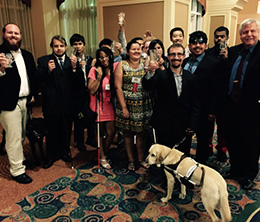
Jamey Gump, Bryan Bashin and the LightHouse youth group, dressed up for a banquet

Of the nearly twenty of us assembled at SFO airport, some had been attending these types of conferences for decades, some only a few years, while others had never even stepped foot on an airplane. It was the 4th of July, and I couldn’t help but wonder if on our way to Florida there’d be fireworks popping just outside of the plane window. It was these and other idle questions that the group of about a dozen visually impaired teenagers were mulling over as they got ready to take off for a week at their first-ever convention of blind individuals.

The LightHouse youth group, led by fearless leader Jamey Gump, represented a broad mix of backgrounds and experiences. They ranged from age 16 to 20, some attending public school while others were enrolled at the California School for the Blind in Fremont. Among them were aspiring lawyers, tech trainers, musicians and writers. They all hailed from California — everywhere from the foggy Sunset of San Francisco, the inner city of Sacramento, to the Southern Californian suburbs. Some had been preparing since early childhood for imminently changing vision; taking braille lessons and learning blindness skills in tandem with all the other studies of growing up. Others appeared to be less acclimated, perhaps a little less confident with their status as a blind person, though they all had some common qualities as well. They were the adventurous, the open-minded; the teens and young adults willing to fly all the way across the country to find out what it meant to be a part of a growing, global community of blind individuals.

Jamey Gump takes the LightHouse youth to conferences and events all year round, and so this summer he chose to bring the group to the National Federation of the Blind’s Annual Convention, The week-long affair is the largest of its kind, and carries with it a staunch political agenda, emphasizes fierce independence, and works to instill pride in its members. With almost 3,000 attendees, the convention — like so many conventions — can be experienced on multiple levels, whether it’s simply wandering from room to room, sailing through the sea of white canes and dogs, or engaging critically with the policy and membership activities the organization has to offer. Some people, it seems, are simply there to party, taking advantage of the affordable opportunity to kick back in an environment where, instead of being viewed as an outlier or an oddity, they blend in perfectly. That, to many, is an oasis to look forward to every year. Jamey’s group members, though, were there as students.

Disembarking at the massive Orlando airport, even at 1 a.m., the humidity is the first thing that gets your attention. There’s something heavy and urgent about it, pushing you towards the indoors, into the haven of air-conditioned environments built not just for shelter, but total habitation. It was immediately obvious that no one would be leaving the hotel. But for the ensuing week, there was almost no reason to step outside the doors of the Rosen Center anyway.

For starters, there were seminars, speeches, and official business that introduced our students to a whole new world of education, tools, attitudes, and advocacy that they never knew existed. In one room, the makers of the KNFB Reader demonstrated how to read any print book out loud with a simple app on your phone. In another room, musicians and performing arts professionals gathered to share their resources. These were everyone from old school piano tuners to production professionals preaching the merits of ProTools. In still other exhibit halls all along the gargantuan hotel, divisions of young lawyers, educators, and students each met to discuss the topics that motivated them and propelled them forward. Depending on their unique interests, our students were able to pick and choose the seminars which excited them most — to see what it would take to become a teacher, an artist, or an attorney.

Up the escalators and across the catwalk to another building was the Independence Market. A trade show for tools, tech, and even apparel revolving around adaptation and blindness, this is where you could find blind folks wandering like kids in a candy store throughout the week. Here you could browse all the various reading tools, special earbuds and headphones, hi-tech and low-tech alike. Jamey walked out with a t-shirt printed with the blithe public service announcement: “Keep Calm, It’s Just A Cane.”

Starting Wednesday and throughout the following three days, the entire convention met in the grand ballroom. Those talks had a much more unifying tone, seeking to deliver big messages and shore up any doubts that the blindness community is a powerful and influential one. Our youth diligently sat through hours of lecturing, three days in a row, taking in speeches by everyone from Google futurist Ray Kurzweil, new NFB President Mark Riccobono, Massachusetts Attorney General Maura Healy, and Target.com Vice President Alan Wizemann.

Then came Serena Olsen, who was closer in age to any of us than probably most people on the stage. Olsen was asked to speak to tell her story of not only living abroad and taking blindness international, but about doing it as a member of the Peace Corps. Olsen has spent the last year in Kyrgyzstan, the former Soviet nation in central Asia known mostly in the West for its place on the global “Least Developed Countries” list. Olsen has been living, working, and teaching in the Kyrgyz Republic, redefining her own sense of herself as a blind person as she faces each new obstacle (which you can read about in detail on her blog, Blind Broad Abroad). She also brought along Hayot, a young lady from Kyrgyzstan for whom she was able to fund a summer in America. Hayot is currently working as a counsellor at Enchanted Hills Camp; more on that later.

These speeches were the types of powerful experiences you’d never get in everyday life. In addition to these “big room” experiences, the LightHouse also made sure to arrange some special “small room” experiences of our own. That meant a networking dinner with a select group of mentors: rockstars like Hoby Wiedler who’s earning his PhD in chemistry and leads wine tastings at Francis Ford Coppola Winery; or disability rights attorney Haben Girma, the first deaf-blind graduate of Harvard Law School, who recently introduced President Obama at the White House. Talking one-on-one to these peers and role models made a huge impact on the teenagers, and showed them not only that there are great blind people out in the world, but that they also are interested and engaged with the what young people have to say, ready to exchange advice on a peer level.

As one of our students in the youth group put it after the convention, “It made me feel like a part of something, much bigger than just a blind kid: a blind kid that was part of a blind family that is spread throughout the country. Being in an environment where there are over 2,000 blind people was a new experience for me; that felt very different from a normal day in San Francisco.”

To reach youth leader Jamey Gump, or to sign up for our Youth Events List, email jgump@old.lighthouse-sf.org.

Email the author at communications@old.lighthouse-sf.org.

My First Convention: National Federation of the Blind’s Annual Convention

My First Convention: National Federation of the Blind’s Annual Convention

Of the nearly twenty of us assembled at SFO airport, some had been attending these types of conferences for decades, some only a few years, while others had never even stepped foot on an airplane. It was the 4th of July, and many questions surrounded the group of about a dozen visually impaired teenagers were mulling over as they got ready to take off for a week at their first-ever convention of blind individuals.

The LightHouse youth group, led by fearless leader Jamey Gump, represented a broad mix of backgrounds and experiences. They ranged from age 16 to 20, some attending public school while others were enrolled at the California School for the Blind in Fremont. Among them were aspiring lawyers, tech trainers, musicians and writers. They all hailed from California — everywhere from the foggy Sunset of San Francisco, the inner city of Sacramento, to the Southern Californian suburbs. Some had been preparing since early childhood for imminently changing vision; taking braille lessons and learning blindness skills in tandem with all the other studies of growing up. Others appeared to be less acclimated, perhaps a little less confident with their status as a blind person, though they all had some common qualities as well. They were the adventurous, the open-minded; the teens and young adults willing to fly all the way across the country to find out what it meant to be a part of a growing, global community of blind individuals.

Jamey Gump takes the LightHouse youth to conferences and events all year round, and so this summer he chose to bring the group to the National Federation of the Blind’s Annual Convention, The week-long affair is the largest of its kind, and carries with it a staunch political agenda, emphasizes fierce independence, and works to instill pride in its members. With almost 3,000 attendees, the convention — like so many conventions — can be experienced on multiple levels, whether it’s simply wandering from room to room, sailing through the sea of white canes and dogs, or engaging critically with the policy and membership activities the organization has to offer. Some people, it seems, are simply there to party, taking advantage of the affordable opportunity to kick back in an environment where, instead of being viewed as an outlier or an oddity, they blend in perfectly. That, to many, is an oasis to look forward to every year. Jamey’s group members, though, were there as students.

Disembarking at the massive Orlando airport, even at 1 a.m., the humidity is the first thing that gets your attention. There’s something heavy and urgent about it, pushing you towards the indoors, into the haven of air-conditioned environments built not just for shelter, but total habitation. It was immediately obvious that no one would be leaving the hotel. But for the ensuing week, there was almost no reason to step outside the doors of the Rosen Center anyway.

For starters, there were seminars, speeches, and official business that introduced our students to a whole new world of education, tools, attitudes, and advocacy that they never knew existed. In one room, the makers of the KNFB Reader demonstrated how to read any print book out loud with a simple app on your phone. In another room, musicians and performing arts professionals gathered to share their resources. These were everyone from old school piano tuners to production professionals preaching the merits of ProTools. In still other exhibit halls all along the gargantuan hotel, divisions of young lawyers, educators, and students each met to discuss the topics that motivated them and propelled them forward. Depending on their unique interests, our students were able to pick and choose the seminars which excited them most — to see what it would take to become a teacher, an artist, or an attorney.

Up the escalators and across the catwalk to another building was the Independence Market. A trade show for tools, tech, and even apparel revolving around adaptation and blindness, this is where you could find blind folks wandering like kids in a candy store throughout the week. Here you could browse all the various reading tools, special earbuds and headphones, hi-tech and low-tech alike. Jamey walked out with a t-shirt printed with the blithe public service announcement: “Keep Calm, It’s Just A Cane.”

Starting Wednesday and throughout the following three days, the entire convention met in the grand ballroom. Those talks had a much more unifying tone, seeking to deliver big messages and shore up any doubts that the blindness community is a powerful and influential one. Our youth diligently sat through hours of lecturing, three days in a row, taking in speeches by everyone from Google futurist Ray Kurzweil, new NFB President Mark Riccobono, Massachusetts Attorney General Maura Healy, and Target.com Vice President Alan Wizemann.

Then came Serena Olsen, who was closer in age to any of us than probably most people on the stage. Olsen was asked to speak to tell her story of not only living abroad and taking blindness international, but about doing it as a member of the Peace Corps. Olsen has spent the last year in Kyrgyzstan, the former Soviet nation in central Asia known mostly in the West for its place on the global “Least Developed Countries” list. Olsen has been living, working, and teaching in the Kyrgyz Republic, redefining her own sense of herself as a blind person as she faces each new obstacle (which you can read about in detail on her blog, Blind Broad Abroad). She also brought along Hayot, a young lady from Kyrgyzstan for whom she was able to fund a summer in America. Hayot is currently working as a counsellor at Enchanted Hills Camp; more on that later.

These speeches were the types of powerful experiences you’d never get in everyday life. In addition to these “big room” experiences, the LightHouse also made sure to arrange some special “small room” experiences of our own. That meant a networking dinner with a select group of mentors: rockstars like Hoby Wiedler who’s earning his PhD in chemistry and leads wine tastings at Francis Ford Coppola Winery; or disability rights attorney Haben Girma, the first deaf-blind graduate of Harvard Law School, who recently introduced President Obama at the White House. Talking one-on-one to these peers and role models made a huge impact on the teenagers, and showed them not only that there are great blind people out in the world, but that they also are interested and engaged with the what young people have to say, ready to exchange advice on a peer level.

As one of our students in the youth group put it after the convention, “It made me feel like a part of something, much bigger than just a blind kid: a blind kid that was part of a blind family that is spread throughout the country. Being in an environment where there are over 2,000 blind people was a new experience for me; that felt very different from a normal day in San Francisco.”

To reach youth leader Jamey Gump, or to sign up for our Youth Events List, email jgump@old.lighthouse-sf.org.

Email the author at communications@old.lighthouse-sf.org.

Google Announces “Day-in-the-Life” Study Following Blind Individuals

Google Announces “Day-in-the-Life” Study Following Blind Individuals

Google Logo, written in Braille

We’ve had a terrific summer getting to know the folks at Google who think deeply about accessibility on a daily basis, and as a product of that relationship we’ve been able to provide some great new opportunities for our students and community members, both in receiving training and providing feedback.

Now, on the heels of our highly successful July workshop, we’re proud to announce a new opportunity: Google would like to follow you around for a day — quite literally.

The announcement, direct from Mountain View:

At Google, our Android and Accessibility teams are studying current and future technologies that help people with visual disabilities. We are seeking to understand what works and doesn’t work with smartphones and other devices that help. We would like to deeply understand the emotions, hurdles, achievements and surprises that are involved in navigating the world with visual impairment. Familiarity with the Android operating system is not a prerequisite to contribute to this research.

The research will take place between Monday August 17th and Saturday August 22nd.

To participate in this research, there are 2 options: Full-day and partial-day. Descriptions are listed below.

Full day shadow:
– For this research project, one researcher would like to observe a typical day in your life, including one significant activity (like going to a museum or going grocery shopping). The researcher would meet you in the morning at your home, as early as you feel comfortable starting. She [these researchers happen to all be women] will generally sit quietly nearby as you go through your daily routine. She’ll ask questions, take notes and take photographs occasionally. She will accompany you on any events you have planned for the day.

In addition to the observation, we would like to also conduct an interview you with you and some friends, on the following day. You would invite one to two friends to meet together at a convenient time and place (e.g., your home, Google office), to chat together about your experiences with different tools and different situations.

For your time, you would be compensated $700. Your friends would each receive $150 for attending the 2-hour buddy session.

Partial-day shadow:
– “For this research project, two researchers would like to follow you through a significant activity in your daily life (like going to a museum, having lunch with friends, or going grocery shopping, etc.). The researchers would meet you at your home,and travel with you to the activity, to get to know you and also observe transportation experiences. They will ask questions, take notes and take photographs occasionally, but try not to be too disruptive to what you need to accomplish. You can choose which activity you would take them along to. They expect to spend about 3 hours with you. For your time, you would be compensated $300 for your time.”

Note: The quotes and photographs that we collect during our research will be kept confidential to our company, and never be used publicly. We will use the stories and experiences that we gather to build develop new opportunities for technology to help people with visual disabilities.

If you are interested, please click here and complete the survey. If you have any further questions, please direct them to LightHouse’s deputy director, Scott Blanks at sblanks@old.lighthouse-sf.org.

Camp with us at Half Moon Bay State Beach

Though the Youth Program rafting trip has been canceled due to lack of fresh water in the river, this will not stop us from having a great end of summer expedition. Join us as the LightHouse Youth Program goes to Half Moon Bay to camp by the ocean.

We’ll start the adventure with a trip to the Half Moon Bay wharf where we’ll pick up some fresh fish for dinner that evening. After we explore the wharf, we’ll head to Half Moon Bay State Beach for our overnight camp-out. A day of trail and beach exploration in our campground area will wrap up with a team effort to set up camp and cook a feast. Sunday morning, we’ll pack up camp and head back to the LightHouse, arriving by 12:00 noon.

Who: Blind and low vision youth between the ages of 13 and 18
What: Camping in Half Moon Bay
When: 11:00 a.m. Saturday, August 22 to 12:00 noon Sunday, August 23
Where: Half Moon Bay State Beach
Cost: $50.00
Waiver: Each participant must complete a LightHouse Youth Program application, if you have not done so already.
Things to bring: bag lunch for Saturday afternoon, sleeping bag, warm clothes, water bottle, sunscreen, bug spray, toothbrush and toothpaste, medication (students must be able to manage their own the medication)

Camping gear including tents and cooking utensils will be provided.

To RSVP, or if you have questions, contact Jamey Gump, LightHouse Youth Services Coordinator, at jgump@old.lighthouse-sf.org or 415-694-7372.

This Fall, Retreat to a Bigger, Better Enchanted Hills

Sunlight on the redwoods at Enchanted Hills RetreatThis summer the staff at Enchanted Hills Retreat and Camp is hard at work, filling out to the far reaches of the property with enhancements. In addition to the preexisting sports field, picnic areas and various craft and recreation buildings, there are three new miles of hiking trails that circumnavigate Enchanted Hills’ less explored regions. In upper camp, construction manager George Wurtzel is rehabbing the old dilapidated barn, and it will soon become a fully functional workshop for woodworking, leatherworking, and other hands-on art projects.

We’re also proud to see the Redwood Grove Theater take shape; it will be a beautiful and serene performing arts space which will soon become the crown jewel of lower camp. Complete with a stage, electricity, lighting and sound, the theater will be the perfect venue for any group show. With a semicircle of tiered, comfortable wooden benches built into the natural bowl in the redwoods, the theater will be the perfect venue for musical and dramatic performances, film screenings, and other types of presentations.

Enchanted Hills fills up fast for private bookings, but there are still a few opportunities to book retreats toward the end of summer and beginning of the fall! If you’re interested in booking an event for anywhere from a few to a few dozen guests, call (415) 694-7310 or visit www.enchantedhillsretreat.com.

Thank You to Our Community Partners

Thank you to the following foundations, corporations and individuals who have recently shown their support by providing significant funds to help our programs go further and reach higher:

Business Links, Inc. – for general operating support
Charitable Adult Rides & Services, Inc. (CARS) – for general operating support
Cotati Food Service – to support Enchanted Hills Camp
Delta Gamma Foundation – for general operating support
Francis North Foundation – for Changing Vision Changing Life Immersion at Enchanted Hills
The Gump Family – for Enchanted Hills Camp Scholarships
JRV Construction Company – to support Enchanted Hills Camp
Local Independent Charities – for general operating support
Howard and Julia Eastman Fund through the San Francisco Foundation – for general operating support
Metta Fund – for Enchanted Hills Camp Scholarships
Moca Foundation – for Blind Music Academy at Enchanted Hills
Michele Spitz – tickets for performances at the Jewish Community Center of San Francisco
Rotary Club of Napa – Cycle for Sight ride for Enchanted Hills Camp
Telecare Corp – for Superfest Sponsorship
State Street Foundation – for Employment Immersion
Welfare Foundation of San Jose Lions – for Enchanted Hills Camp

Adaptations Sales Associates Provide Winning Customer Service

Ben Einstein (left) and Starrly WinchesterOne in a series of staff profiles.

“Did you know that Dave bought the large Magnabrite magnifier for his nautical maps?” asked Starr. “For his sailing trip down to San Diego?” Ben replied. Starr responded, “Yea, of course, though I bet he’ll end up in Mexico.” Ben and Starrly (who also goes by Starr), are two of the Sales Associates at Adaptations, LightHouse’s brick-and-mortar store, and they frequently check in with each other about regular customers, people they refer to as friends.

Store customer Dave was introduced to the LightHouse and its services through Adaptations. As his vision changed, Ben found products to immediately address his needs and then connected to LightHouse Orientation and Mobility instructors as well as the LightHouse Changing Vision Changing Life immersion program. Dave’s shopping experience at Adaptations ultimately enabled him to get back to the things he loves, like sailing.

I watch Starr and Ben welcome customers and laugh with them. Every single customer, and there were fourteen in 1.5 hours, smiled while picking out their cane or looking at their first magnifiers. First time visitors are sometimes nervous but Starr and Ben immediately put people at ease by welcoming them and addressing their needs. They are sales associates, but in reality, Ben and Starr provide reassurance and sound advice.

We asked Starr why she works at the store and her response said it all: “I’m not here to push products. Our store is non-profit; we don’t make a profit. I’m here to help people help themselves, and to help them enjoy being here. People are here shopping, shopping should be fun, so I make it fun.” Starr brings her sense of humor and levity to any room she’s in. A singer since she was young, it’s hard to keep track of which venue Starr will be singing at next – maybe The Utopia Café in Chinatown, the Society Cabaret at the Rex Hotel, or Martuni’s. “I love to sing cabaret the most. People think all sorts of things when they hear the word “cabaret”; to me it means intimate singing – a small crowd and an intense song.” Starr started as a LightHouse volunteer in 2009 and she continues to volunteer. “I love my family at the LightHouse, from my coworkers to my store patrons.”

Ben has a similar sentiment about Adaptations. “I first learned about blindness technology while working in accessible services for Apple where I loved teaching people how to make their lives easier. At Adaptations I get to do that, but with more than just technology.” In his free time, Ben is a long-boarder (“I don’t know enough tricks to be a skateboarder,” quips Ben.) Like Starr he is musical and his band, Bear Lincoln, performs throughout the Bay Area at illustrious venues such as The Independent and the Noise Pop Music Festival. “I also find time to bike,” Ben understates – what he really means is that he sometimes takes long and challenging bike trips, such as his recent ride from Portland, OR to Crescent City, CA.

During this interview two suntanned customers, Jeff and Rick, walk in. After flying in from Florida for work, they’ve made a bee-line from the airport to the store. “I’m particular about my cane,” Jeff explains. “I love my old cane, but it was so worn I had to buy a replacement online which I ended up hating. So when I learned we’d be in San Francisco, I said to Rick, ‘We have to go to Adaptations. They have the cane I love, and we can try out others to see if there are any better ones.’” Jeff went on to explain that near their home in Jacksonville, there aren’t stores where blind people can try out tools like canes and magnifiers. He said, “You have to hope what you order online will be good because you never have a chance to ‘try it before you buy it.’ Even worse, it’s sometimes hard or impossible to return adaptive equipment that you aren’t satisfied with. I wish I had an Adaptations near me, will you open a franchise in Florida?” Jeff jokes.

The Adaptations phone rings constantly with calls from people all across the country and even the world. People call Adaptations because of the incredible customer service and knowledge the Sales Associates provide. Ben and Starr have made Adaptations more than just a place to get the things you need; it’s a joy to shop there. And the Store is often someone’s first step towards a life of independence.

The Adaptations store in the new 21st Century LightHouse will be larger, feature more products and will offer people even more space to try out the products. Starr reminds us, “We’re one of the only stores serving blind and visually impaired folks in the Western U.S. It seems like almost every blind person within 200 miles has been to our store at least once in his or her life. In our new building, we’ll be one of the best stores of its kind in the country.”

We urge you to visit Adaptations and give the products a try. You might even be able to hear one of Ben or Starr’s songs. Call the Store at 415-694-7301 or email us at adaptations@old.lighthouse-sf.org.

Two English and one All-Spanish Changing Vision Changing Life Introduction to Blindness Retreat at Enchanted Hills

Students walk along wooded path at Enchanted Hills Retreat

August, September and November are great months for learning successful skills for life, work or play while surrounding yourself with the support and camaraderie of peers and staff who are blind or have low vision.

At the LightHouse Changing Vision Changing Life Immersion at Enchanted Hills Retreat, you’ll have a real workout on the skills that keep you living the life you want, whether it be improving your use of the technology that brings the print world to you or walking with confidence through beautiful Enchanted Hills Retreat. Throughout the week students are introduced to strategies and tools that can transfer from home to school to work, from sunup to sundown and from cooking to home repair. While it is an active week, time out is provided for students to share their personal experiences with each other, gaining insight, perspective and support for moving forward.

After the session students continue their journey in their own personal way, by continuing their training; improving their ability to continue at their jobs or becoming newly employed; volunteering or mentoring; connecting to other programs at the LightHouse or to those in their community; joining advocacy blindness organizations and a myriad of other outcomes. Most importantly, one the most resounding themes we hear from attendees of the Immersion session is, ‘Now I know am not alone, I have a community of support’.

Here are the upcoming Changing Vision Changing Life Immersion training weeks:

Changing Vision Changing Life Immersion for Spanish Speakers
Where: Enchanted Hills Retreat
When: August 24 through 28

This session is facilitated in Spanish for adults who are monolingual Spanish speakers. Any blind or low vision adult whose primary language is Spanish may be eligible. Transportation is provided from San Rafael, San Francisco and Ashby BART. There is no cost to attend if you are 55 or older and living in San Francisco, Alameda, Marin, Humboldt or Del Norte counties.

For more information please contact Esmeralda Soto (Spanish & English), at 415-694-7316 or Kathy Abrahamson (English and Spanish), at 415-694-7336.

Changing Vision Changing Life Immersion Sessions in September and November
We have two session coming up, both held at Enchanted Hills Retreat:
September Session: September 13 through 18
November Session: November 15 through 20

If you’d like to attend either the September or November Immersion trainings at Enchanted Hills Retreat, please contact the following LightHouse staff:
San Francisco Bay Area, contact Debbie Bacon at 415-694-7357 or dbacon@old.lighthouse-sf.org.
Marin County contact Jeff Carlson at 415-258-8496 or jcarlson@old.lighthouse-sf.org.
Humboldt or Del Norte Counties, contact Janet Pomerantz at 707-268-5646 or jpomerantz-sf.org.