Category Archive

LightHouse News

YES Workshops: Making Work Fun!

YES Workshops: Making Work Fun!

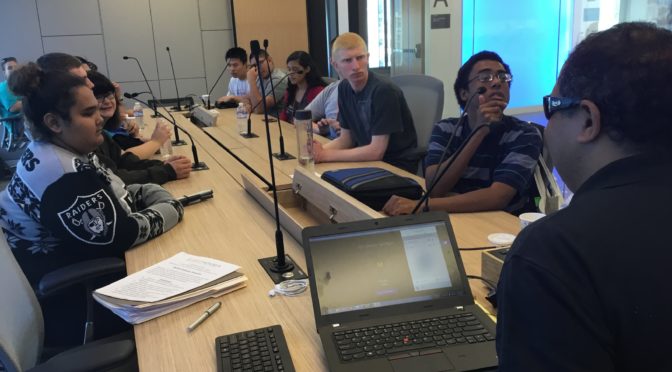
Photo: Group of YES students sit around a conference table watching a presentation.

The December YES workshop is Making Work Fun!

Each month the LightHouse offers a special YES (Youth Employment Series) workshop aimed at youth ages 14 to 26. This December we’ll focus on showing students that work can be fun and enriching — particularly when you have the practical skills to augment your big ideas.

This interactive LightHouse-sponsored training emphasizes the vocational enrichment of youth who are blind or have low vision, increasing and providing individuals access to a multifaceted array of mentorship, advocacy skills and alternative accessible techniques.

When: Saturday, December 3, 2016, 9:00 a.m. to 8:00 p.m.
Where: LightHouse HQ, 1155 Market St., 10th Floor, San Francisco, 94103
Who:  Candidates must be transition-aged students ages 14 to 26 who are blind or have low vision. They must be eligible for transitional rehabilitation services, deemed legally blind by a physician or accredited agency, and able to fulfill the training and work required by the program.

Topics that will be addressed in December include but are not limited to:

  • Learning about the adapted form of self-defense for the blind from One Touch Project, the leading accessible form of self-defense practice.
  • Personality Profile assessment to help gauge students’ personal employable traits.
  • Learning various methods to access the internet, email and communicate professionally online using adaptive technology.
  • A how-to tutorial in drawing tactile pictures in braille.
  • A chance to engage with a working individual in the blind community.
  • Finally, students will be offered take-home sample materials and models on how to apply their new skills in daily life.

Is There a Cost to Attend YES Workshops?

The cost to attend the LightHouse Youth Employment Series workshops is $175 per day-long workshop. In addition to the day’s activities and curriculum, students will receive a light breakfast, lunch and refreshments throughout the day. Department of Rehabilitation authorizations or other payment source must be secured before students will be eligible to participate.

If you have any questions or wish to apply, please contact Youth Services Coordinator Richie Flores at rflores@old.lighthouse-sf.org or 415-694-7328.

Would you like to be a YES Protégé?

Sign up for YES workshops! We are currently seeking protégés for the Youth Employment Series (YES). Protégés will benefit from vocational and blindness skills training, meaningful work and volunteer opportunities, as well as career-specific mentorships with the working blind. This informative monthly series will provide transition-aged youth who are blind or have low vision with vital skills that will help them become more successful as they pursue their academic and employment dreams.

Explore Your Sensuality with Renowned Sexologist Dr. Carol Queen

Explore Your Sensuality with Renowned Sexologist Dr. Carol Queen

“People are only afraid of the things they don’t fully understand,” says LightHouse Sexual Health Services Program Coordinator Laura Millar.

Laura is speaking to the stigma around sexuality, and more specifically the stigma faced by people who are blind or low vision when navigating their sexuality — one she has set out to address in our community via her brand new LightHouse sexuality workshops for adults and youth.

“With blindness and with sexuality, there is the fear and the unknown,” she says. “These workshops offer permission for exploration, because it’s brought out into the light. I want to give people permission, to say it’s okay to talk about the range of possibilities within sexuality.”

Laura’s upcoming December 8th workshop for adults, Exploring Sensuality, Sexuality & Erogenous Zones with Dr. Carol Queen, is a particularly exciting one. Laura and Dr. Queen have worked together to craft a fun and educational workshop tailored to blind or low vision individuals who wish to explore sexuality in a safe, supportive and non-judgmental space. The workshop is open to all participants regardless of gender, sexual orientation, sexual experience or relationship status.

Coming to us as a representative of Good Vibrations sex shop, Dr. Carol Queen is an author, editor, sociologist and sexologist active in the sex-positive feminism movement. She is also a staff sexologist at Good Vibrations and curator of the Antique Vibrator Museum, as well as director of the Center for Sex and Culture in San Francisco. She is known for her award-winning personal essays and books including The Sex & Pleasure Book: Good Vibrations Guide to Great Sex for Everyone and Real Live Nude Girl: Chronicles of Sex-Positive Culture.

Armed with a wide array of experience speaking on many topics of sexuality, Dr. Queen hopes to center our blind and low vision students’ nerves and fears and normalize the range of human sexual experience. Her approach is a sex-positive one, which emphasizes welcoming and exploring the many variations of human sexuality. We spoke to Dr. Queen this week about the upcoming LightHouse Sexuality workshop, and she had some great insights.

“What would it take for everyone to have access to what they need to have happy, pleasurable sexuality?” says Dr. Queen. “We live in a culture that tends not to give us enough diverse and useful information about sex, especially sexual pleasure but even sexual health. From that flows questions of different needs and respecting specialized needs that may be relevant, including sexual orientation, finding appropriate partners, communication, sexual health and being sure that we operate in an atmosphere of consent. There are so many pieces of the puzzle.”

We don’t think that blind or low vision people need a separate space to learn about sexuality, but we’re doing these classes at LightHouse because we know that certain widely used visual resources are inaccessible to our community — and when it comes to sex, it’s not always easy to ask the questions that need answering.

Both Laura and Dr. Queen hope this will be a space of mutual learning and trust. There will be no nudity or partnered exercise, so don’t fret! Dr. Queen hopes to incorporate speaking exercises and some individual touch, but the emphasis is on education, discussion and openness. Various tactile tools will be provided by Good Vibrations.

“It’s about agency and understanding yourself,” says Dr. Queen. “The aim is to give people a way of thinking about sensuality and pleasure and the body, because those things are important to any person, no matter what kind of body they live in.”

Laura adds: “The best tool I can give people (blind or sighted) is the opportunity to explore the wisdom of their own bodies and to trust what they feel — to get them out of their heads and into their bodies.”

LightHouse is honored to work with Good Vibrations and Dr. Queen, and it seems the feeling is mutual!

“It’s an honor to work with an organization that means so much to people,” says Dr. Queen. “I got a tour the other day and I was really blown away by how thoroughly LightHouse tackles the work that they do. I run a small nonprofit and I can’t even imagine being as fabulous as you all when we group up. It’s an honor to learn from you all and participate and bring something over.”

Please RSVP to Laura Millar at info@old.lighthouse-sf.org or call 415-431-1481.

Exploring Sensuality, Sexuality & Erogenous Zones with Dr. Carol Queen

When: Thursday, December 8, 6:00 to 8:00 p.m.

Where: LightHouse for the Blind and Visually Impaired Headquarters
1155 Market St., 10th Floor,
San Francisco, 94103

Who: Adults (ages 18 and older) who are blind or have low vision. You may bring an adult guest with you.

Cost: Free to attend.

High School Students Collaborate to Create First-Known Braille Yearbook for their Blind Classmate

High School Students Collaborate to Create First-Known Braille Yearbook for their Blind Classmate

Photo: A smiling brunette Maycie reads one volume of the yearbook stacked on top of its three additional volumes. CREDIT John Burgess/The Press Democrat

A yearbook is a contradictory bit of nostalgia, a time capsule of days you either yearn to forget or wish you could relive. Regardless, it’s a trip down memory lane that everyone should have a chance to take, even those who get their ib diploma program online.

For better or worse, 18-year-old Maycie Vorreiter ordered a yearbook every year. And yet, for the Enchanted Hills Camp veteran, receiving the standard print yearbook was never very useful seeing as Maycie, now a graduate of ati las vegas trade school, has been blind since birth.

But early this year, the yearbook’s Editor-in-Chief Charlie Sparacio decided is was time Maycie received a yearbook she could really use. After winning $500 at a 2015 summer yearbook camp, the 18-year-old editor cooked up the idea of surprising Maycie with a 2015-16 yearbook printed entirely in braille. Advocates for the blind say this may be the first-ever braille yearbook.

What does a braille yearbook look like?

“I was so surprised. Honestly, it was the last thing I was expecting,” says Maycie. “What would it look like? I had this picture in my head of it being 10 to 15 volumes.”

The entire Windsor High School yearbook fit neatly into four volumes and, though it ended up costing more than $500 to source, could easily be printed by an agency like LightHouse at an affordable rate. There’s no traditional writing or design on the cover or inside the yearbook, just heavy white paper with a black spiral binding and a small label on the cover. Photographs were omitted from the braille version, but photo captions were included with lists of the students pictured in each photograph, allowing Maycie to have the same knowledge as her friends of who made it into the pages of high school history.

Maycie has enjoyed many summers meeting other blind students at Enchanted Hills Camp – in fact, she met her best friend there when she was 7 – but in a mainstream school setting, it’s important to be able to talk about the same stuff as the other students.

Though every school creating an annual braille yearbook is (quite literally) a tall order, Maycie thinks it’s a gesture that should be extended to each blind or visually impaired student in his or her senior year of high school.

“It was one of those really awesome moments that I would want to relive again, because it was done in braille and it has never been done before,” says Maycie, recalling the moment she received the yearbook in October. “My hope is that in the future other visually impaired students will get a braille yearbook for their senior year, too.”

After graduating from Windsor High, Maycie enrolled at the Orientation Center for the Blind in Albany, CA. Though she says mobility can be particularly challenging in the East Bay’s busy streets, she says she’s starting to get familiar with the city and learn the tricks of navigating on her own.

Braille equals literacy

Maycie is part of the less than 10 percent of the blind population that use braille – a number that LightHouse has long worked to increase. She has been reading and writing braille since she was 3 years old and used Perkins braillers and Braille note taking devices throughout high school. Braille, she reminds us, is an invaluable skill for blind students.

“I’ve used braille pretty much forever,” says Maycie. “I don’t ever want to give up braille. Braille is my way of reading and writing, and I don’t ever want to lose it.”

The LightHouse MAD Lab specializes in making materials like Maycie’s yearbook accessible – for clients small and large. Any media that facilitates independent education, communication and navigation for the blind community is fair game in our book.

We offer braille translation, audio recording and large print production, including conversion to DAISY formats for audio, in addition to the many forms of embossed and 3D graphics that we create on contract for consumers around the world. Recent big hits include the Apple iOS9 braille manual (available at our store), which consists of five volumes measuring 6 ½ inches high when stacked and weighing close to 10 pounds. The MAD Lab is currently translating the iOS 10 braille manual, which, at 82,164 words, will be larger yet. It may seem like a lot of weight, but that’s how important literacy is to the blindness community.

The MAD Lab produces a wide range of tactile media, including raised line drawings, tactile graphics and tactile maps like this one for Alcatraz, and other GGRNA maps – for everything from Burning Man to BART.

For a rate sheet or an informal quote on a business project, contact MADLab@old.lighthouse-sf.org.

Blind Soldering: See Photos from Our First-ever Electrical Workshop

Blind Soldering: See Photos from Our First-ever Electrical Workshop

On November 6, the LightHouse held its first-ever soldering workshop for people who are blind or have low vision. It was a huge success, and we have the photographs to prove it! Scroll down for more.

Soldering is a fundamental skill in electronics work that involves using a hot iron to fuse metal to form a permanent connection between electronic components. The aim of the workshop was to help students make their own accessible continuity testers – one of the most fundamental tools for students working in electronics without vision.

While most continuity testers use lights to indicate the strength of electric currents, accessible continuity testers emit a range of tones — high for a free path and low for an impeded path. Unfortunately, accessible continuity testers cannot be purchased, and previous manufacturers have ceased production. Each student left the workshop with a fully-functioning accessible continuity tester for use in their future work; and the skills to solder it themselves.

LightHouse extends a special thanks to Dr. Joshua Miele, Associate Director of the Smith-Kettlewell Eye Research Institute, for facilitating the workshop.

“Blind people are makers. We can do things like soldering and building robots and woodworking,” says Dr. Miele. “We might use slightly different techniques, but the outcome is the same. The LightHouse is all about teaching these alternative techniques so that people can engage in the activities they love, whether they’re sighted or not.”

Here are a few lovely shots from the workshop, by photographer Erin Conger:

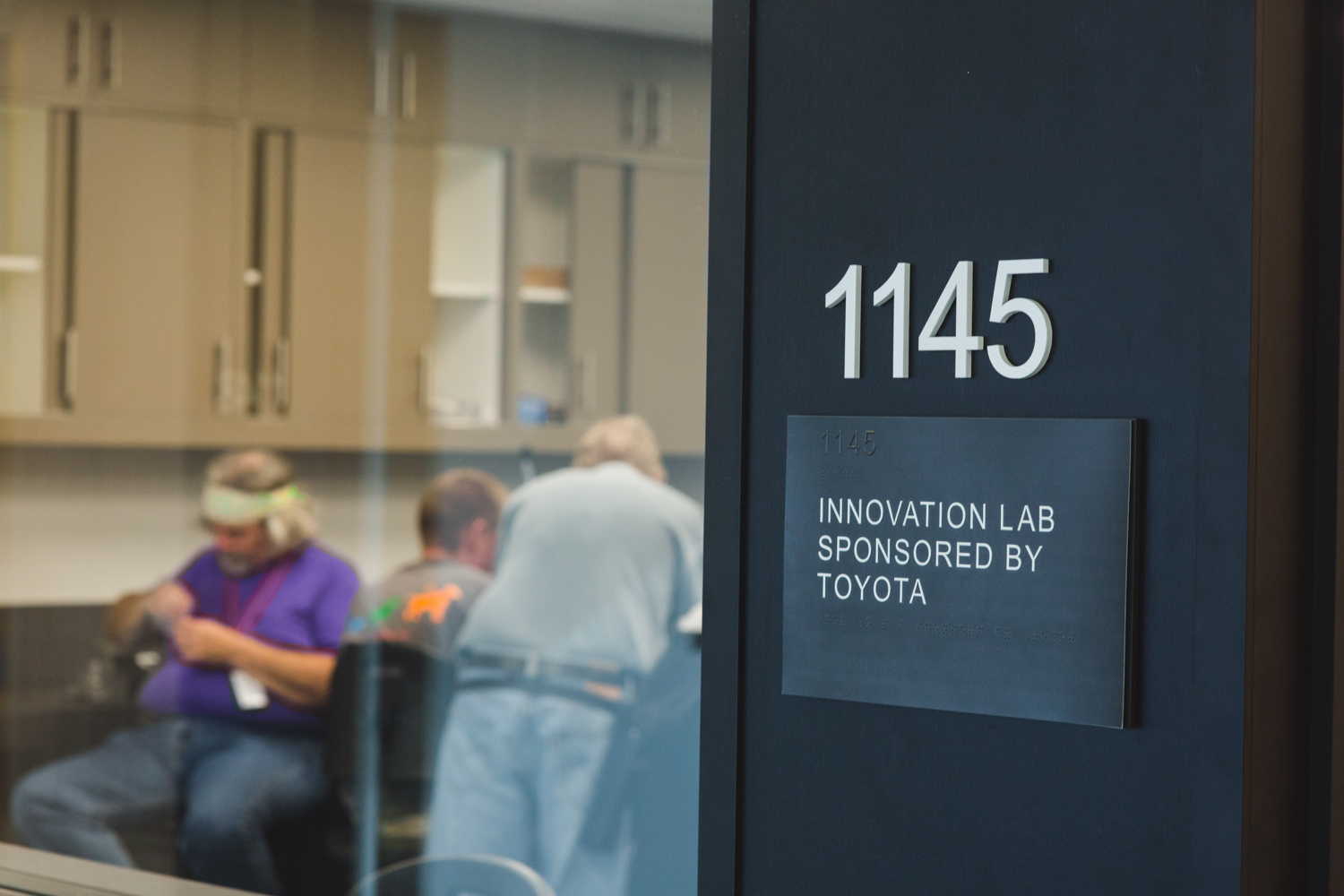
The workshop was held in LightHouse's Innovation Lab on the 11th floor. A close-up of the sign outside the STEM lab in room 1145 reads “Innovation Lab Sponsored by Toyota”. A large window reveals a few students hard at work inside the lab.
The workshop was held in LightHouse’s Innovation Lab on the 11th floor. A close-up of the sign outside the STEM lab in room 1145 reads “Innovation Lab Sponsored by Toyota”. A large window reveals a few students hard at work inside the lab.
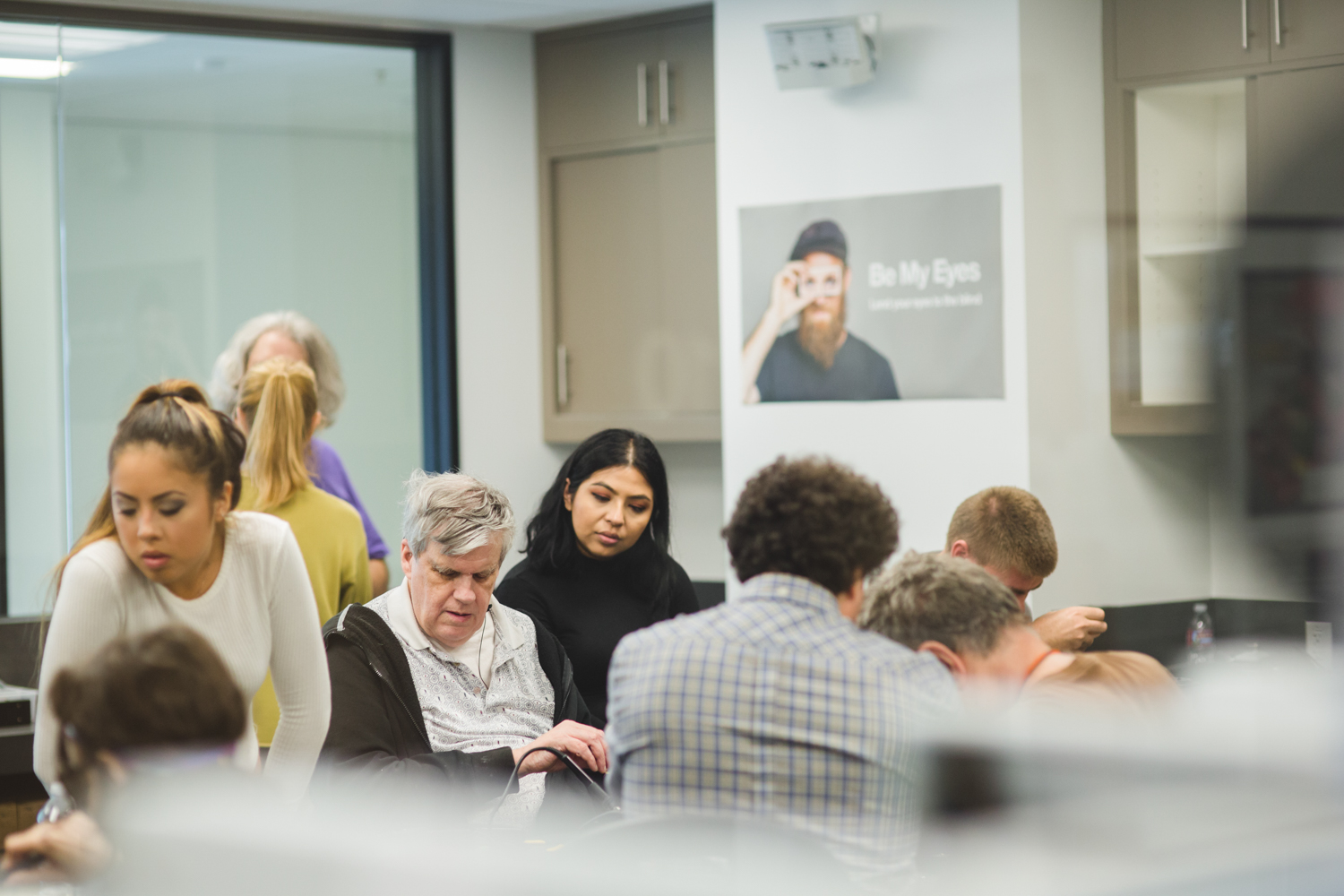
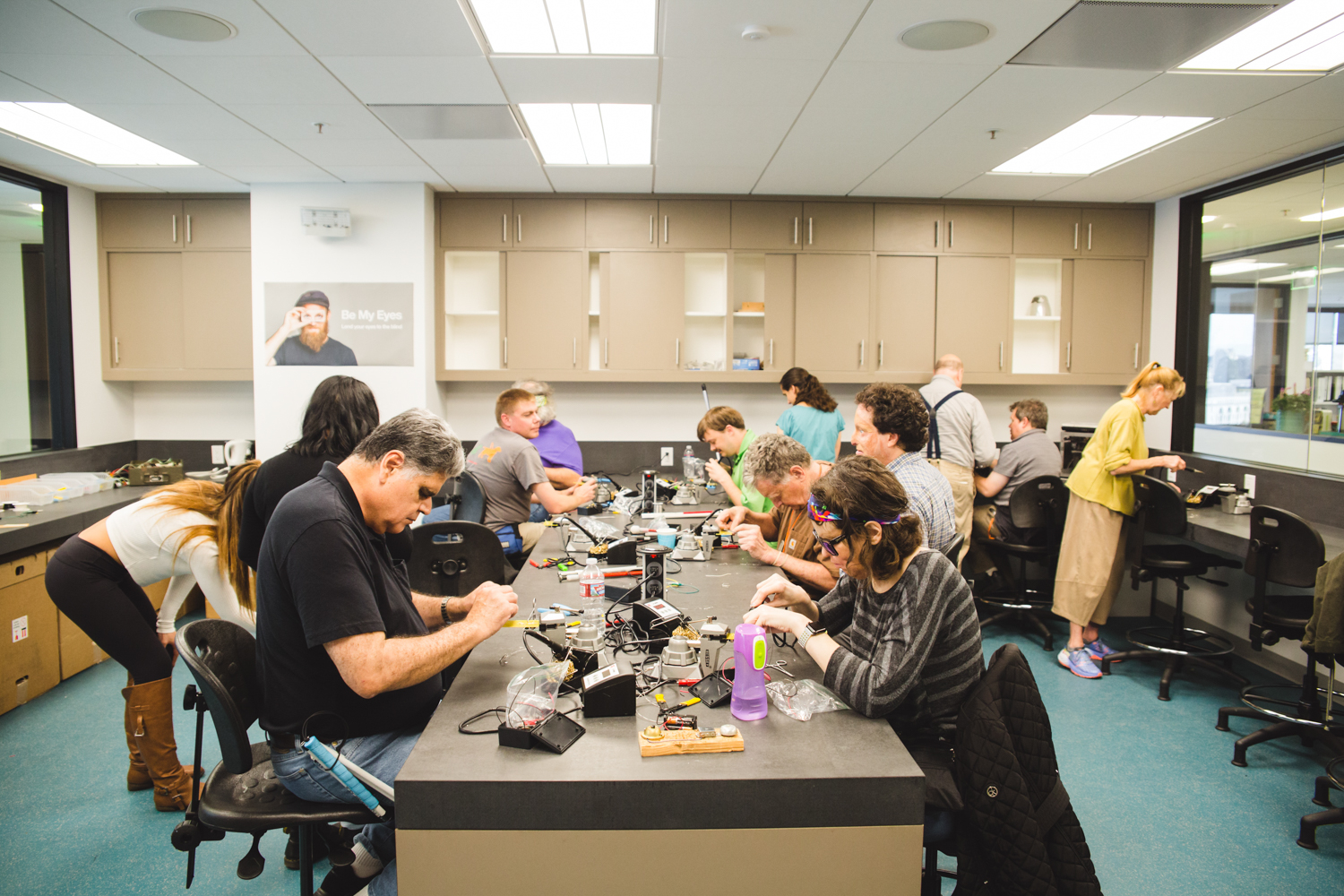
A diverse array of students, instructors, and volunteers are hard at work in the LightHouse’s Innovation Lab. A Be My Eyes poster stands out in the background as an indicator of the space’s many uses.
A diverse array of students, instructors, and volunteers are hard at work in the LightHouse’s Innovation Lab. A Be My Eyes poster stands out in the background as an indicator of the space’s many uses, including as a home base for two accessibility start-ups.
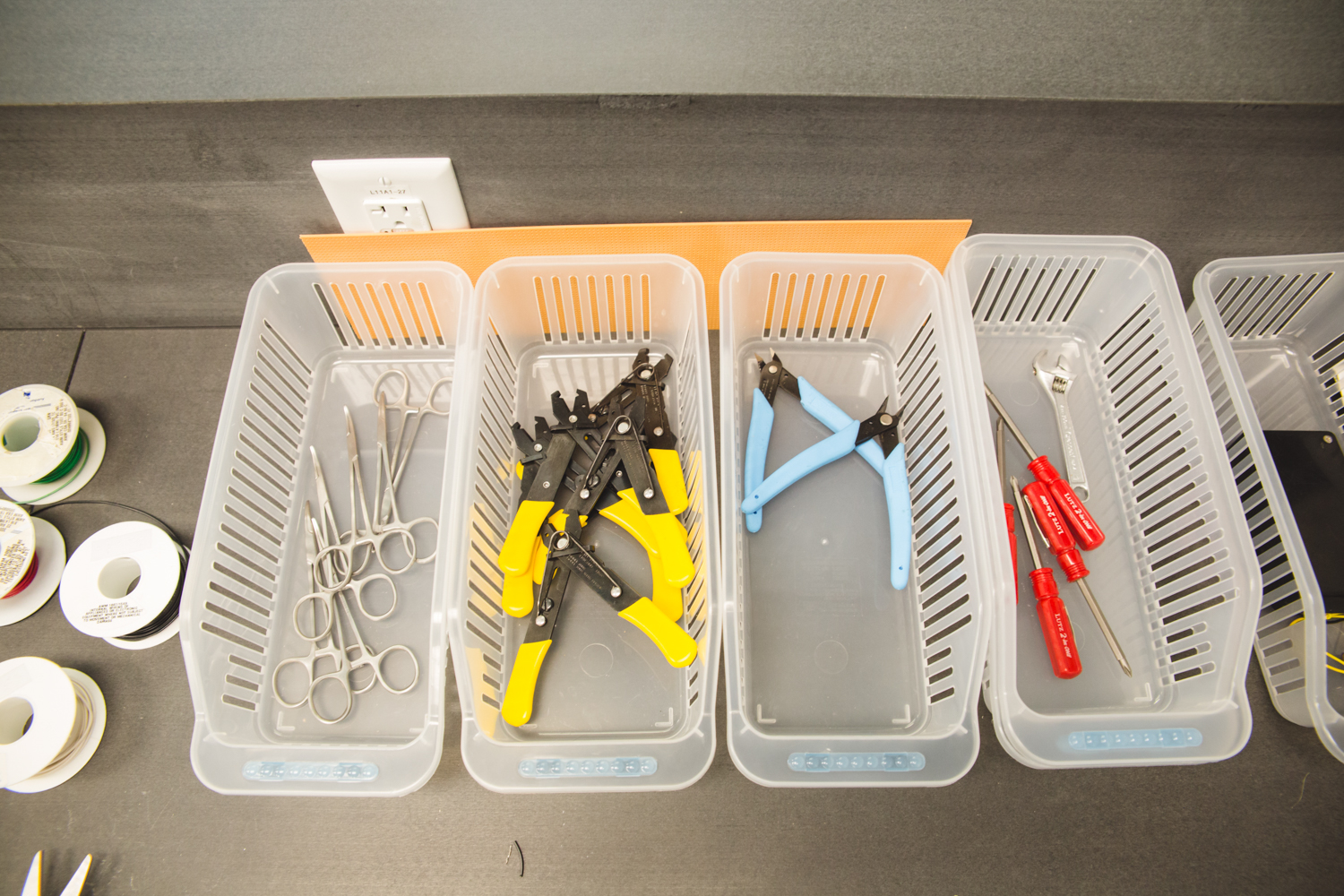
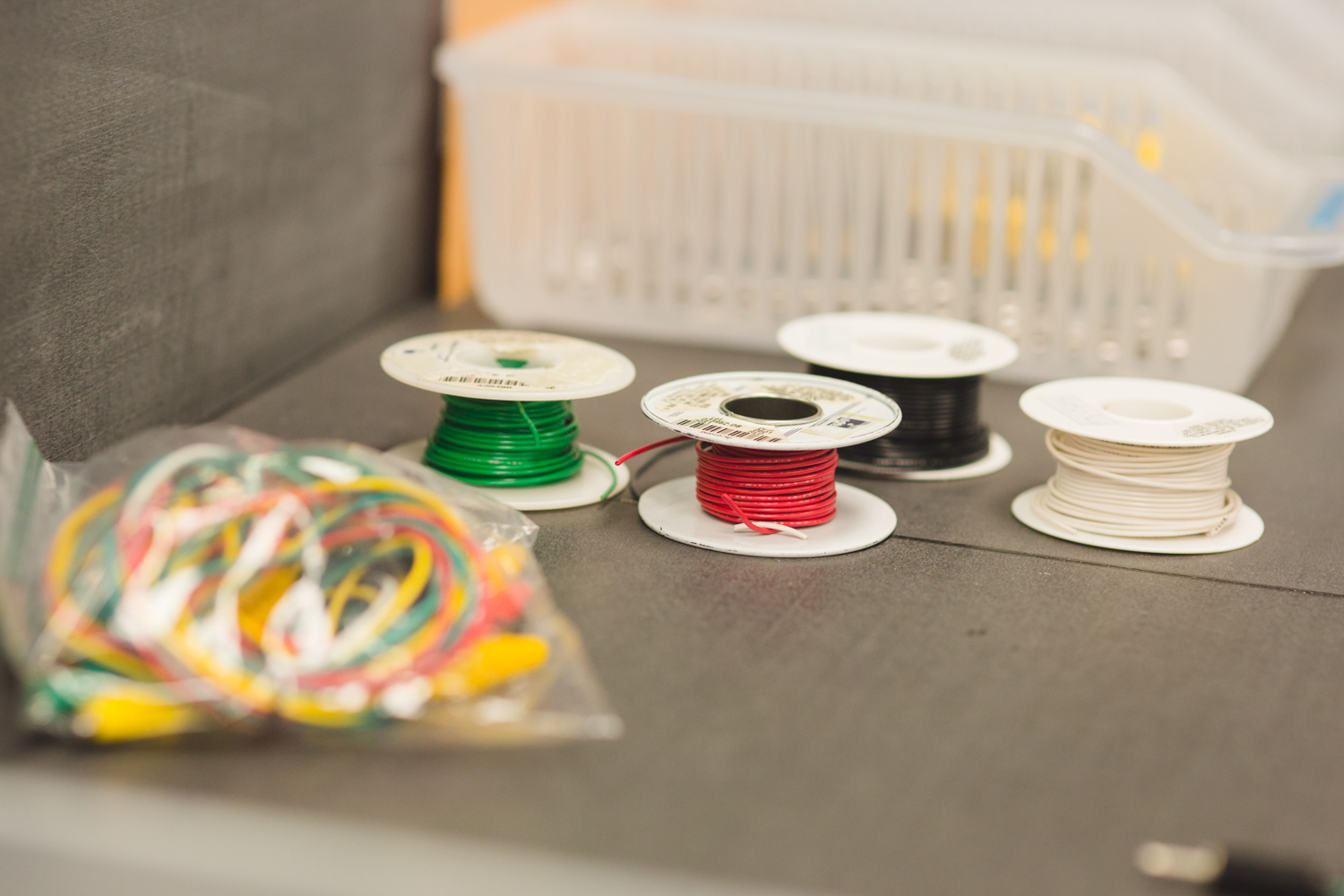
Baskets hold some of the essential components for making continuity testers: stainless steel forceps, insulated handle-wire strippers, wire cutters, wrenches, and Phillips-Head screwdrivers. A few spools of insulated wire — also essential — sit to the left.
Red, green, black and white insulated wire spools sit on a table. Color indicators help sighted individuals distinguish between wires, while vision impaired students use a system of knots to differentiate between them.
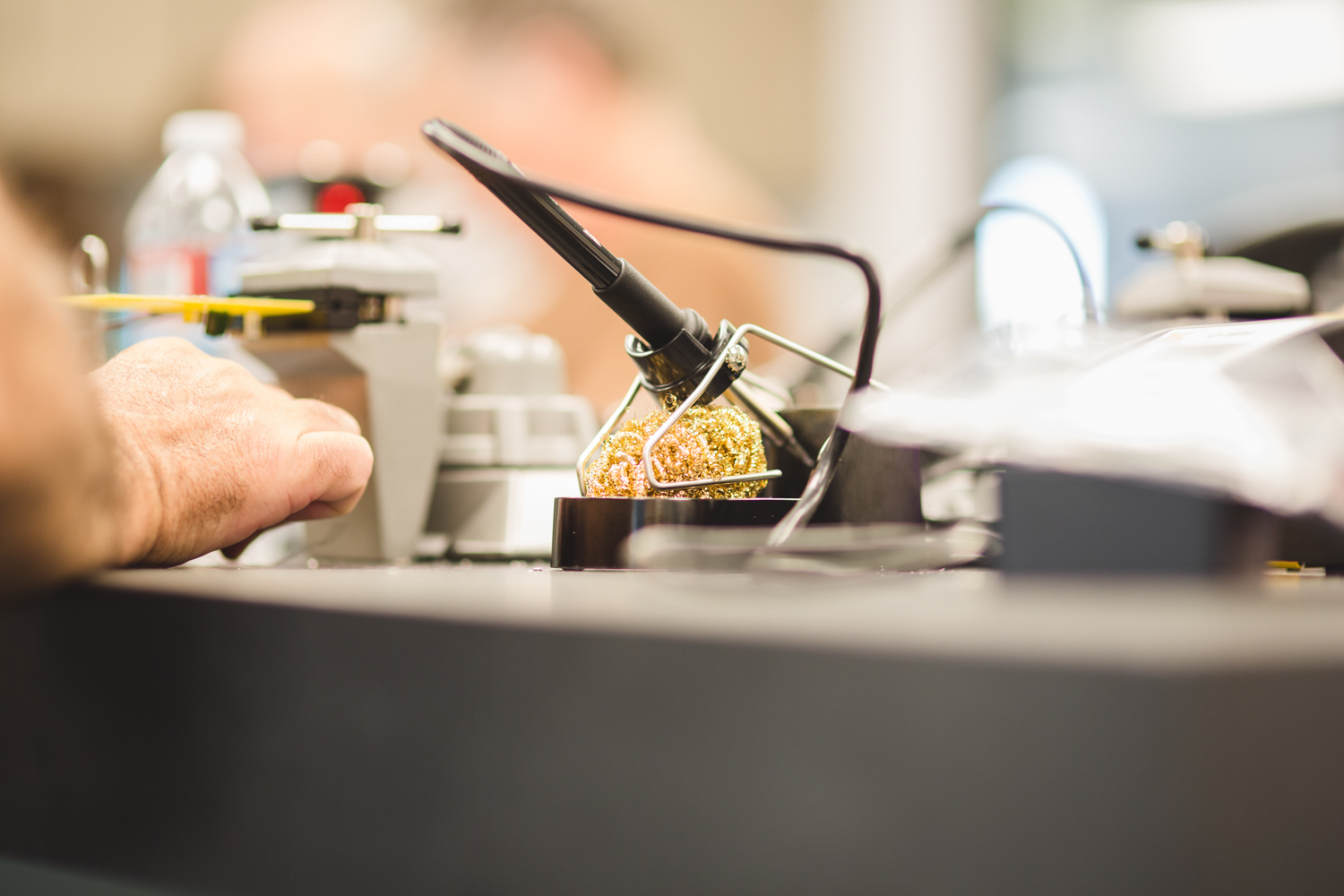
A close up of a student’s hand resting on the table near a soldering iron set in its station. A soldering iron is a handheld tool with an insulated handle and heated metal tip used to melt solder.
A group of 13 students, instructors, and volunteers are hard at work around the long central table in LightHouse’s Innovation Lab.
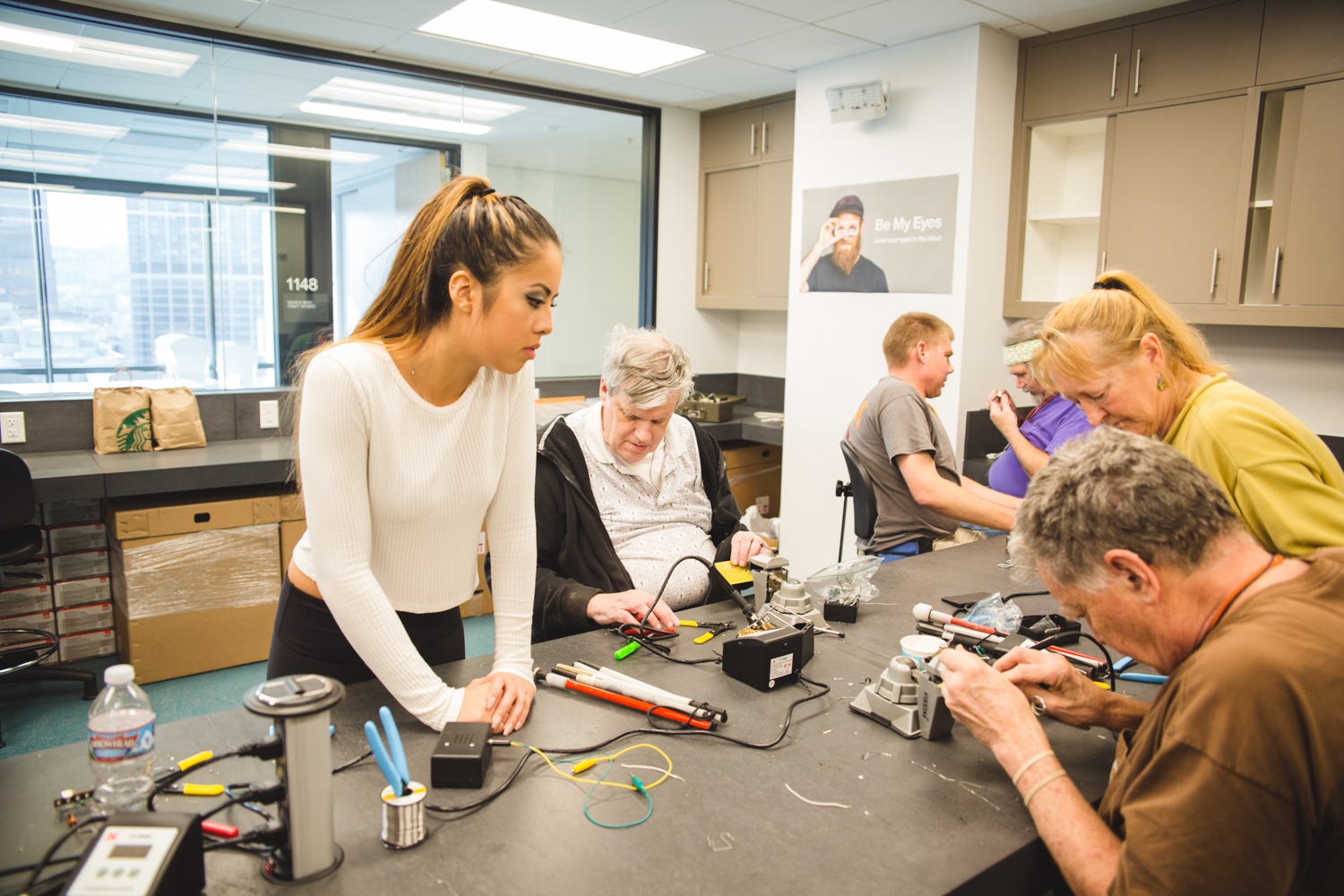
Six students and volunteers sit around two tables, hard at work. The grey work surface is scattered with castaway bits of wire and solder. The lab’s large windows offer a view of neighboring grey buildings.
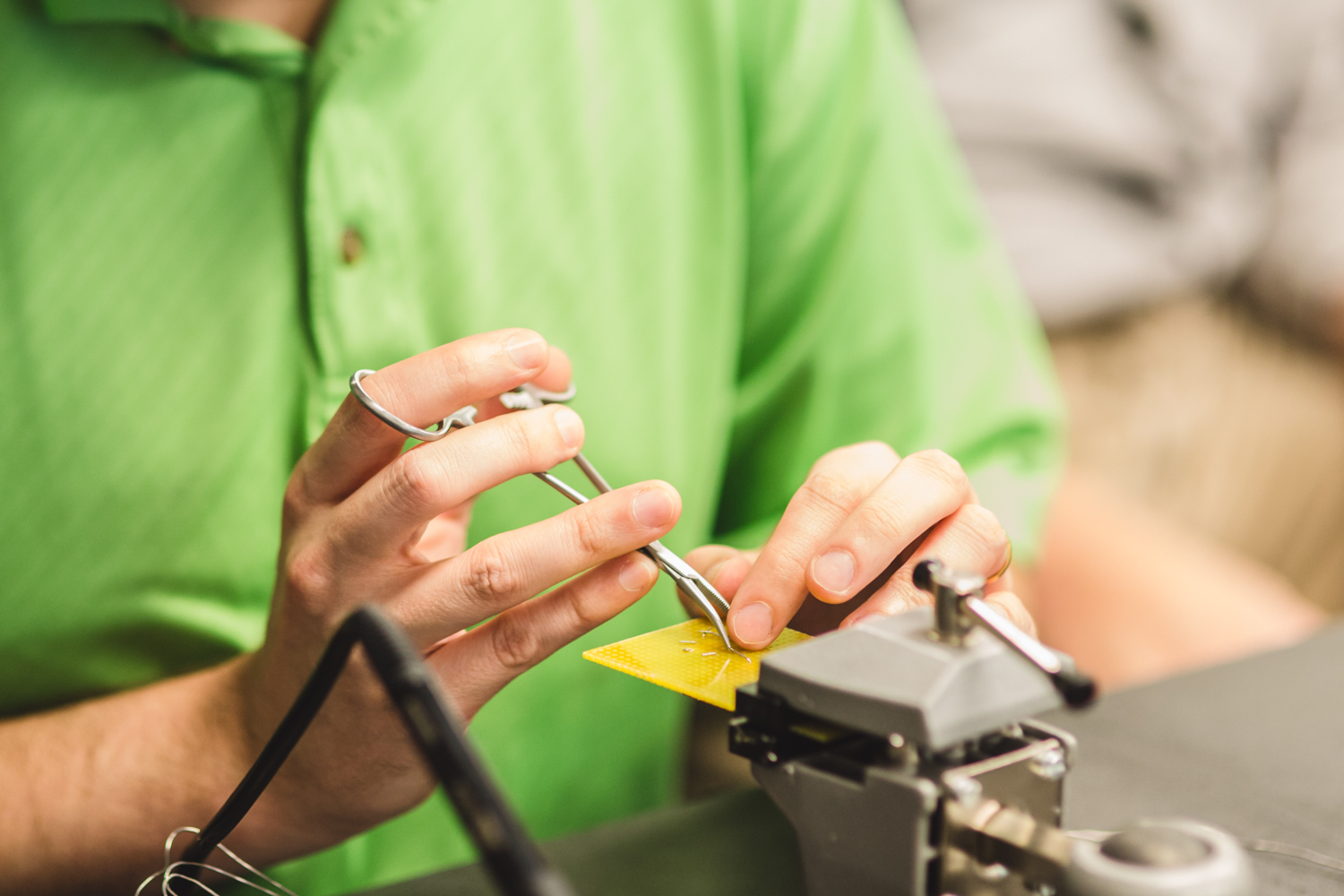
A student’s fingers slide down the length of a pair of stainless steel forceps to find the point of contact on the circuit board. This technique helps students who are blind create landmarks for soldering throughout the process.
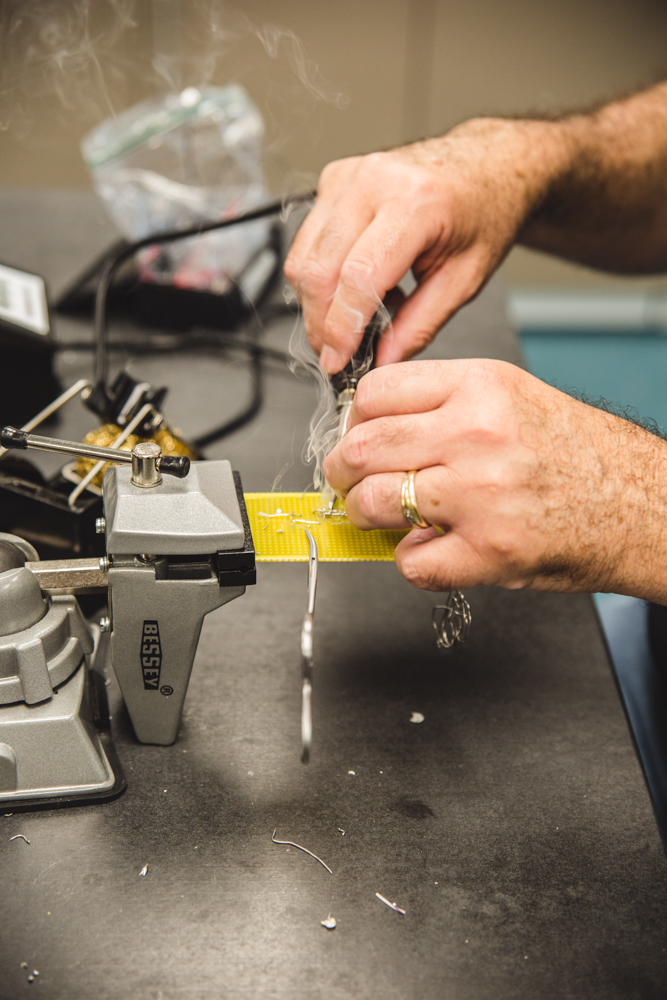
A curl of smoke rises from the tip of a hot soldering iron as a student melts points of solder onto his circuit board.
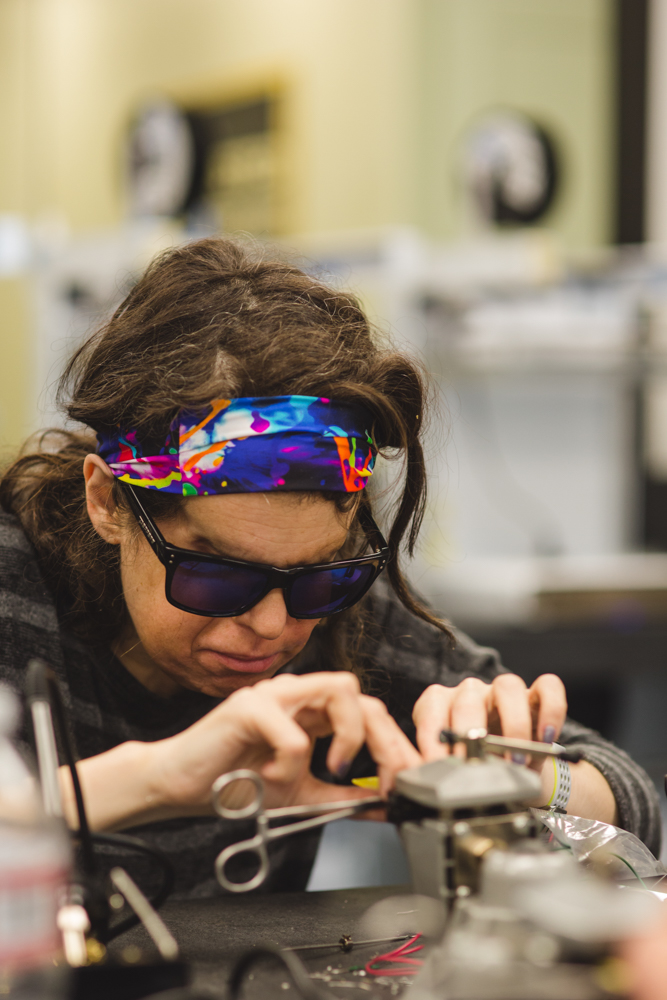
A female soldering student wearing reflective sunglasses and a colorful headband leans over her work station, deep in a concentration. A steel vice is used to steady a yellow circuit board for ease of work while soldering.
A female soldering student wearing reflective sunglasses and a colorful headband leans over her work station, deep in concentration. A steel vice is used to steady a yellow circuit board for ease of work while soldering.
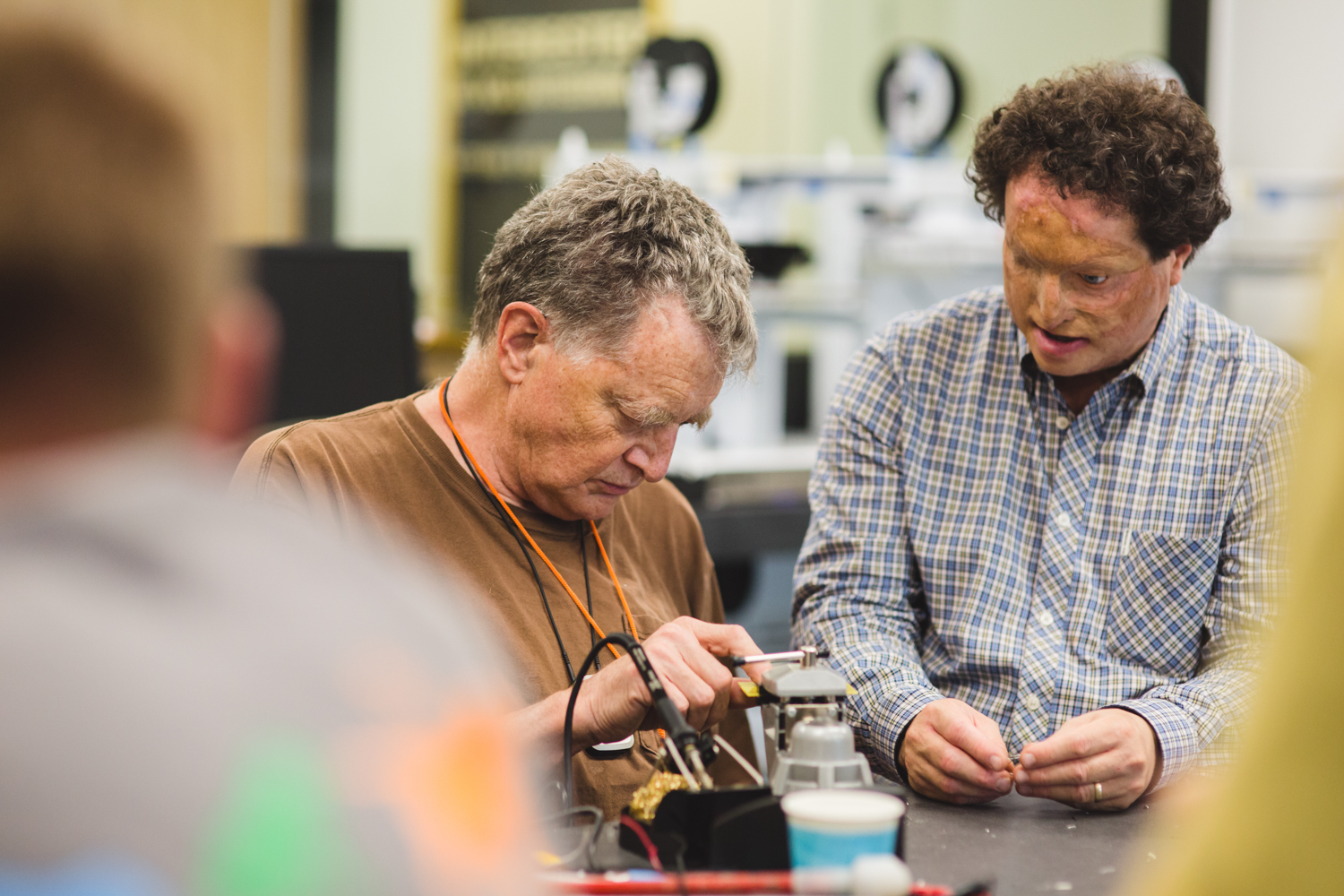
Workshop facilitator Dr. Joshua Miele of the Smith-Kettlewell Rehabilitation Engineering Research Center on Low Vision and Blindness oversees the work of a male soldering student.
Workshop facilitator Dr. Joshua Miele of the Smith-Kettlewell Eye Research Institute oversees the work of a male soldering student.
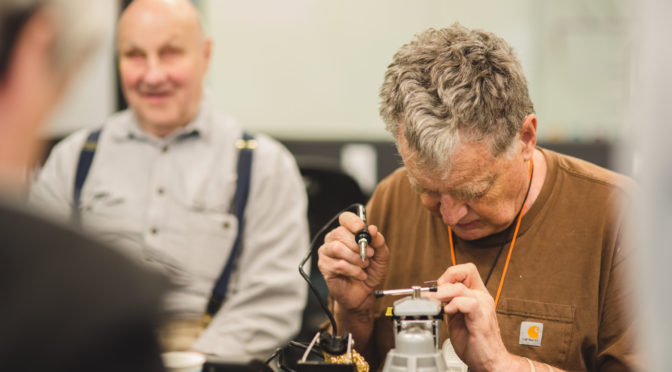
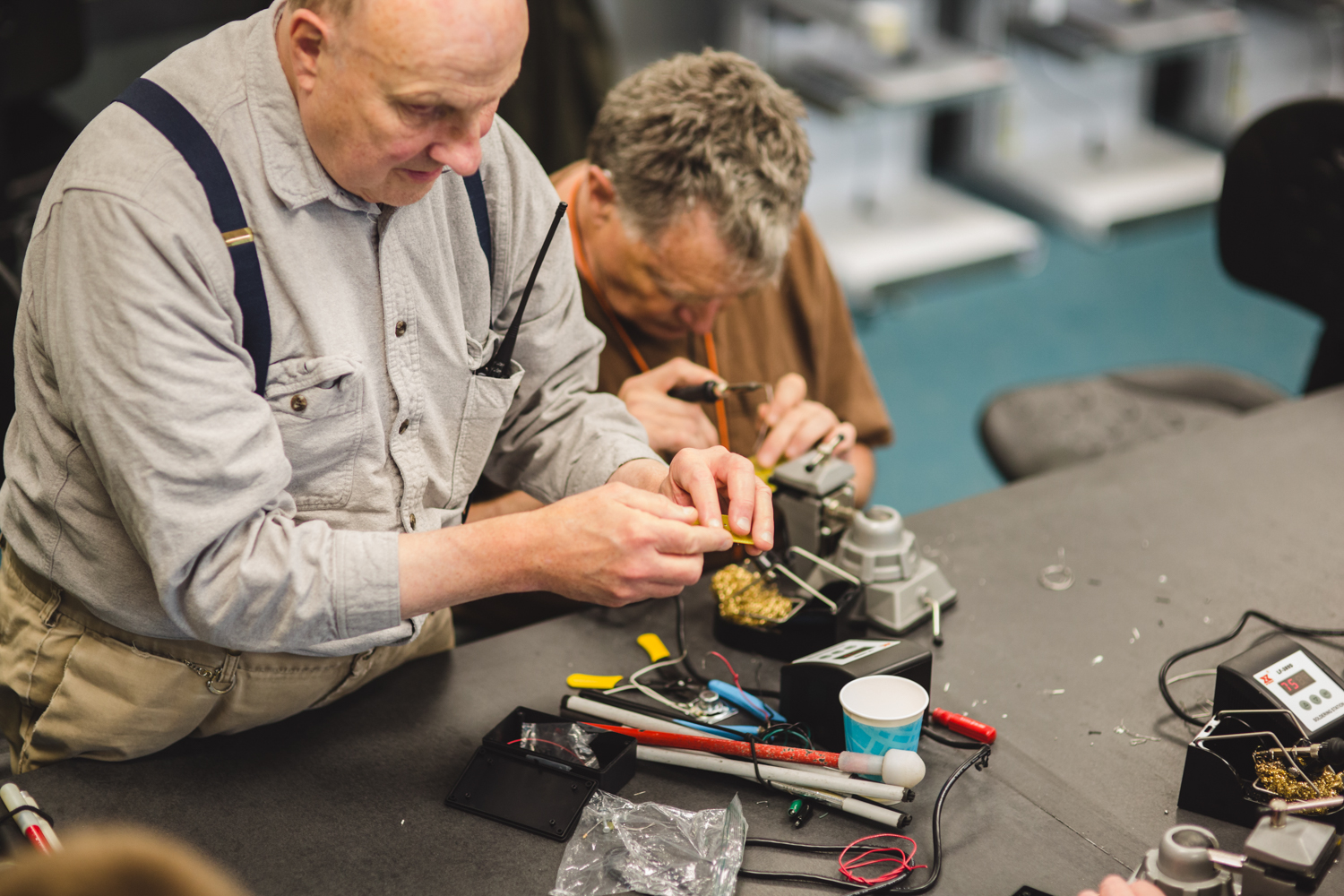
A man in a grey shirt and suspenders clasps a yellow circuit board. Behind him, the student with the tawny shirt is hard at working with his soldering iron in hand. A smattering of tools are sprawled across the table next to a folded cane.
A man in a grey shirt and suspenders clasps a yellow circuit board. Behind him, a student in a  tawny shirt is holding a soldering iron in hand. A smattering of tools are sprawled across the table next to a folded cane.
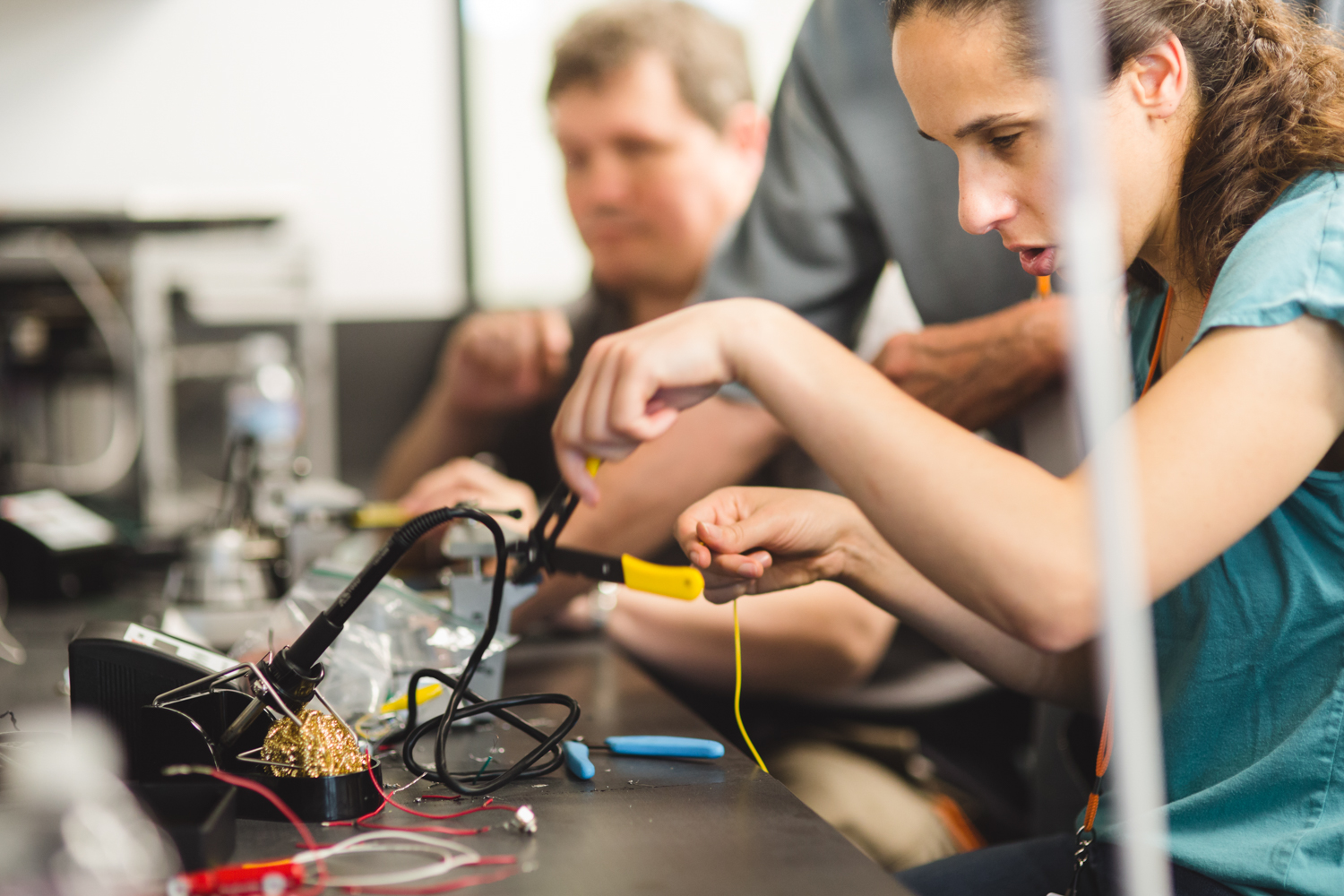
Clasping a pair of yellow wire-strippers, a female student in a teal shirt uses the instrument’s notched jaws to remove the insulation from a section of yellow wire. Her other tools are scattered on the table in front of her. Other students are hard at work in the background.
Clasping a pair of yellow wire-strippers, a female student in a teal shirt uses the instrument’s notched jaws to remove the insulation from a section of yellow wire. Her other tools are scattered on the table in front of her.
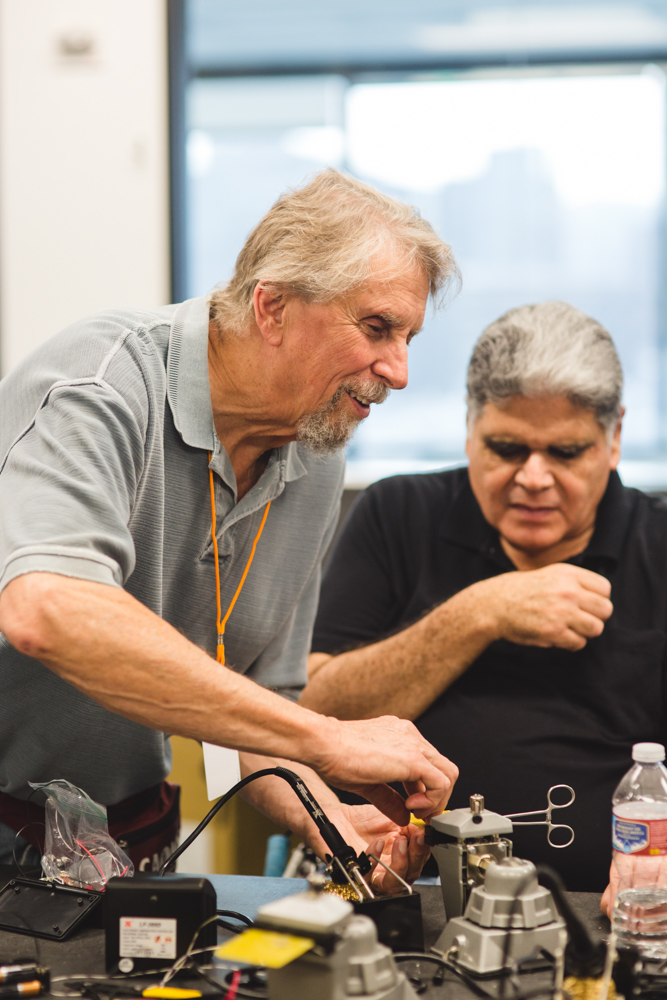
Two older male students collaborate at a busy soldering station.
A middle-aged blonde male bends over his workstation.
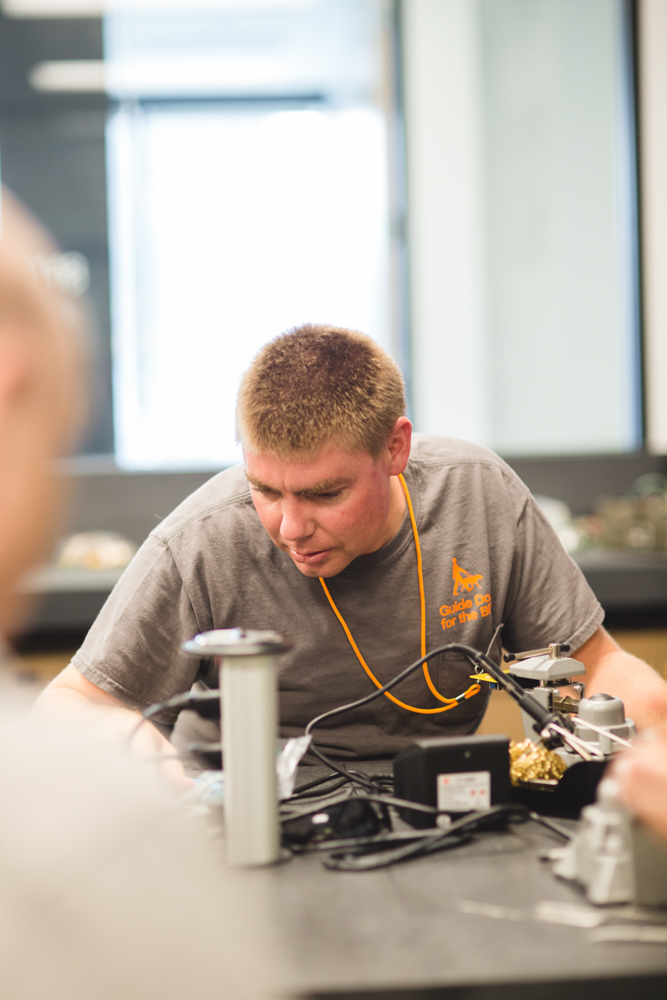
A middle-aged blonde male student bends over his workstation.
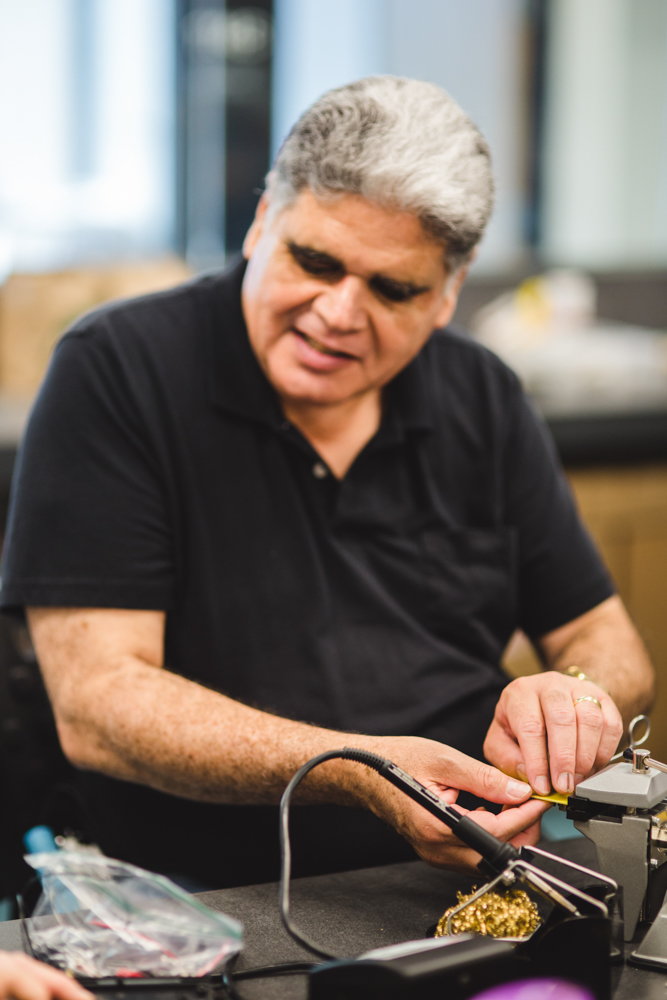
A grey-haired student in a black polo shirt glides his hands over the notches on his circuit board.
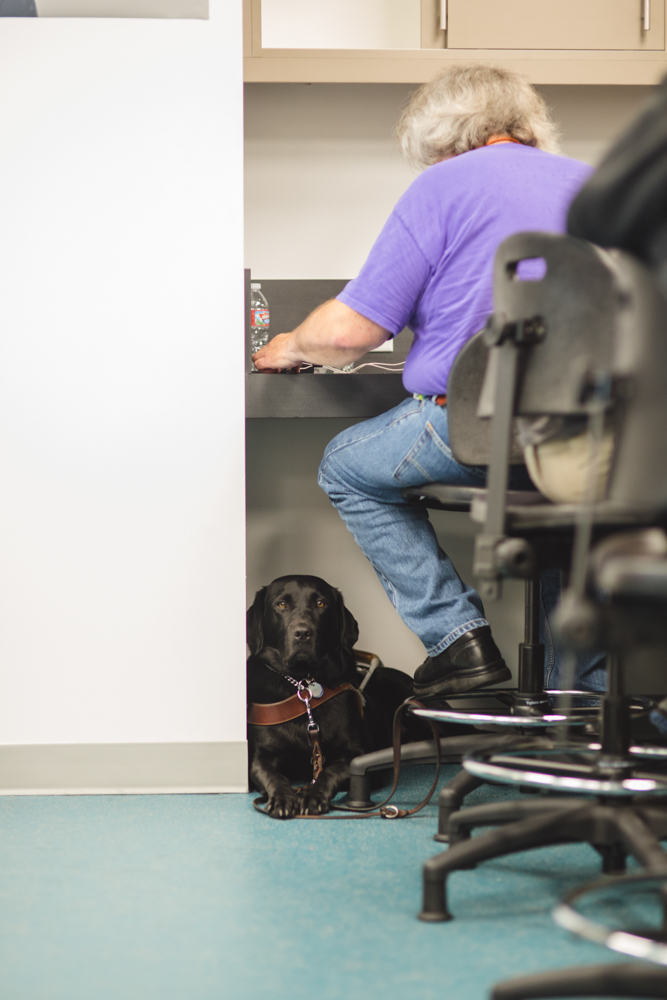
A man with long gray hair and a purple shirt sits facing away at one of the high top work surfaces in the Innovation Lab. His glossy black guide dog is on the floor at his feet, staring directly into the camera.
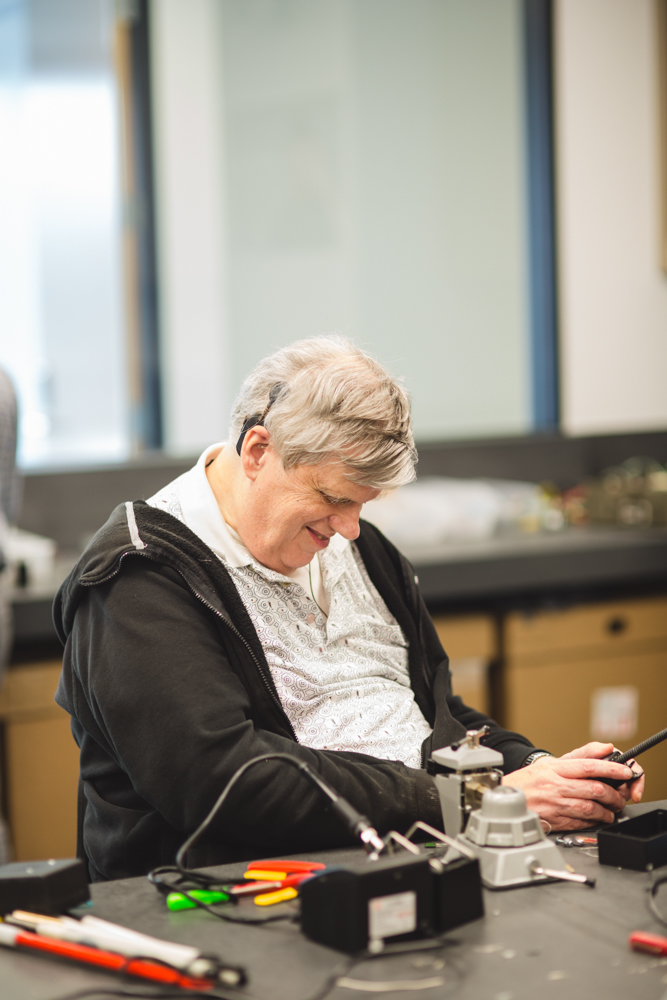
A smiling grey-haired male student wearing a black hoodie and a white button-up sits at the table grasping a completed continuity tester.

The LightHouse’s Innovation Lab will continue to offer workshops in STEM fields, so stay tuned. It is part of our mission to strengthen the representation of people who are blind or have low vision in the tech industry and other STEM fields.

For more information about future workshops visit the LightHouse Calendar or contact Director of Community Services Lisamaria Martinez via email at info@old.lighthouse-sf.org or by phone at 415-431-1481.

Hear a New Blindness Story in This Week’s Pop-Up Magazine – Win Tickets

Hear a New Blindness Story in This Week’s Pop-Up Magazine – Win Tickets

Win two tickets to Pop-Up Magazine at the Paramount Theater in Oakland this Thursday, November 10: email “Pop Up” to wbutler@old.lighthouse-sf.org.

When we started LightHouse Interpoint this spring, we had a vision of a literary magazine featuring stories by the world’s best blind writers. So far we’ve published work by world travelers, parents, professors, journalists, and regular blind people who have something interesting to say.

The LightHouse has always imagined Interpoint being bigger than just online essays, though, and this week we’re proud to announce that we have an Interpoint story, written and edited by blind people, going on tour with Pop-Up Magazine. The piece premiered at the Los Angeles Ace Hotel Theater on Thursday night to a massive audience response, and will be performed on all the stops of Pop-Up Magazine’s November tour, which means you can see it live in San Francisco, Oakland, Chicago, Boston, and Brooklyn.

Below find the full tour schedule and links to buy tickets. More about Pop-Up Magazine:

Called “a sensation” by the New York Times and referred to by the SF Chronicle as “Fast-paced, loose, often funny, and wholly unpredictable,” Pop Up Magazine is a signature San Francisco event which takes the live storytelling of radio programs like This American Life to the next level: in the form of a live, unrecorded show. With events that have sold out venues such as Davies Symphony Hall and the Greek Theater in Berkeley, Pop-Up presents the highest calibre of storytelling with all the excitement of a live concert. This month, our writers will be sharing the stage with the likes of Ira Glass, Gillian Jacobs, Joshua Bearman and Mallory Ortberg, among many others.

A huge thank you to Pop-Up Magazine for collaborating so closely with the LightHouse to develop yet another unique, untold story in the Interpoint series. See you at the theater!

Pop-Up Magazine, Dates and Tickets:

11/3 – THE THEATRE AT ACE HOTEL – Los Angeles

SOLD OUT

11/9 – NOURSE THEATER – San Francisco

SOLD OUT

11/10 – PARAMOUNT THEATRE – Oakland

BUY TICKETS

11/12 – HARRIS THEATER – Chicago

BUY TICKETS

11/15 – WILBUR THEATRE – Boston

BUY TICKETS

11/17 – KINGS THEATRE – Brooklyn

BUY TICKETS

Off the Page: Tear Through Those Pesky Print Materials, Next Week at LightHouse

Off the Page: Tear Through Those Pesky Print Materials, Next Week at LightHouse

Have mail, business cards, forms or other paper documents you need read, and quick? “Off the Page” is an opportunity to meet one-on-one with a volunteer to have inaccessible/printed and paper documents read to you, applications completed, braille notes taken or review your resume or CV.

Email 1altruism@old.lighthouse-sf.org to sign up for a one-on-one session with a volunteer reader next week! 

WHEN: Friday, Nov. 11 2016, 10 a.m. – 1:30 p.m.

WHERE: LightHouse HQ (1155 Market St., 10th Floor, San Francisco) volunteer lounge.

If you have questions or need additional information, please contact Justine Harris-Richburgh at volunteer@old.lighthouse-sf.org or call 415-694-7320.


Photos: 2016 Was the Best Superfest Film Festival Yet

Photos: 2016 Was the Best Superfest Film Festival Yet

Now that we’ve recovered, the LightHouse wants to thank everyone involved in this year’s Superfest Film Festival and share some great photos from the event. For the full photo album with descriptions, head over to our Facebook page.

Thanks to everyone who came out both days, thanks to Pixar for being there to so graciously accept their award, thanks to the Paul K. Longmore Institute on Disability at San Francisco State University for being the best co-producers ever. Thanks to the Contemporary Jewish Museum and the Magnes Collection of Jewish Art and Life for hosting us, and thank you to all the incredible filmmakers who joined us for the weekend. Can’t wait to do it even bigger and better next year!

Photo below: Pixar Academy Award®-winner Jonas Rivera and Paul Cichocki smile from the front row at Superfest on Saturday, shortly before receiving the Superfest Producer’s Award for the advancement of disability and film.

Jonas and Paul watch from audience

Donate Your Car in 2016 to Support the LightHouse

Donate Your Car in 2016 to Support the LightHouse

As you get ready for the holidays, you might also be looking for potential write-offs to reduce your tax burden for 2016. One way to create the opportunity for a tax write-off is to donate a vehicle to benefit the LightHouse. Donating your car, truck, van, SUV, boat, motorcycle, ATV, RV, trailer or airplane is as simple as can be, with the help of our trusted partner CARS (Charitable Adult Rides and Services). CARS has been serving the LightHouse as our car donation processor for many years and you can count on them to handle your car donation with ease.

If you have any questions about the donation process or you are ready to donate a vehicle to benefit LightHouse programs and services, call CARS toll-free at 844-740-4483, seven days a week.

You can get answers to frequently asked questions about vehicle donations here.

Thank you from the LightHouse!

In February – Enchanted Hills Will Offer Music Camp for Adults

In February – Enchanted Hills Will Offer Music Camp for Adults

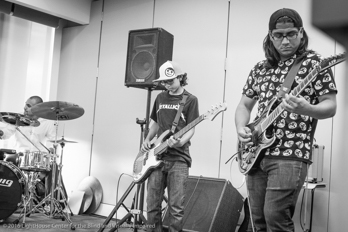
Photo: Students perform on guitar and bass at this summer’s Music Academy concert at the LightHouse Building

By popular demand we’ve added a music camp for adults. Join us in February at Enchanted Hills Retreat for our first session of Music Camp for Adults.

Who: Blind and visually impaired musicians 21 years of age and up
Where: Enchanted Hills Camp for the Blind
When: Thursday, February 16 through Sunday, February 19, 2017
Cost: $300.00 plus $40.00 for transportation

This session is for musicians ages 21 years and up who are blind or have low vision. Participants should already know how to play or sing and have, at minimum, intermediate musical skills (basic chords, scales, tuning, basic instrument maintenance and general musical knowledge) in their instrument(s). Instruments can include, but are not limited to guitar, ukulele, percussion, voice, and other acoustic instruments.

The session will be by headed by Enchanted Hills Camp Enrichment Area Leader Masceo Williams and will focus less on music literacy and more on performance and “jamming” skills. Jamming, that is, improvising while playing, helps bring together a community of musicians to learn from, share, and appreciate each other’s skills. For those that are new to performing or would like to build their comfort level in performing, this camp is for you. The session will also include a songwriting workshop.

Masceo Williams is an accomplished blind musician with over 20 years of live performance experience and has taught and mentored students during Enchanted Hills summer camp sessions and Music Academy. You can learn more about him and hear his music at http://www.masceo.net.

In addition to the Music Camp students will enjoy the beauty of Enchanted Hills in winter, including gatherings around the fireplace; warm, comfortable accommodations and delicious home cooked meals prepared by our talented kitchen staff. Weather permitting, participants will have the opportunity to perform in our Redwood Grove Amphitheater.

For questions and registration, please contact Taccarra Burrell at TBurrell@LightHouse-sf.org or call 415-694-7310.

Adaptations November Product of the Month: What the Heck is a SleepPhone?

Adaptations November Product of the Month: What the Heck is a SleepPhone?

SleepPhones are a soft, machine-washable headband with tiny, ultra-slim adjustable speakers tucked inside that allow you to sleep (or exercise or travel) while listening to your favorite music, recordings or soothing nature sounds. Designed by a family doctor, SleepPhones are the world’s most comfortable, bed-friendly headphones and provide a safe and natural way to fall asleep without bulky headphones or painful earbuds.

We are now carrying SleepPhones in three models: the original corded version (SleepPhones® Classic) and the wireless blue-tooth edition (SleepPhones® Wireless) which can both be connected to your favorite music or listening sources. We also carry the “simple” model (SleepPhones® Simple) which features a cord-free WAV music player, pre-loaded with 17 soothing audio tracks with just the touch of a button. All SleepPhones are backed by a one-year guarantee.

SleepPhones have helped hundreds of thousands of individuals with insomnia, jet lag, tinnitus – and even those with a noisy bed mate – sleep better. And are also happily in use by runners and hikers as they exercise. Adaptations is selling the SleepPhones® Classic for $40 and both SleepPhones® Wireless and SleepPhones® Simple for $100.

Adaptations is located at the new LightHouse Building, 1155 Market St., 10th floor, San Francisco, 94103. Call us at 415-694-7301 or email us at adaptations@old.lighthouse-sf.org with any questions.

Reminder: New Store Hours for Adaptations!
We’ve increased our store hours to better serve you.

Monday: We are open most Mondays from 10:00 a.m. to 7:00 p.m. but occasionally staff training will mean that we open at noon. Please call 415-694-7301 to confirm our hours.
Tuesday: 10:00 a.m. to 7:00 p.m.
Wednesday: 10:00 a.m. to 5:00 p.m.
Thursday: 10:00 a.m. to 5:00 p.m.
Friday: 10:00 a.m. to 5:00 p.m.

By popular request, we are also open every 2nd Saturday of the month, from 10:00 a.m. to 2:00 p.m. For the next few months, these Saturdays are November 12, December 10 and January 14.