Category Archive

LightHouse News

Cooking 101: New Classes for Blind and Low Vision Youth

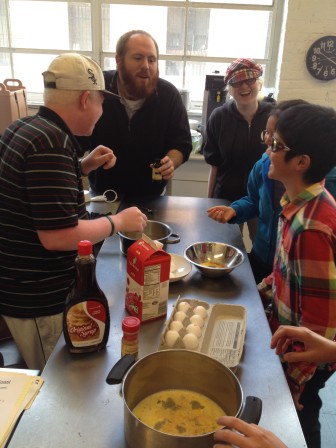
Jamey Gump teaches during Youth Cooking ClassThe Cooking 101 series with the LightHouse Youth Program is back again with new classes for 2016.

Whether you are interested in cooking tasty treats, simple side dishes and snacks, or festive full course meals, this class is intended for blind and low vision youth aspiring to be more competent and confident in the kitchen. In addition to skills training, participants will also learn the ABCs of kitchen safety and sanitation.

Upon completion of the course, students will have the necessary skills, knowledge and confidence to independently prepare and cook just about any meal their taste buds desire.

Who: Blind and Low Vision Youth
What: Learn to cook tasty treats for yourself, your friends and your family
When:  From 10:00 p.m. to 12:30 p.m. on the second Saturday of the month
Where:  LightHouse San Francisco Headquarters
Waiver: Each participant must submit a LightHouse Youth Program waiver form if they have not done so for a previous outing or event.
Cost: FREE for low vision and blind youth

To register or for more information about Cooking 101, please contact Jamey Gump, Youth Services Coordinator, at (415) 694-7372, or by email at jgump@old.lighthouse-sf.org.

Classes will be limited to 8 participants and all participants must RSVP.

Note: It is essential to notify Youth Services Coordinator Jamey Gump of any food allergies prior to any class.

Class Schedule
January 9: Sushi, Miso Soup and Seaweed Salad
February 13: Street Tacos, Tamales, Salsa and Guacamole
March 12: Spaghetti from scratch
April 9: Fish and Clam Chowder
May 14: Simple Healthy Snacks

Pixar is Throwing a Red Carpet Screening for the Blindness Community — Win Tickets Here

White Canes, Red Carpet - glamorous evening of audio description, tech, and access for all

In October, we wrote about the work we’ve been doing with Disney-Pixar to make their movies more accessible for the blind. Today, we’re thrilled to announce that next week, we’re throwing a party at Pixar Animation Studios, offering a sneak preview of their new technology at an accessible screening of their new film, The Good Dinosaur.

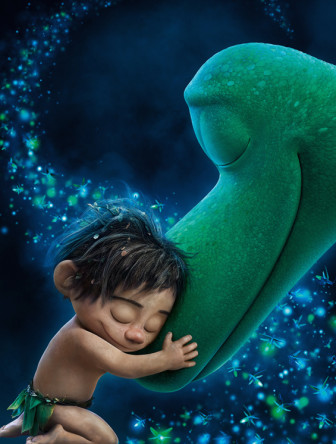
little caveman boy rests, eyes closed, on the Good DinosaurWe conceived “White Canes, Red Carpet” as a celebration — of audio description and technology, but moreover, inclusion and access for all. We believe that not having to contend and litigate for good accessible technology is not just a luxury, but a civil right, and seeing such an influential studio as Disney-Pixar take on the challenge wholeheartedly is truly something worth celebrating. What’s more, this will be an unprecedented gathering of blindness organizations across the Bay Area — and we’ve been working closely with the Blind Babies Foundation, Guide Dogs for the Blind, and several other agencies to ensure that as many groups as possible are represented.

So on the evening of December 10, the red carpet will stretch through the atrium at Pixar Animation Studios, and the majority of the hundreds of attendees will be blind or have low vision. The evening will culminate with a very special screening of The Good Dinosaur, and representatives from Disney and Pixar will speak and seek feedback from attendees on their new technology. It will be a grand evening, and the LightHouse is very proud to be a part of it.

HOW TO WIN TICKETS

If you love the magic of a premiere and the glitz of a new film — and especially if you’re blind or have low vision — enter our raffle by Friday, December 4th. In order to win tickets, you must answer the following, and email to lighthouseblind@gmail.com.

1. Full Name:
2. Number of tickets desired (including adult, teen, child):
3. Do you have an an up-to-date iPhone, iPod touch, or iPad?
4. Are you blind, have low vision, or affiliated with a blindness or accessibility organization?
5. Phone contact:

We will notify all ticket recipients by Monday, December 7. Unfortunately we do not have resources to notify all those who are not picked.

Press: please send any media requests to communications@old.lighthouse-sf.org.

Thank You to Our Community Partners

Thank you to the following foundations, corporations and individuals who have recently shown their support by providing significant funds to help our programs go further and reach higher:

American Honda Foundation – for STEM programming
The Annunziata Sanguinetti Foundation – for Enchanted Hills Camp and the LightHouse Youth Program
Business Links, Inc. – for general operating support
Charitable Adult Rides & Services – for general operating support
Culture! Disability! Talent! – for Superfest: International Disability Film Festival
Joseph Chan – for general operating support
Delong-Sweet Family Foundation – for general operating support
George Lucas Family Foundation – for Campaign for a 21st Century LightHouse

Guide Dogs for the Blind – for Superfest: International Disability Film Festival
Howard and Julia Eastman Fund – for general operating support
Andrew Kebbel – for the Campaign for a 21st Century LightHouse
Dean & Margaret Lesher – for Contra Costa youth scholarships to Enchanted Hills Camp for the Blind
The Moca Foundation – for Employment Immersion
Geoffrey Murry – for Campaign for a 21st Century LightHouse
Pacific Gas & Electric Company – for LightHouse Community Services
Polara Engineering – for general operating support
State Street Foundation – for Employment Immersion and Superfest
Todd Stevenot and Anne Sandbach – for general operating support
USABA – for LightHouse Community Services

Learn to Travel Blind with LightHouse Orientation and Mobility Instructor Katt Jones

Katt Jones works with LightHouse student George Montag in NapaThe following is one in a monthly series featuring the extraordinary people who make up the LightHouse staff.

“Being an Orientation and Mobility Specialist is a perfect fit for me,” Katt Jones tells us. “I love teaching one-on-one, and empowering people to live their lives. I also value people’s stories, which I get to hear as I teach them how to safely travel as a blind person. She adds, “There’s more to learn about O&M than white cane travel, like using auditory cues to know when to cross the street, or explaining how weather can change the skills a blind person should use to travel.”

Katt, one of our newer Orientation and Mobility (O&M) Specialists, reminds us that O&M is more than white cane travel. “I love nerding out about smartphone apps, GPS and other means of travel. Though I don’t teach in-depth technology training—that’s what our LightHouse technology specialists are for—I do introduce my students to technology they may not be aware can help them.”

Katt earned her Master’s in Special Education with an emphasis on Orientation and Mobility at California State University, Los Angeles. Before she worked for the LightHouse she gained experience working as an O&M Specialist, and also unofficially began to learn independent living skills, which allowed her to more easily spot when someone needs additional training.

When students work with Katt to enhance their O&M skills, they get someone who listens. She says, “At the University of California San Diego, I studied sociology and psychology to understand how the individual fits within society. This led me to running support groups, where people come together to share experiences, learn and grow. When I’m working with a student, lots of personal things surface. We talk about independence, which often leads to conversations about family and friends being overly protective and not understanding. For students who are naturally shy, we talk a lot about how to respond to strangers who offer unsolicited (though well-meant) help because they see someone with a white cane. Family dynamics come up a lot, and I listen to students’ stories and help them talk through solutions. Mostly, however, I remind my students that they are in control of their lives.”

She goes on to say, “People have so many ideas about what it means to be blind. If you’re new to blindness, it’s easy to let it consume your attention. When I’m with a student, I’m teaching them blindness skills, but I also try to remind them of their hobbies and interests. It’s ironic that students of mine spend a lot of time talking to relatives and friends about blindness, and when they come to me, we start talking about theater, dancing, and hiking. I tell my students that it’s ok to say ‘stop talking about my blindness!’ My first priority is O&M instruction, but sometimes people need to be heard—what they really need is someone who sees them as a whole person.”

Katt encourages her students to come up with locations of interest to travel to during their lessons. “Several of my students want to learn how to get to the de Young Museum, the California Academy of Sciences, or how to hop on the F-line and get out to Pier 39 and Fisherman’s Wharf so they can check out the shops and the sea lions. They get really excited when they can show family members from out of town how to get to these iconic San Francisco locations. Just today I got to work with a student who has a membership at Cal Academy of Sciences and wanted some instruction on how to navigate the stair lifts when it is rather dark. I have another student who has been learning how to get to a San Francisco bakery so she can bring back delicious pastries and sourdough bread to her family back home in the East Bay. I try to let my students dream up any route they want or any location they want to get to so that they can focus on learning the skills while on the way to a place that they really would love to get to.”

Very much a people person, Katt runs a co-op in Oakland where she and five other housemates ensure a constant homey vibe. “We eat dinner together, share chores that we rename ‘spheres of influence’, and encourage each other.” In addition to creating a loving home, a portion of the co-op’s rent is given to nonprofits of their choosing. “Living in a co-op means we know how important community is, which is why we also support nonprofits that enrich and support the community around us.”

Katt truly embraces life and the people around her, from her students who are learning new blindness skills, to a team of performers in a local showing of the iconic film the Rocky Horror Picture Show. “I love music and dancing,” Katt says with a twirl of her head, “and I regularly attend live theater.” She reminds us all, “get up, get out, and get along.”

If you’d like to brush up on your O&M skills, or if you’ve been holding off on learning them, Katt has some words of advice: “Take the leap and let’s laugh while learning.” Contact the LightHouse at 415-831-1481 to get started.

 

LightHouse Students Climb High

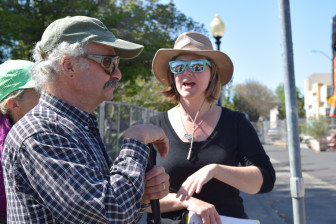
Courtney Mazzola climbs ladder into a tree leading to the zip line.In October a group of eight LightHouse students went to the San Francisco State University’s Challenge (Ropes) Course at Fort Miley. The Fort Miley Challenge Course is an outdoor ropes course and zipline program run by Pacific Leadership Institute (PLI) and located at Golden Gate National Recreation Area, at Lands End in San Francisco. They offer a fun, safe and positive environment in which individuals and groups work together to develop confidence, trust, support, communication, cooperation and leadership skills.
LightHouse Community Services Program Coordinator Beth Berenson wanted to challenge the stereotype that blind people can’t do challenge courses and organized the outing. She told us, “Our group of blind students really wanted to challenge themselves physically and they also wanted bragging rights – they wanted to be able to say, ‘I did it!’ There’s an assumption that blind people cannot participate in exciting and sometimes extreme sports, but that’s just not true.”

The highlight of the adventure was riding the zipline. LightHouse students climbed a tree then walked a tightrope to get to the zipline, wearing safety harnesses attached to ropes held by PLI staff ready to belay to safety anyone who needed help. Beth told us, “First you climb, placing your feet on (ladder rungs) secured to a large tree – once you get to the top, you put your feet on markers – in that position you step onto the wire (there are support ropes at your side to hold onto) and walk on the wire until you get to the platform for the zipline which runs along the top of the trees.”

Student Courtney Mazzola described why she participated, “I really wanted to do a zipline and I’ve had issues in the past with other places that wouldn’t let me try it because I’m blind. PLI was great – they had no hesitation working with blind people. You don’t need to have vision to do this, you just need to be able to follow specific, detailed verbal directions.” About the experience, she said, “It was great – part of it was just the sense of overcoming fear, a cross between accomplishment and having conquered, physical mastery. Now that I know how it works I would definitely do it again.”

We are planning another high flying adventure in the Spring, when the weather is good. Interested? Contact Beth Berenson at 415-431-1481 or info@old.lighthouse-sf.org.

Touching a Frank Lloyd Wright

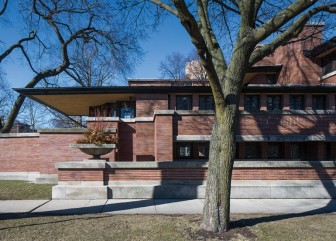
Frank Lloyd Wright’s Robie HouseUntil last month, blind people had no way to explore Robie House. Visiting the Frank Lloyd Wright-designed home in Chicago — a go-to architectural landmark — is a highly sensory, highly visual experience. A cramped low ceiling first guides visitors through a wooden entry hall leading to old playrooms, bedrooms and other private spaces, until you emerge, dramatically, into the main room. For the sighted, this spatial drama, and the ensuing architectural detail revealed in the tour, is quintessential to getting to know a Frank Lloyd Wright building. And now those details that make Robie House so unique and arresting are accessible to the blind, as well.
Generally, to preserve these special buildings, visitors cannot touch the fine details. To celebrate the 25th anniversary of the ADA, the Frank Lloyd Wright Trust started offering Touch Tours of several Wright sites in Chicago, and as such, asked the LightHouse to provide tactile plans and accessible architectural details to assist in the guided tour of spaces, affording visitors a spatial understanding of the house without compromising preservation efforts. Using our new tactile plans, blind visitors can experience and understand the architectural elements which make Robie house unique: the window and door geometry, wood fixtures and accents, signature angles, as well as the East and West “prows” bookending the house in the dining and living rooms.

The Robie House is built in the Prairie Style of architecture, characterized by long, flat lines and incorporating colors and materials from the surrounding environment. Influenced by Japanese art and architecture, this American architectural style prioritizes the connection between inside and outside, removing the heavy interior and exterior walls of the Victorian era. To achieve this, 127 art glass windows and doors line the exterior of the home, bringing light, warmth (and cold), and nature into the open floor plan. The wall of windows, open plan, and use of structural steel are common elements found in Modern Architecture, a typology arguably influenced by Wright’s designs, which took hold decades later in Europe and the US.

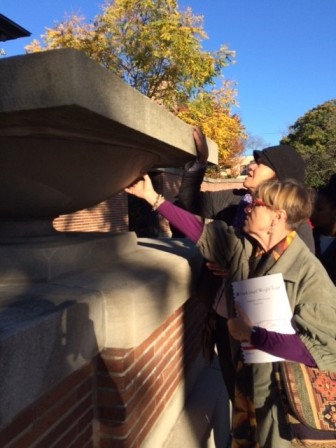
Visitors touch a planter in the form of Wright’s logo- on the exterior wall of the yard of Robie House.

Robie House staff are now using our braille-labeled, physical model to orient blind guests to the forms of the building. Guests receive a booklet with tactile drawings, large print and braille, including a diagrammatic site plan of the ground level, main floor detailed floor plan, and art glass window detail.

“The guests lit up when they felt their way through the window detail,” says Joe Barrett, Daily Operations Manager at Robie House when describing a recent touch tour. “The diagrammatic page was invaluable as a tool to express the open floor plan and the layout of the rooms.” This forced Barrett to think creatively about his tours, as well; at one point, he took the guests out onto the South Balcony, and said he “was able to convey the tone of the windows and lighting by referring to the warmth of the sun pushed through the glass… It was incredible for me, just as it was for them. You guys provided us with such fantastic tools that only made their experience better.”

For more information or inquiries about making your exhibition accessible, email MADLab@old.lighthouse-sf.org.

Outdoor Educators Learn the Ropes at Enchanted Hills Retreat

Members of the Outdoor Educators Institute (OEI) participate in a low-ropes challenge course at EHC. All under training shades, they support three members who are balancing on a single rope raised a few inches off the ground.In November members of the Outdoor Educators Institute (OEI) visited Enchanted Hills for a two-day training to learn more about how to adapt outdoor recreation activities to include the blind community. We provided instruction on human guide technique, myths and facts about blindness and philosophy of inclusion. Participants had a chance to meet with LightHouse Board and staff on issues of accessibility and discuss best ways to instruct blind students.

“We learned so much this weekend. Thank you to Enchanted Hills Camp and LightHouse for the Blind – San Francisco Bay Area for showing us how you create access to the ‪#‎outdoorsforALL”
-from the OEI Facebook page

Enchanted Hills Camp Director Tony Fletcher said, “I was extremely impressed by the enthusiasm and competence demonstrated by the students. The opportunity for Enchanted Hills Camp to partner with OEI, gave both our organizations the chance to build a partnership that will truly benefit the blind community in inclusive outdoor education.”

An OEI student explores a tree carving tactilely.

The Outdoor Educators Institute provides a 3-month long professional and workforce development program training the next generation of outdoor leaders. Their leadership training includes wilderness backpacking, sea kayaking, ropes course facilitation, environmental education, group management, professional skills, conservation skills, and equity, diversity, and inclusion trainings.

Are you looking for a retreat setting for your company training or other group outing? Please call us at (415) 694-7310 or learn more at www.enchantedhillsretreat.com.

In the Dining Hall at Enchanted Hills, Camp Construction Manager George Wurtzel, complete with feathered hat, takes time out to chat with members of OEI.

Our Latest Employment Success – Greg Trela

Greg Trela never quite knew when his vision was going to change. Since age 11, Greg has known that changing vision would be a fact in his life, but it didn’t make the process any less of a challenge. Using only one eye for thirteen years, Greg got through college, pursued all of his interests, and then, in 2011, his other retina detached, requiring four surgeries. At the time he had one quarter left on his master’s degree in engineering.

Greg returned to school, finished his degree program, but did not find a clear path waiting for him once he got out. He put in applications and went on job interviews, but despite his qualifications, something didn’t catch. Finally, in 2013, someone gave him the number of DOR counsellor Sylvia Oberti, who put him on the fast-track to finding good work.

“I didn’t have a cane until I saw Sylvia. She just happened to have one my size.” (Greg is 6’6”). “So I wasn’t using a cane, and I think I had four or five interviews in 2014. What I realize now since I’ve started using a cane is it just changes peoples’ perceptions — and for the most part I think it’s actually for the better.”

Not only was Greg given a cane, but he was introduced to Kate Williams at the LightHouse’s Employment Immersion program, where over the course of the program, he learned how to turn those frustrating interviews into job offers. “I didn’t know about writing thank you notes. Knowing that after you go to an interview you need to write a thank you note to everybody you saw, try to emphasize some point, recognize that it’s part of the hiring process, part of the expectation of the interview. And you can ask questions about the upcoming interview, ask for an updated job description so that you know what’s expected.”

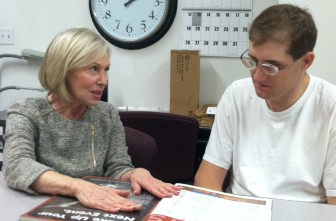
Kate Williams and Greg Trela

It wasn’t just interview training either. With Kate at this side, Greg learned about every stage of the training and hiring process. “For me, the big thing about working with Kate was getting my cover letters better,” he says. “Emphasizing what skills you have can contribute to the company or institution you’re going to go work for. How can you benefit them? Working for them, yes, you will benefit; but in your cover letter it’s more about how you can benefit the company. You have to sell yourself by saying ‘this is who I am and this is how I can help you.’”

All these skills helped land Greg a job this fall as a Junior Civil Engineer for the City of San Francisco, Department of Public Works. He is currently reviewing permits for new constructions, and coincidentally, works right downstairs from the LightHouse’s future home on Market Street. We couldn’t be happier for him.

Next Employment Immersion Session Starts January 12
Get ready for your first or next job. The next Employment Immersion session will run from 9:00 a.m. to 2:00 p.m. every Tuesday, Wednesday and Thursday from January 12 through February 11 at the LightHouse Ed Roberts Campus office in Berkeley. For more information, please contact Kate Williams at kwilliams@old.lighthouse-sf.org or 415-694-7324.

Make 2016 Your Best Year Yet – Help Make it Bright by Becoming a Volunteer at the LightHouse

hands holding red letters that spell volunteerThe beginning of a new year is always a perfect time to volunteer. With only a few hours a week, you can put your loyal, altruistic aspirations to work by becoming a Personal Service Volunteer, which supports the independence of our students by assisting with reading mail, grocery shopping, filing and other tasks, or becoming a Fitness and Activity Partner, which supports the healthy and active lifestyles of our students.

We also have a need for administrative assistance as well as volunteer assistance with several fun programs like the Walking Club, BINGO night, Farmer’s Market and bowling trips plus many more scheduled events with our Youth and Community Services Groups.

Why wait? Register today to participate in the next and final volunteer orientation of the year, scheduled on Saturday, December 11th and be an active volunteer before the end of the year. Please contact Justine Harris-Richburgh, Volunteer Engagement Specialist, for more information by email at volunteer@old.lighthouse-sf.org or call at 415-694-7320. You can also register online.

Helen Keller once said, “The most beautiful things in the world cannot be seen or even touched, they must be felt with the heart.” Register to volunteer today.