Category Archive

LightHouse News

Student Spotlight: Toby Clark

Student Spotlight: Toby Clark

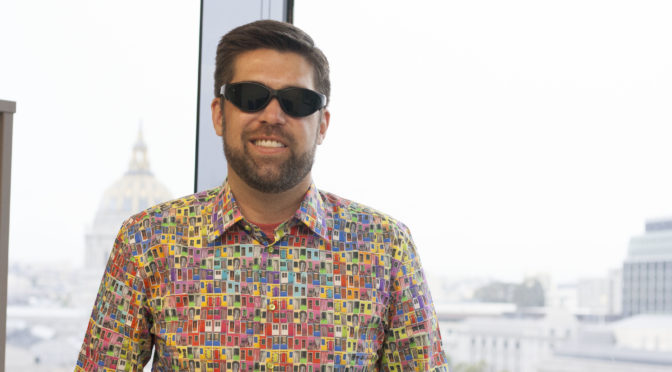
Toby Clark stops by the LightHouse one afternoon to grab coffee with a friend who he met at our 30% and Growing blind professionals meet-up. The friend has been taking cooking classes in the 10th floor Teaching Kitchen and ushers Toby into the pre-function area with a piping hot plate of pasta parmigiano (“It comes with a warning: I might have gone a little heavy on the pepper”).

Toby works around the corner as an attorney at the federal courts, and he’s recently started to regularly attend 30% and Growing.

“It’s a very open and supportive environment,” says Toby. “You connect over shared experiences. So that next time someone asks, again, “Has your hearing improved?”, you can internally roll your eyes but also find the strength to carry forward so that you don’t become embittered by that experience. Instead you can stay positive and even add a little humor into the mix.”

But long before Toby was networking with fellow blind professionals, he was struggling with the uncertainty of a rare retinal disorder and being cycled through doctors offices for various (and often inconclusive) tests. As his eyesight changed, his mood began to decline and he was started to grapple with depression.

As an attorney, Toby’s work requires that he do a significant amount of reading. He was getting constant migraines from the strain of trying to read legal documents and fine print. He had improvised a few adaptive techniques on his computer, but he felt like his progressive condition was a moving target. He was constantly scrambling to improvise new ways to see.

But everything shifted when a friend asked Toby, “Have you heard of LightHouse?”

A year ago, he connected with LightHouse psychological services counselor Connie Conley-Jung for an initial session. She laid out a path for him, showed him the available resources and told him how to get connected with Department of Rehabilitation.

“Connie was great,” says Toby. “It helped to talk with someone who gets it. It was the first time in all that floundering and trying to figure out how to do things on my own that I felt like there was a map forward, both personally and professionally. And it included both internal and external resources. There’s also a great atmosphere here and started to understand that people really care and it’s just an open and welcoming place. And that combined with the quality of services I’ve received it’s just kind of a no-brainer.”

And that was just the start for Toby at LightHouse. Now, he’s completed more counseling sessions with Connie, a Changing Vision Changing Life Immersion Training at Enchanted Hills Camp, orientation and mobility with specialist Katt Jones, technology training and is beginning to dip his toe into braille lessons with braille instructor Divina Carlson.

“Now even as my vision continues to decline, I have that skill set waiting there and I have those resources ready,” says Toby. “Just knowing there are skills that I’ve learned and continuing to learn, like Braille, it’s a longer path but it’s building that foundation for going forward.”

The CVCL session he attended had a particularly strong impact on him, because it was the first time he was surrounded by other blind and visually impaired people, with a whole spectrum of sight and experience with adaptive techniques.

“We were there sharing all our different and shared struggles, our successes, tips and tricks,” says Toby. “You end up cheering for everyone and wanting everyone to succeed and it really felt like we, as a group and including the staff as well, had made progress towards this overall goal of ‘Let’s make our lives better, let’s be there for each other.’”

There, he was emboldened by a mobility exercise that involved navigating the woods at EHC blindfolded with a cane.

“It was really scary but kind of exhilarating at the same time,” says Toby. “And when I got back from the immersion I really started using my cane on a regular basis. I think it removed an emotional barrier, because I’d just think ‘Oh you were blindfolded and walked through the woods and somehow found your way back!’ I was like, “I can make it through the city.’”

And Toby has been making it through this city every day, as well as far off ones: he’s just returned from visiting Switzerland and Paris with his husband Chad, and they have a trip to Yellowstone coming up.

When he’s not perusing Parisian boutiques or visiting friends at the LightHouse, he’s acting on stage, and in short films and commercials. Losing his vision has made him a director’s pet though: he memorizes all his lines before the first rehearsal. “Directors love that,” he says, laughing.

These days, Toby uses Zoom Text, Jaws and NVDA to access his acting scripts and legal documents. And who knows, after a few more braille lessons, he might be reading braille scripts — so he can go back to procrastinating like the rest of us.

To learn more about LightHouse programs, visit old.lighthouse-sf.org/programs/ or call 415-431-1481. 
Volunteer Spotlight: Abby Cochran

Volunteer Spotlight: Abby Cochran

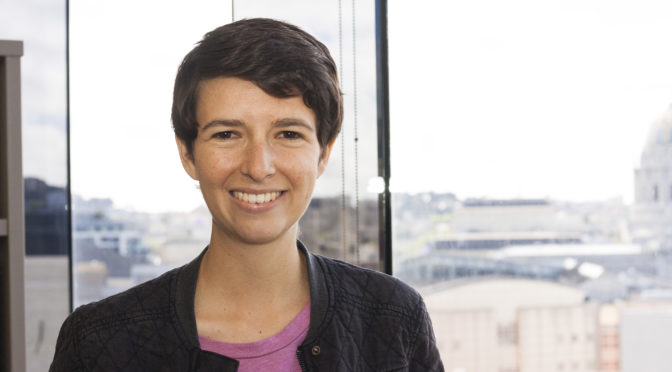
When Abby Cochran first found the LightHouse three years ago, she came asking for help – but she wasn’t blind.

Abby, who is fully sighted, had just moved to Berkeley for her Masters degree and was working at a startup in the city called TransitScreen. The company was using bluetooth beacons to send transit data to users phones – particularly useful for blind users at inaccessible signs. She needed user testers though, and someone told her LightHouse was the obvious choice.

“I met a lot of really friendly people who expressed interest in my work and welcomed me,” she says. “They said, ‘Wait, that’s actually a really interesting thing. Can we talk about doing this? It was really welcoming and nice.”

As Abby transitioned into her PhD in Urban Planning at UC Berkeley, LightHouse stuck in the back of her mind. Her social circumstances were changing, her time circumstances were changing, and she was looking for new people and activities to fill her time.

A couple months and a few LightHouse newsletters later, Abby discovered our Fitness Partner’s program.

“At the time it was in the middle of a beautiful week and I was like man, if I’m going out running anyway, I might as well have a buddy,” she says. “That would be the best.”

Abby signed up for a Volunteer Training and Volunteer Coordinator Justine Harris-Richburgh connected her to her new fitness partner who, like Abby, lived in Berkeley and was excited to spend time every weekend getting out and about. The two quickly fell into a rhythm with hikes all around the Bay Area. Abby says they still hike about once a week, usually for half a day.

“Within the first few weeks we were exercising together, he invited me to an event,” she says. “We were doing introductions and meeting people, and he said this is Abby. And they were like ‘Oh, how do you two know each other?’ And we hesitated for a second and looked in each other’s direction and said, ‘Well, we’re… friends.’”

Despite morphing into a supportive friendship, Abby says the fitness outings are both regular and casual. “We might go to see a particular section of the Bay trail,” she says, “or one of us — I won’t say which — might want to go shoe shopping. We’re flexible.”

Abby continues to volunteer at numerous LightHouse events, assisted in our Sexual Health workshop series, connected with other fitness partners, and will work as an Orienteering instructor for STEAM Camp at Enchanted Hills this summer.

So what keeps Abby coming back to LightHouse, time and time again?

“I love the people first,” she says. “I like hanging out with my friends and my friends are now here. I have a really wonderful confluence in the LightHouse. There is a mission that I also think that I’d like to forward, and that is to increase opportunities for those who are blind and low vision, but also everyone with different capabilities to reach the potential and quality of life that they desire. I want to help people do whatever they want. I’m in a privileged position to do so, and I think it would be remiss not to take advantage of that.”

“So that’s the do-gooder response. But I’m also very selfish and everyone is super nice to me and they invite me to fun things and sometimes we go get beers. They’re very supportive.”

Abby found a home at LightHouse, but she also found a valuable network and wealth of information for her research and work. She’ll be writing her dissertation on disability responsive planning, and critically examining accessibility in cities and to show how we define, perceive and measure access determines qualities of the built environment that hinder or enable people in particular ways.

“It evolved as a direct result of my work here,” she says. “This place runs deep. It’s been hugely influential and meeting the network of people here that also have a network in fields that i’m interested in, in city planning, transportation. You cannot remove people from place.”

Browse the various volunteer opportunities we offer and fill out our volunteer sign-up form or our group sign-up form. If you have any questions, contact Justine Harris-Richburgh, Volunteer Engagement Specialist at volunteer@old.lighthouse-sf.org or by calling 415-694-7320. All new volunteers are given background checks and are often given a group volunteering opportunity to start. We hope, like Abby, you’ll consider giving your time to the LightHouse (and becoming part of our diverse and growing community in the process)!

AMC Theaters Agrees to Improve Services for Blind Movie-Goers

AMC Theaters Agrees to Improve Services for Blind Movie-Goers


FOR IMMEDIATE RELEASE:

San Francisco, CA – April 28, 2017 – AMC Theaters (AMC) has reached an agreement with several blind individuals, the California Council of the Blind (CCB), and the LightHouse for the Blind and Visually Impaired in San Francisco (LightHouse) to ensure blind customers have reliable access to audio description services at AMC movie theaters nationwide.

Audio description is a verbal description of the visual events on screen, which plays between pauses in dialogue. Many movies come with audio description tracks, and customers who are blind or visually impaired can listen to audio description through special headsets that are available at the theatres. With audio description, people who are blind and visually-impaired can fully enjoy the important and beloved American pastime of going to the movies.

Under the agreement, AMC will require the managers and staff who are responsible for programming and handing out audio description equipment to be trained on the equipment. AMC and the plaintiffs in the case have developed staff and customer information guides to facilitate better service. AMC also will require managers to check the equipment regularly. Additionally, AMC will now offer audio description immediately before the feature movie begins, so customers can test the equipment before the feature movie begins to help ensure customers don’t miss any of the movie troubleshooting problems. In the rare event that a theater’s audio description equipment is out of service, AMC will now update theater websites to remove the audio description designation from showtimes. AMC has agreed to implement these changes in theaters nationwide.

This agreement resolves a lawsuit brought by CCB, the LightHouse, and several individuals, represented by Disability Rights Advocates and Rosen Bien Galvan & Grunfeld LLP, in 2016, alleging that audio description equipment at AMC theaters frequently malfunctioned and that AMC staff did not properly check, program, or distribute the equipment to customers. AMC has provided audio description equipment to customers for years, but some blind individuals have had difficulty accessing the service because of equipment and customer service issues.

AMC Theatres and the Plaintiffs look forward to improved access to audio description services for blind and visually-impaired persons across the country.

Plaintiff Scott Blanks commented, “This settlement marks an important step toward improving access to the movies for people who are blind or have a vision impairment. I’m looking forward to going to AMC theaters and enjoying the movies with my family when AMC makes the changes to improve reliability of audio description in its theaters.”

Cynthia Pierce, AMC Senior Vice President for Facilities, Sight and Sound for AMC commented, “AMC is pleased to have worked with these organizations and individuals to develop solutions that will help bring the joy of movies to the blind community.”

California Council of the Blind President Judy Wilkinson stated, “The California Council of the Blind applauds AMC for working with us to enhance access to the movie-going experience for people who are blind. Movies are a central pillar of modern society, and ensuring that the blind community receives access to this content is critical to ensure that people who are blind are fully integrated into society.”

Bryan Bashin, Executive Director/CEO of the LightHouse states, “Access to reliable audio description is essential to ensure that blind movie-goers are able to enjoy movies in the same way that their sighted friends and family members do. Dependable audio description levels the playing field for the blind community. The LightHouse is pleased with AMC’s commitment to providing this service to blind movie-goers. We look forward to working with AMC to ensure that all blind movie-goers have a seamless experience when utilizing audio description.

Plaintiffs’ counsel Rebecca Williford of Disability Rights Advocates (DRA) explains, “We are pleased that AMC is committed to improving audio description services in its theaters. Audio description should be as reliable as any other service or technology at an AMC theater, such as a sound system or popcorn machine.”

Ernest Galvan of Rosen Bien Galvan & Grunfeld, counsel for Plaintiffs, said “when effectively implemented, technology like audio description has the power to further integrate people with disabilities into their communities.  By improving access to audio description services, this agreement harnesses that potential.”

Press Contacts

Scott Blanks

Senior Director, Programs

Lighthouse for the Blind and Visually Impaired

sblanks@old.lighthouse-sf.org

Rebecca Williford, Disability Rights Advocates

(510) 665-8644

rwilliford@dralegal.org

Michael Nunez, Rosen Bien Galvan & Grunfeld LLP

(415) 433-6830

mnunez@rbgg.com

About the California Council of the Blind

California Council of the blind (CCB) is a non-profit membership organization composed of Californians who are blind or have low vision. CCB’s mission is to gain full independence and equality of opportunity for all blind and visually impaired Californians. To read more about CCB visit: http://www.ccbnet.org/.

About the LightHouse for the Blind and Visually Impaired

The LightHouse for the Blind and Visually Impaired (the LightHouse), a San Francisco-based non-profit corporation, is California’s oldest organization serving the blind and visually impaired community. Through training, mentorship and recreation, the LightHouse is dedicated to aiding blind and visually impaired individuals in leading productive, enriching, and independent lives. For more information visit old.lighthouse-sf.org.

About Disability Rights Advocates

Disability Rights Advocates is one of the leading non-profit disability rights legal centers in the nation. With offices in Berkeley and New York City, DRA’s mission is to advance equal rights and opportunities for people with all types of disabilities nationwide. DRA has successfully negotiated access improvements to many contemporary technologies, including Redbox’s self-service video rental kiosks, Scribd’s digital library, the Uber ridesharing platform, and Netflix’s video streaming and disc rental. For more information, visit www.dralegal.org.

About Rosen Bien Galvan & Grunfeld LLP

Rosen Bien Galvan & Grunfeld LLP is a private law firm that specializes in complex litigation, including with respect to business disputes, employment matters, institutional reform, and civil rights.  For more information, visit www.rbgg.com/.

###########

A Week with Be My Eyes: The First Truly Social Network

A Week with Be My Eyes: The First Truly Social Network

On May 11 from 5:00 t0 7:00 p.m., LightHouse will host Be My Eyes and its blind or low vision users for an evening of creative use, feedback and even a bit of friendly competition. The Be My Eyes team will take blind users through the past, present and future of the technology, and share some incredible stories about the iPhone app that connects blind people to a network of sighted volunteers via live video chat. The event is free and intended for blind and low vision users – RSVP on Facebook.

We love our independence. Even if our vegetables are grown and picked by hundreds of hands, our cars designed by teams of closely collaborating engineers, and everything from our electricity to our government benefits kept running by vast networks of individuals — modern day technology and consumption are designed to make us feel self sufficient.

We are thus allowed to hold ourselves ideals of self-determination and rugged individualism that have been passed down over the centuries. As blind people, these values are challenged every day of our lives. When something is poorly designed or downright unusable, we confront a deep conundrum: going it alone or asking for help, and risking the perceived possibility of burdening others.

When Be My Eyes launched nearly two years ago, a new tool was born: a radically different way to ask for help. Be My Eyes introduced blind smartphone users to a whole new type of social support network, one unbounded by geography, bureaucracy, or even practical limitations, that allowed blind users to get sighted assistance via video chat.

Today there are about half a million sighted volunteers with Be My Eyes loaded onto their phones, with more than 30,000 blind users on the other end. These volunteers will do anything from help you adjust the thermostat to spending half an hour helping you pick out an outfit for a high-stakes presentation. But at it’s core, each interaction is random, at-will and obligation free. The free app puts no limit on the number of calls you can make in a day. If you really wanted to, you could call 100 different people and have each of them identify the exact same piece of art – and the service, as always, would be free.

Even though thousands of blind people benefit from this app every week, the platform can handle thousands more. I wonder often if our notion of independent living so engrained, so hard-wired that we have still have trouble asking for help, even when there are really no strings attached.

Be My Eyes is working toward a gold-standard for people helping people. They have hundreds of thousands of hours of free labor, given with good faith, at a moments notice from people all around the world. It’s truly a new tool – like a fishing pole that reels in assistance whenever you want it. But as the old saying goes, you have to “teach a man to fish” before he can really benefit from the tools at hand.

Last month, I challenged myself to re-consider how I use the app. Occasionally I will be somewhere, alone, and realize that I am struggling. We all do this, sighted and blind alike: make things harder for ourselves then they need to be.

For one week, I told myself, any time I needed help I would pull out the app and give it a spin. What came out of it was surprising. Watch the video below to see Be My Eyes in action.

Not only did I use it for things I never thought it could work for – like identifying house numbers as I walked through a neighborhood or even the types of fish on my sushi plate – but I met people who were patient, not overbearing, and curious as to what they could do to be helpful without being obtrusive.

No one asked me personal questions, no one tried to coach me on how to live my life, and above all no one grabbed me by the arm and steered me somewhere I didn’t want to go. When I got what I needed, I could politely say thank you and hang up without fear that being brisk with someone would have repercussions later. It’s all the value of having someone nearby without any of the additional worry of initiating contact, explaining yourself, and ultimately breaking free of their of custody.

Our understanding of “independence” is not truly about total independence, but instead about masking the assembly line of helpers which make up our lives: the tiny little micro-transactions where individuals step in to provide assistance, whether or not we have a disability. For blind people, this is a more obvious reality than for most.

The reason Be My Eyes is so remarkable is because it embraces this reality wholesale: You can get the tiniest bit of help and move on through your life. The safety net is huge, and yet doesn’t loom over you.

Maybe it makes sense, then, that the guys behind Be My Eyes hail from Denmark, where you’re much more likely to hear about a more “social” approach. And if we think of human interaction as give and take, as an exchange of ideas or assistance as a true social interaction – maybe Be My Eyes has created the first truly social network.

Guide Dog Users: Have Your Voice Heard on AB1705  Regarding the California Guide Dog Board

Guide Dog Users: Have Your Voice Heard on AB1705 Regarding the California Guide Dog Board

On April 25, the Business and Professions Committee will hear California Assembly Bill 1705 starting at 9:00 a.m. The hearing will determine whether to extend the term of the California State Board of Guide Dogs for the Blind to January 1, 2022. Under the existing bill, the board will sunset on January 1, 2018. This is an impactful decision that affects many members of the LightHouse community. Take a moment to gain some background on the bill and let your voice be heard in the outcome of this vote.  

The California State Board of Guide Dogs for the Blind was established in the 1940s, in response to an influx of people with insufficient skill, expertise or knowledge claiming to be guide dog trainers. The guide dogs they provided weren’t trained properly and, rather, were ineffective and dangerous to blind people. At that time, a state-mandated governing body for guide dogs was a necessary regulatory and safety measure.

Now, however, the usefulness of this Board is being called into question by numerous blindness organizations and prominent guide dog users, including California Council of the Blind.
California is the only state with a board of this kind, most likely because the International Guide Dog Federation (IGDF), established in 1989, serves a similar purpose. IGDF is the industry-elected body responsible for the development, monitoring and evaluation of guide dog training standards applied within all IGDF-member organizations.

In light of this body, many think having a state-mandated board is redundant and a misuse of state resources, as well as a drain on the time and resources of the California guide dog schools, all of whom are accredited by IGDF.

LightHouse Board Member Gena Harper, who has been a guide dog user for 35 years, is taking a firm stance on the matter.

“As a blind person, the presence of the board is frustrating,” she says. “It is patronizing that the state feels the need to have a protective body over guide dogs for the blind, especially when that body doesn’t actually do anything to provide the protections it claims.”

If you are a guide dog user who has traveled to or from the state of California or spent time in that state, and/or if you anticipate traveling with your guide dog to California, we urge you to let your voice be heard on this matter. Contact the Legislative Committee described below to express your view on extending the term of the State Board of Guide Dogs for the Blind.

To have your voice heard, contact the committee members below and relay your stance on AB1705. Voting YES will extend the board’s term for four years, while voting NO will uphold the dismantling date of January 1, 2018.

Rudy Salas, Jr. (Chair) Dem – 32

assemblymember.salas@assembly.ca.gov

Capitol Office, Room 4016

P.O. Box 942849, Sacramento, CA 94249-0032; (916) 319-2032

William P. Brough (Vice Chair) Rep – 73

assemblymember.brough@assembly.ca.gov

Capitol Office, Room 3141

P.O. Box 942849, Sacramento, CA 94249-0073; (916) 319-2073

Dr. Joaquin Arambula Dem – 31

assemblymember.arambula@assembly.ca.gov

Capitol Office, Room 5155

P.O. Box 942849, Sacramento, CA 94249-0031; (916) 319-2031

Catharine B. Baker        Rep – 16

assemblymember.Baker@assembly.ca.gov    

Capitol Office, Room 2130

P.O. Box 942849, Sacramento, CA 94249-0016; (916) 319-2016

Richard Bloom   Dem – 50

assemblymember.Bloom@assembly.ca.gov

Capitol Office, Room 2003

P.O. Box 942849, Sacramento, CA 94249-0050; (916) 319-2050

David Chiu        Dem – 17

assemblymember.chiu@assembly.ca.gov

Capitol Office, Room 4112

P.O. Box 942849, Sacramento, CA 94249-0017; (916) 319-2017

Jordan Cunningham     Rep – 35

assemblymember.cunningham@assembly.ca.gov

Capitol Office, Room 4102

P.O. Box 942849, Sacramento, CA 94249-0035; (916) 319-2035

Brian Dahle      Rep – 01  

assemblymember.dahle@assembly.ca.gov

Capitol Office, Room 4098

P.O. Box 942849, Sacramento, CA 94249-0001; (916) 319-2001

Susan Talamantes Eggman        Dem – 13

assemblymember.eggman@assembly.ca.gov

Capitol Office, Room 4117

P.O. Box 942849, Sacramento, CA 94249-0013; (916) 319-2013

Mike A. Gipson Dem – 64

assemblymember.gipson@assembly.ca.gov

Capitol Office, Room 3173

P.O. Box 942849, Sacramento, CA 94249-0064; (916) 319-2064

Timothy S. Grayson      Dem – 14

assemblymember.grayson@assembly.ca.gov

Capitol Office, Room 4164

P.O. Box 942849, Sacramento, CA 94249-0014; (916) 319-2014

Chris R. Holden Dem – 41

assemblymember.holden@assembly.ca.gov

Capitol Office, Room 5136

P.O. Box 942849, Sacramento, CA 94249-0041; (916) 319-2041

Evan Low          Dem – 28

assemblymember.low@assembly.ca.gov

Capitol Office, Room 4126

P.O. Box 942849, Sacramento, CA 94249-0028; (916) 319-2028

Kevin Mullin    Dem – 22

assemblymember.mullin@assembly.ca.gov

Capitol Office, Room 3160

P.O. Box 942849, Sacramento, CA 94249-0022; (916) 319-2022

Marc Steinorth  Rep – 40

assemblymember.steinorth@assembly.ca.gov

Capitol Office, Room 5128

P.O. Box 942849, Sacramento, CA 94249-0040; (916) 319-2040

Philip Y. Ting    Dem – 19

assemblymember.ting@assembly.ca.gov

Capitol Office, Room 6026

P.O. Box 942849, Sacramento, CA 94249-0019; (916) 319-2019


See Your Designs Through Someone Else’s Eyes: A New Virtual Reality Experience

See Your Designs Through Someone Else’s Eyes: A New Virtual Reality Experience

On May 18th, LightHouse for the Blind presents Eyeware, So You Can See Your Designs Through Someone Else’s Eyes

“Looking through the eyes” of another is a nice empathetic metaphor, but it can quite literally be a valuable exercise. Next month, a mini-conference at LightHouse for the Blind in San Francisco spotlights a new real-time, immersive ocular simulation that allows individuals to experience how people with low vision, color blindness or a variety of eye conditions navigate built environments.

LightHouse invites architects, developers, educators, designers and anyone who strives to build accessible environments – including transport systems, urban spaces, buildings, automotive design, interiors, software interfaces and prototyping – to explore a new opportunity in inclusive design: Join us to try on Eyeware.

On May 18, we’re inviting designers and planners to move beyond metaphors and look at the world a little differently. For years, vision professionals have simulated various eye conditions through goggles, plastic filters and other low tech solutions. Here, users are invited to try on a more efficient solution. The first demonstration of its kind, Eyeware will demo new virtual and augmented reality technology developed by Theia Immersive Systems that allows designers and consumers to step into a real-time simulation of someone else’s eyesight.

LightHouse welcomes Theia in their first North American presentation and workshop at 1155 Market St. (10th Floor) in San Francisco. Co-presented by Yahoo and welcoming a host of other companies dedicated to universal design, this event will take place in two sessions, with one morning presentation geared toward physical space, and an afternoon session focused on interface design. All are invited to a complimentary lunchtime event with two active simulation rooms. The event will likely sell out, so RSVP now.

More about the Eyeware App

Utilizing a robust set of proprietary visual filters (“like Instagram for your eyeballs”), Theia Immersive Systems’ Eyeware App is the gateway to a software suite that allows design professionals to see the world with a variety of eye conditions including color blindness, glaucoma, diabetic retinopathy and even certain rare conditions that cumulatively affect hundreds of millions of people worldwide.

Eyeware can be used with a cardboard or custom headset to deliver a combination VR + AR experience, giving anyone with so-called “normal” vision a new level of insight. The Eyeware filters, when applied, give designers additional tools to audit, manipulate and run wayfinding routes in both preexisting and newly rendered environments. Theia’s design tools can be deployed anywhere in the design process to facilitate collaboration, design review and visual accessibility for professionals, clients and users both sighted and blind – moving designers beyond simple notions of brightness and contrast into nuanced aesthetic palettes that work for all types of vision. The Eyeware App, available now for iOS and Android, sets the stage for a comprehensive design suite from Theia, now in Beta.

Why would I want to experience a Visual Impairment?

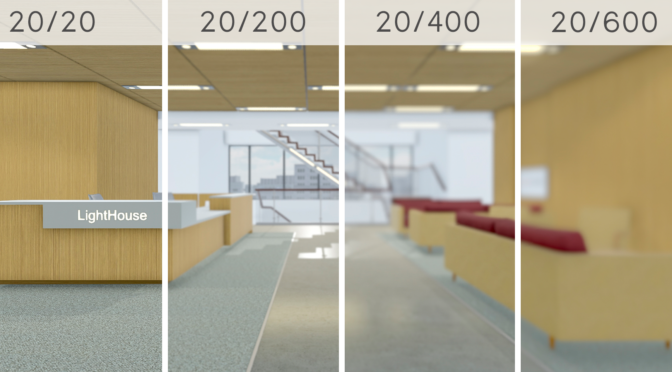
From the subtle, gauzy effects of cataracts to the more dramatic challenges of tunnel vision or retinopathy, changes in vision are incredibly hard to convey in words, photographs or standard-ratio video. Fully sighted designers can guess, but rarely know exactly how to optimize their products for low vision.

Developed by the UK Transport Systems Catapult’s spinoff – now called Theia Immersive Systems – to tackle the challenges of public transit, the new virtual and augmented reality software will join the toolkit of accessibility best practices observed by agencies such as the LightHouse and Arch4Blind in communicating the nuances of various eye conditions and their implications for design. With Theia’s tools, the designer now has a direct connection to the experience of a variety of clients and users.

From testing out physical interfaces for low lighting conditions, to evaluating for effective color contrast in side-by-side comparison, to actually strapping on the gear and diving into your CAD model or environment design, these tools give designers an edge on ensuring the project’s visual accessibility from the outset.

Try it for the first time

Join us at the LightHouse to hear Theia’s creators discuss concepts, applications and exciting emerging use cases, including integrations with 3D audio and force-feedback synthetic touch. There will be ample time to try out the technology in custom simulations generated specifically for the LightHouse facility.

The Theia and LightHouse teams will also be available for meetings to share more information about product rollout, support and partnerships for maximizing the potential of these exciting new tools.

RSVP for the event on Eventbrite. Trouble with Eventbrite? Email dbrown@old.lighthouse-sf.org.

Thursday, May 18: Full Day Schedule

10 a.m.
Theia Immersive Systems – Presentation
“Ocular Simulations for Interior and Exterior Environments”
Fee: $10 (includes cost of VR cardboard)

11 a.m. – 12:30 p.m.
VR + AR Activations
Free to attend
Experience Theia’s ocular simulations over a variety of environments and interfaces in LightHouse’s custom-outfitted simulation rooms.

12:30 p.m. – 1:30 p.m.
Complimentary Lunch

1:30 p.m. – 2:30 p.m.
Theia Immersive Systems – presentation
“Ocular Simulations for Physical and Digital Interfaces”
Fee: $10 (includes cost of VR cardboard)

2:30 p.m. – 4 p.m.
VR + AR Activations
Free to attend
Experience Theia’s ocular simulations over a variety of environments and interfaces in LightHouse’s custom-outfitted simulation rooms.

LightHouse Listenings presents Erik Weihenmayer with Davia Nelson

LightHouse Listenings presents Erik Weihenmayer with Davia Nelson

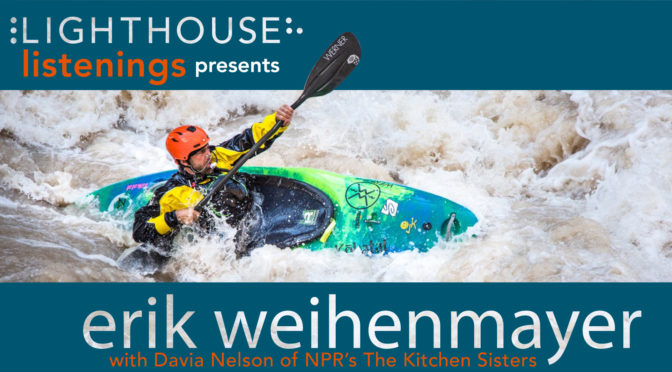
In 2014, Erik Weihenmayer, the first and only blind person to ever reach the summit of Mount Everest, attempted a new and daunting challenge: to ride 277 miles of thunderous, wild rapids down the Colorado River in a solo kayak. Why would he take such a gamble? How exactly did he pull it off? Discover the answers to these questions, and more, when Erik joins us at LightHouse on May 2 for a far-reaching and candid conversation with Davia Nelson, of NPR’s award-winning production team The Kitchen Sisters.

The event is the latest installment in our ongoing series LightHouse Listenings and follows, most recently, a live production of the podcast The World According to Sound. A “listening party for ears only,” the LightHouse Listenings series is a celebration of the aural medium, and is designed to create a space for conversation, creativity, and sound that connects blind and sighted audiences over a shared experience. At each event, we provide sleep shades in order to give you the option to focus solely on what you’re hearing.

Event details

LightHouse for the Blind Headquarters

1155 Market St., 10th Floor, San Francisco

Cost: $10 in advance. $15 at the door (cash only). Tickets can be purchased through our Eventbrite page. Reception begins at 6pm; the event at 7pm. If you experience any difficulties with accessibility, contact Events Manager Dagny Brown at events@old.lighthouse-sf.org or 415-694-7333.

This unique event is an opportunity to meet Erik during his national No Barriers tour and to hear the blind adventurer in conversation with one of the world’s finest radio journalists, Davia Nelson.

Davia’s work has taken her all over the world, from interviewing hummus chefs in Ramallah, to wine physicists in France and “kitchen botanists” in India. We can’t imagine anyone better suited to interview Erik about imagination, non-visual exploration and what drives him along his incredible journeys.

We’re proud to program and host this one-of-a-kind event, which will include braille passages from Erik’s book, read aloud, a meet-and-greet reception with attendees and an open bar. Books will be available onsite for purchase.

About LightHouse Listenings

This year, we began putting on regular listening parties for ears only – from live podcast recordings to pre-recorded material. To bring your sound experience to a live audience in San Francisco, contact dbrown@old.lighthouse-sf.org.

About Erik Weihenmayer

Over the past two decades, Erik Weihenmayer’s name has become synonymous with determination and ambition. In 2008, when he reached the top of Carstensz Pyramid in Indonesia, he completed his quest to climb all of the Seven Summits-the tallest peak on each of the seven continents.

Erik is the author of the best-selling memoir Touch the Top of the World, which was made into
a feature film, as well as The Adversity
Advantage, which shows readers how to turn
everyday struggles into everyday greatness. His
latest book, No Barriers: A Blind Man’s Journey to
Kayak the Grand Canyon is more than an
adventure story, it illuminates how we overcome the barriers that get in our way. He is an internationally recognized speaker and brings his message of living a No Barriers Life to audiences around the world.

About Davia Nelson

Davia Nelson is one half of The Kitchen Sisters, producers of the du-Pont Columbia and James Beard Award-winning series Hidden Kitchens, as heard on NPR’s Morning Edition, and two Peabody Award-winning NPR series, Lost & Found Sound and The Sonic Memorial Project.

The Kitchen Sisters are also the producers of The Hidden World of Girls, heard on NPR and hosted by Tina Fey. Their first book Hidden Kitchens: Stories, Recipes & More From NPR’s Kitchen Sisters was a New York Times Notable Book of the Year.

Artist Exhibition: LightHouse Features Blind Painter Charles Blackwell

Artist Exhibition: LightHouse Features Blind Painter Charles Blackwell

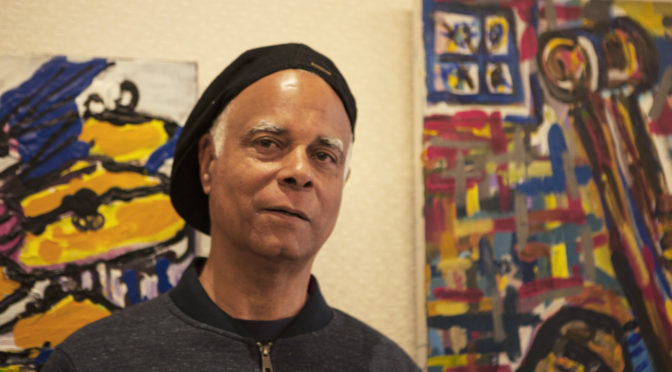
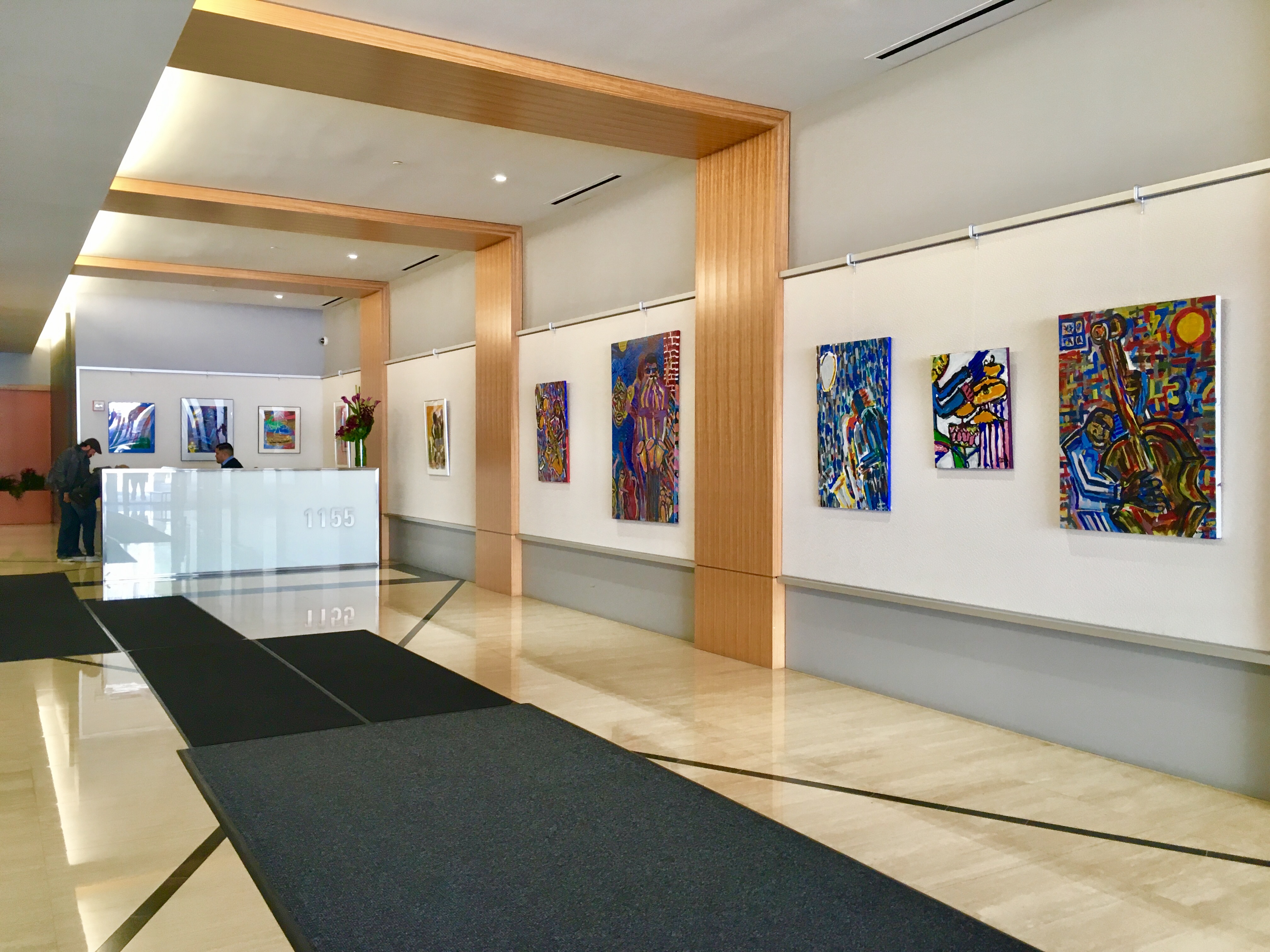
On March 23, we hosted the opening of painter Charles Blackwell’s art exhibition in our headquarters building lobby at 1155 Market Street. Blackwell is a longtime member of the LightHouse community, and we are thrilled to provide a platform for his bright and expressive acrylic and pastel paintings, along with braille descriptions of each one.

“My blindness, in a sense, gives me the originality,” says artist Blackwell of his lively, jazz-inspired paintings, which are on display starting today in the 1155 Market Street lobby. “Before, I was trained. I could do a sketch of you in a minute and a half. I could have been a courtroom artist. I can’t do that no more, so I just had to take another approach. I use my fingers, I use the bottom of a paintbrush, I pour paint onto the paper. I’d much rather do that. That’s what I’m after — that improvisation, that serendipity.”

Blackwell’s paintings will be up in the lobby until October. Get a taste of photos and descriptions below, or come by our headquarters and ask at reception for braille or large print titles, prices, and descriptions of the paintings.

FullSizeRender

A shot of the lobby with paintings hanging on the righthand wall as you walk in.

FullSizeRender-1

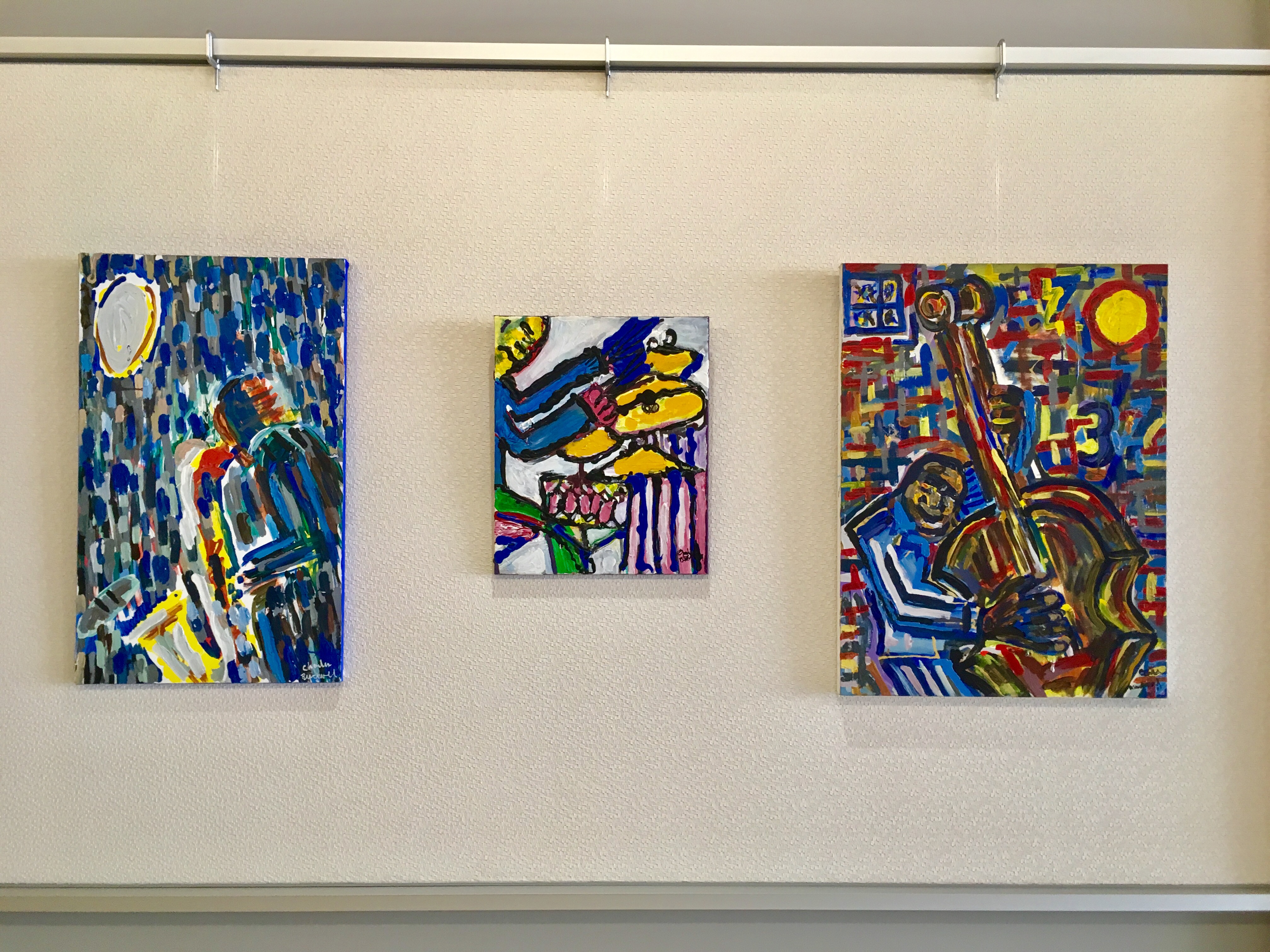
An image of three paintings, from left to right: 

73 Miles Away X the Speed of Light     

24 x 39.5 inches

$1,400

Acrylic on Canvas

Quick, bold strokes of paint form the uneven figure of a saxophonist in the right quadrant of the canvas. The figure leans into his yellow and orange instrument. Short blue, gray, tan and green brush strokes give the background depth and accent an ovular silver and yellow globe in the top left corner.

(#5) Drummer in the Thick of It    

20 x 24 inches

$350

Acrylic on Canvas

A drummer keeps time with wire brushes on a pair of golden cymbals. He is seated, wearing green pants and blue shirt. His face sports a classic drummer’s grimace — as though he just settled into a particularly groovy beat. The paint strokes are thick and bold — black outlines filled with jewel tones of blue, pink, gold, yellow and green.

(#20) Hummin’ Down That One Lonely String

2011

30 x 40 inches

$1,600

Acrylic on Canvas

A bass player in a blue suit plays on a textured stand-up bass. His loosely depicted face is jovial. The background is a patchwork of lines in primary colors with a large golden orb in the top right and a window in the top left. The number 3 stands out against the lines in the background.

A standing, bowed saxophonist emerges into the canvas on the right. He plays a golden saxophone that is almost the length of his body. A smaller figure playing a trumpet is behind him. Both figures play into a silver old-fashioned microphone in the bottom left-hand corner of the canvas. Two golden spotlights hang in the top left corner of the image. The background is a repetitive rhythm of short, blunt strokes of blue, pink, purple, yellow and maroon.

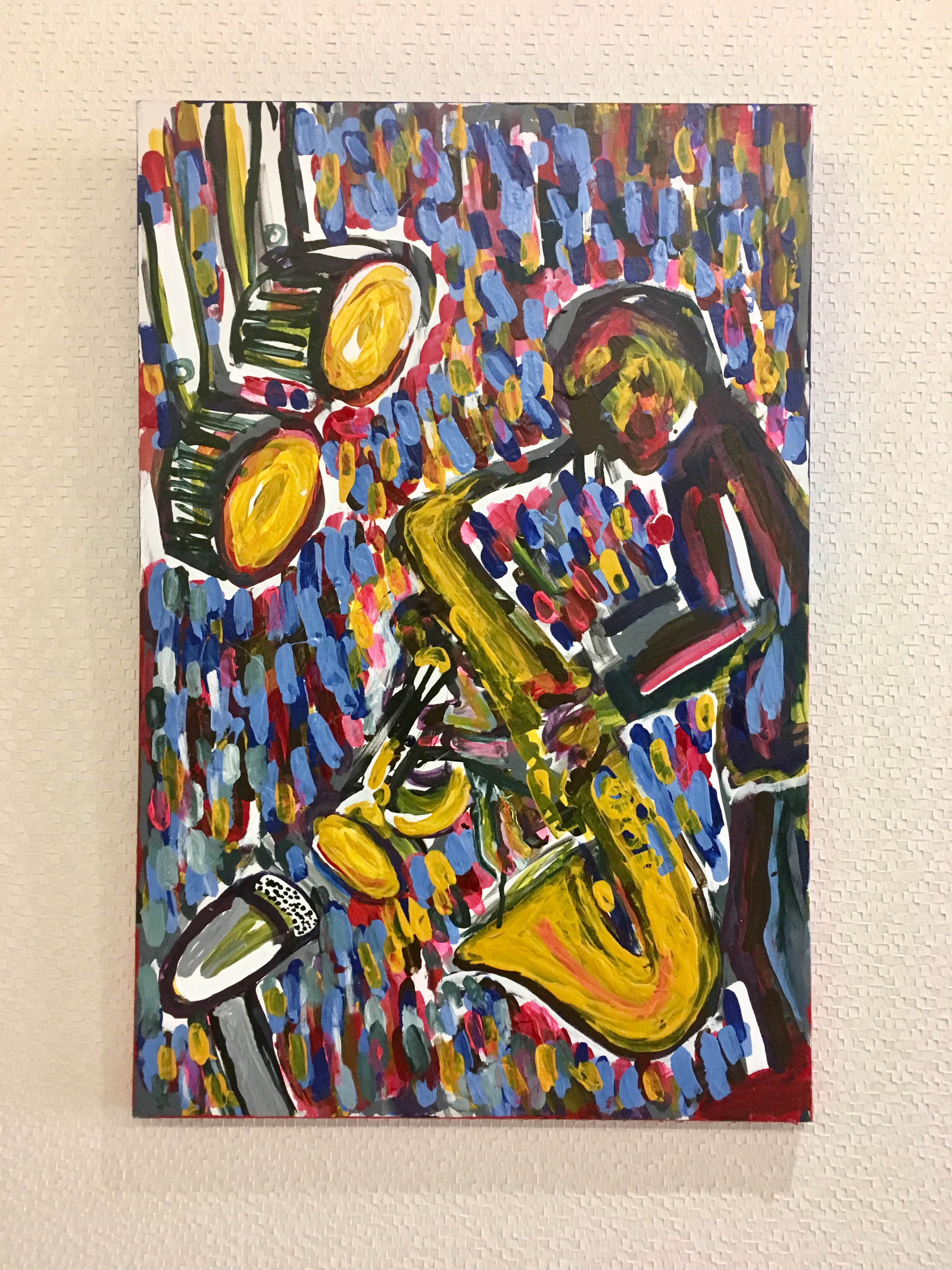
(#1001) After the Movement of the Blue Note Mystery

24 x 30 inches

$880

Acrylic on Canvas

A standing, bowed saxophonist emerges into the canvas on the right. He plays a golden saxophone that is almost the length of his body. A smaller figure playing a trumpet is behind him. Both figures play into a silver old-fashioned microphone in the bottom left-hand corner of the canvas. Two golden spotlights hang in the top left corner of the image. The background is a repetitive rhythm of short, blunt strokes of blue, pink, purple, yellow and maroon.

FullSizeRender-2

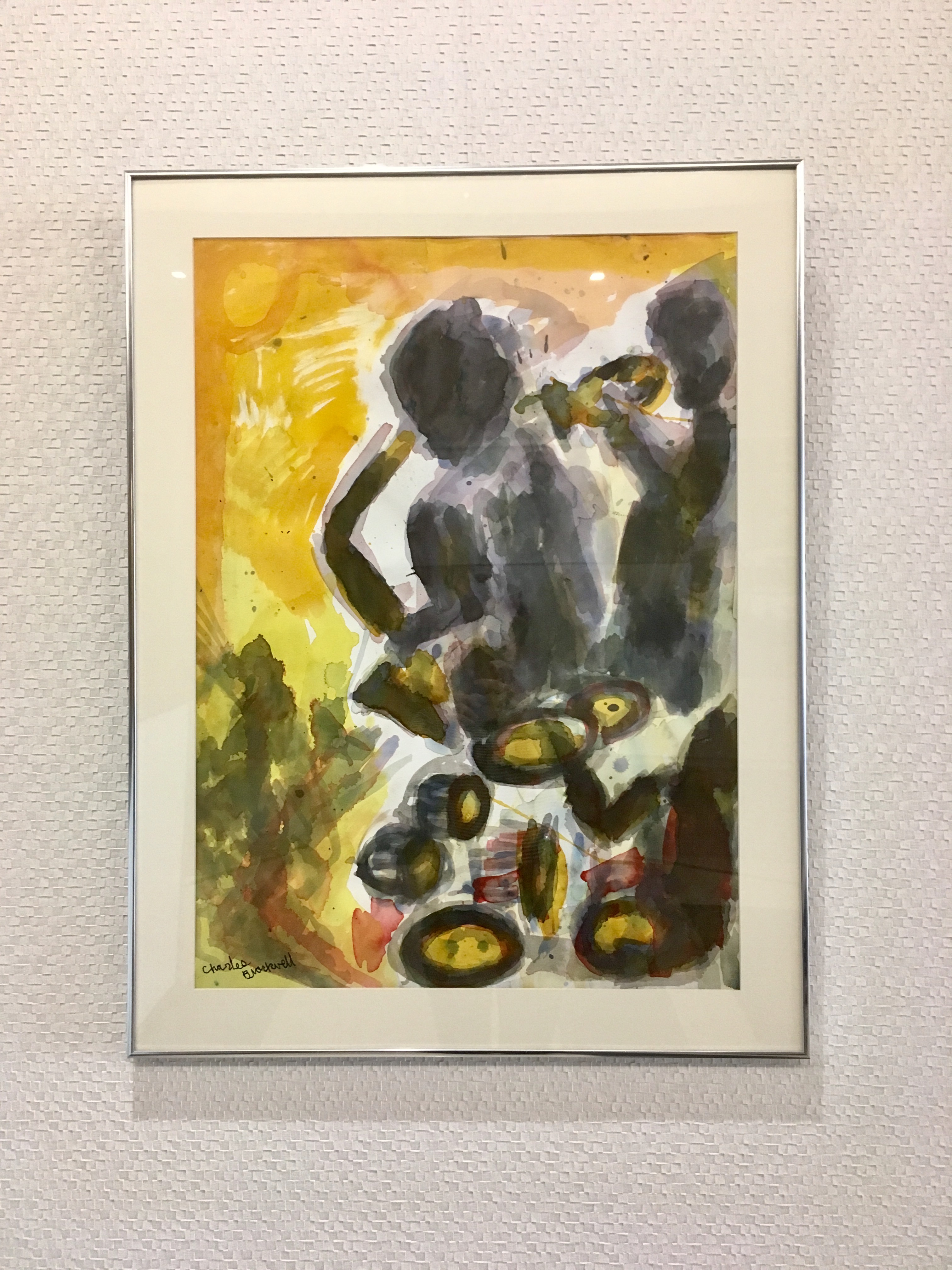
(#14) Savory Smoky 1967 Night Club

2013

26 x 34 inches

$875

Ink on Paper

A freely depicted trumpet player, saxophonist and drummer are grouped at the right of the painting, all in smoky tones. Their instruments are accentuated with yellow. The background is a warm wash of yellow with a few red accents.

FullSizeRender-3

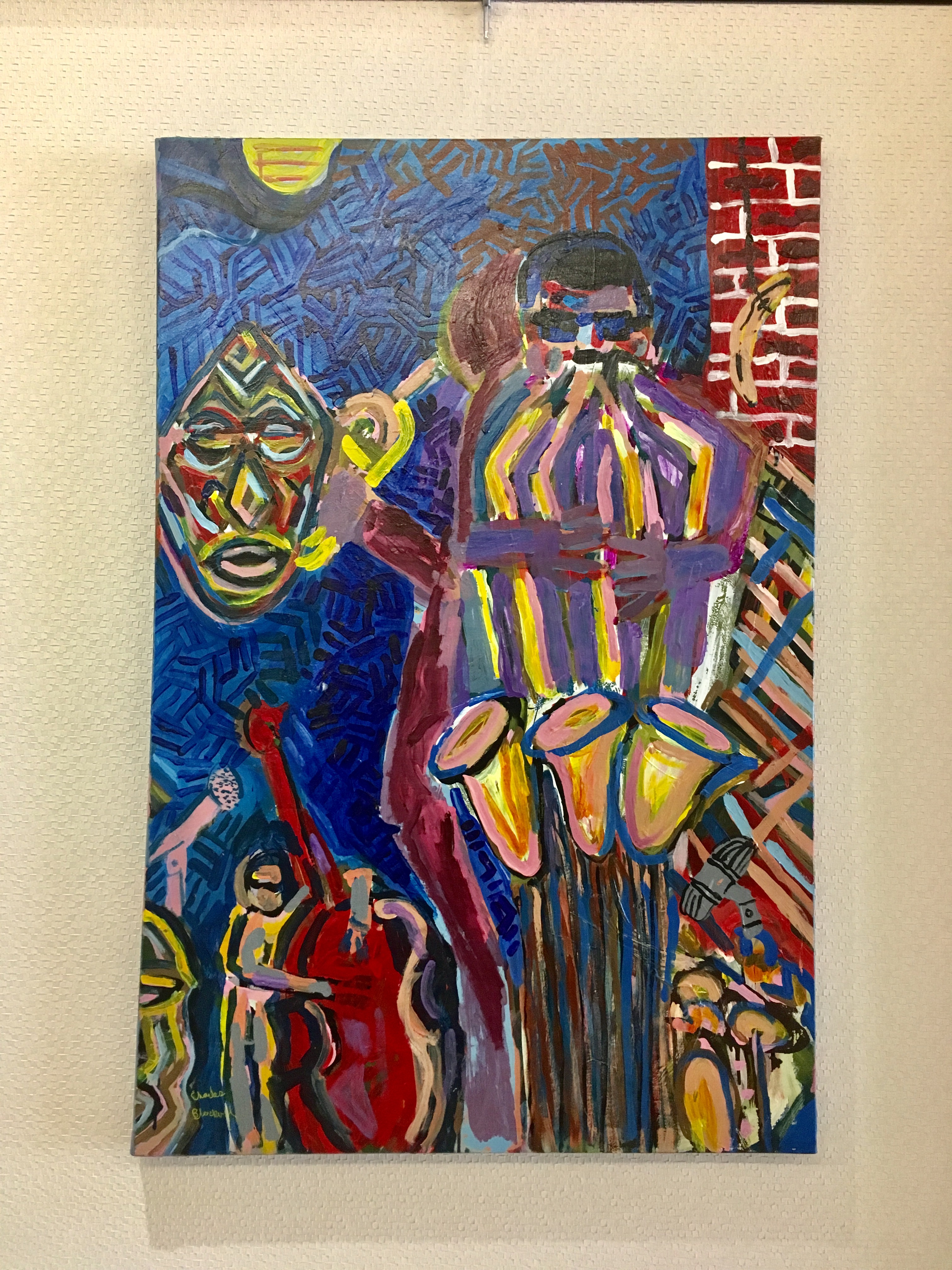
(#1004) Downstairs in the Dark of Blue with Rahsaan Roland Kirk Inflated

57 x 38 inches

$3,800

Acrylic on Canvas

Jazz artist Rahsaan Roland Kirk wears sunglasses and plays three saxophones at once. Directly behind him is a trumpet player, and in the background, a small bassist and a drummer. A mask adorns the wall and a banana hangs from the sky to the right of Kirk. All of the figures are made up of bold lively pinks, purples, yellows, reds and blues. The background is a deep blue patterned with straight but variable lines.

FullSizeRender

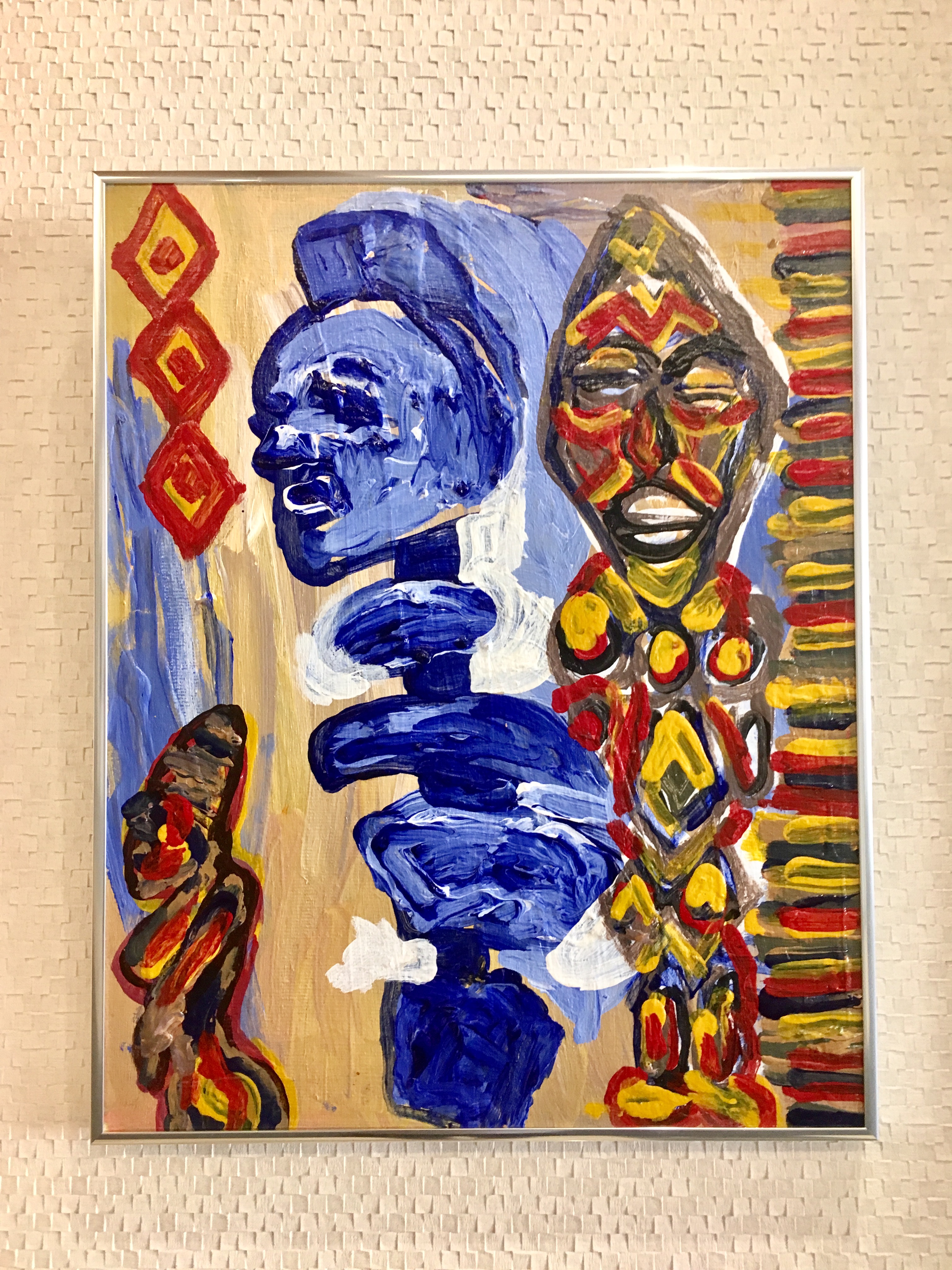
Kulu se Mama in Conference with Moe Betta over Lucy

16 x 22 inches

$750

Acrylic on Canvas Board

Three African-inspired figures stand, statue-like, in a row. The smallest, on the left, is a female form, perhaps in the distance. The figure in the center is indigo blue and the other two are covered in geometric patterns in bright red and yellow.

Stop by our headquarters at 1155 Market Street to view the full exhibition! 

Cycle for Sight: Join Team LightHouse in Napa on April 22!

Cycle for Sight: Join Team LightHouse in Napa on April 22!

“She’s game for things that a lot of people aren’t,” says Marc Sutton of his fitness partner Ginger Jui. “She’s willing to go on dirt, she’s willing to go down steep stairs. The more you ride with someone, the more you have that built trust. I feel safe with her, but I feel like it’s not an overcautious safe — it’s just like, alright, let’s go have fun… something exciting is going to happen here. Let’s see what it is.”

Marc and Ginger have been riding tandem together for going on eight years. For Marc, who is blind, riding with Ginger creates a physical outlet that gets him out of his mind and into his body. For Ginger, it’s a pedaling meditation and a chance to catch up and talk about life. Both have gained a lifelong friendship. Get to know their story in the video below.

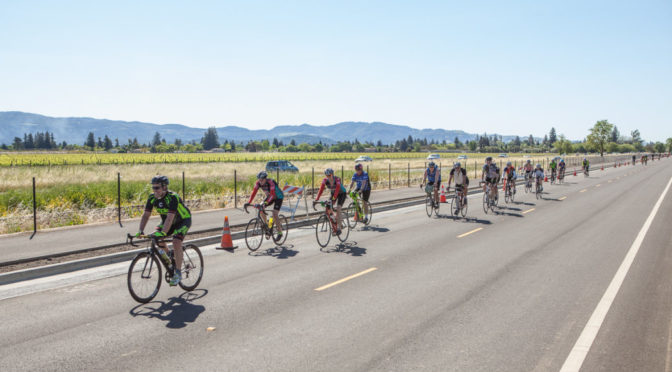
Every spring, LightHouse rallies a team of blind and sighted cyclists like Marc and Ginger to ride and train together for Napa Rotary’s Cycle for Sight and raise funds for Enchanted Hills Camp. You can ride on your own or join a tandem team for the 15, 25 or 50 mile routes through wine country with more than 2,500 other cyclists. This is also great opportunity for Anthem and USABA’s National Fitness Challenge to set new and different fitness goals!

Start by signing up for Cycle for Sight and select Team LightHouse at signup. Then contact Tony Fletcher at tfletcher@old.lighthouse-sf.org or 415-694-7319 if you’re interested in being part of a tandem team. Check out the existing members of our team!

If you’re curious about riding tandem but haven’t done it before, don’t fret — we’re offering free trainings in early April, so you can join the event with confidence. Mark your calendars for these upcoming training sessions at Bay Area Outreach & Recreation Program (BORP) at 3075 Adeline St #200 in Berkeley. Tandem bikes will be provided onsite, so contact Dagny Brown at events@old.lighthouse-sf.org or 415-694-7333 to reserve your spot.

April 6 – 5 p.m. – 7 p.m.

April 13 – 5 p.m. – 7 p.m.

April 15 – 11 a.m. – 1 p.m.

Members of Team LightHouse get a snazzy biking jersey and the opportunity to help raise vital funds for Enchanted Hills Camp for the Blind. All participating cyclists will receive an individual rider profile on our Cycle for Sight page, with a built in donation form. If you’re interested you can crowd fund via your individual rider page after you sign up and answer a few questions about yourself.

Raise $300 or more to receive a free stay the evening before the ride at Enchanted Hills, including meals! We also offer a prize for the person or tandem team who raises the most contributions. All proceeds support Enchanted Hills Camp. We hope you’ll join us!

Visit www.cycle4sight.com for route information, start times and more info.

Maker Faire: LightHouse & Oracle Present an Accessible Weekend-long Retreat for Blind Makers

Maker Faire: LightHouse & Oracle Present an Accessible Weekend-long Retreat for Blind Makers

“Blind people are makers. Since 1917 LightHouse blind workers under the Blindcraft label have made everything from fine rattan furniture to advanced basketry and even chains and rope for the US Navy. Today, blind people solder, build robots and do advanced woodworking,” says Dr. Joshua Miele, Associate Director of the Smith-Kettlewell Eye Research Institute, organizer of the local Blind Arduino Meetup and LightHouse Board Member. “We might use slightly different techniques, but the outcome is the same. The LightHouse is all about teaching these alternative techniques so that people can engage in the activities they love, whether they’re sighted or not.”


At LightHouse, we know a lot of accomplished blind makers, which is why we offer blind soldering workshops, science and craft courses both in San Francisco and Enchanted Hills Camp in Napa. This spring, we’re looking for up to 20 young makers to attend the very first “Maker Faire, Made Accessible”: May 18 – 22.

The new LightHouse Maker Faire Made Accessible will be a packed weekend of hands-on experience for blind young adults interested in the maker movement. The weekend will include an overnight stay at LightHouse with a series of events and a daylong trip to the Maker Faire in San Mateo. Expect hands-on learning, guided tours of Bay Area’s Maker Faire facilitated by Oracle volunteers, and demonstrations by blind makers eager to show other blind makers the tricks of their trade. Thanks to a generous grant from Oracle we’ll be offering full scholarships to cover fees and travel expenses for a few lucky participants — so sign up early! The deadline to register is May 5.

Maker Faire Logo

Maker Faire is a celebration of the Maker Movement, a showcase of invention, creativity and resourcefulness. The Bay Area’s Maker Faire is the largest Maker Faire in the nation, right in the heart of Silicon Valley in Northern California. Part science fair, part county fair, and part something entirely new, Maker Faire is a gathering of tech enthusiasts, crafters, educators, tinkerers, hobbyists, engineers, science clubs, authors, artists, students and commercial exhibitors. “Makers” come to Maker Faire to show and share what they have made and what they have learned.

The weekend will use LightHouse headquarters as a home base to expand upon and explore all that Maker Faire has to offer. Our core group will consist of blind makers age 14-30, but we encourage those outside the age range to apply.

Starting on Thursday, May 18 we’ll welcome 20 blind participants from across the country and the region to the LightHouse Headquarters in San Francisco. Students will stay at the new LightHouse student residences, which houses up to 29 students.

On Friday, May 19, students will participate in tutorials, workshops and presentations with blind mentors who are makers themselves. They will offer hands-on demonstrations, exhibit their own work, and provide tailored guidance and consultation.

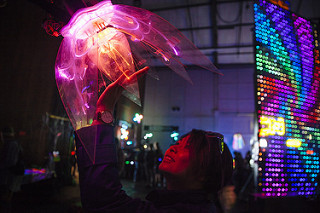
A woman touches a light sculpture at the Bay Area Maker Faire.On Saturday, May 20 students will travel as a group to the Maker Faire for guided tours with Oracle volunteers. Volunteers will accompany students one-on-one to describe the projects showcased at the various booths, and stop off at a few booths of blind makers.

And finally, on Sunday May, 21, former LightHouse Board Member Jerry Kuns will lead participants on a guided walking tour of San Francisco.

To sign up for Maker Faire 2017, receive an application, and determine your eligibility for full scholarship, including travel, please contact youth@old.lighthouse-sf.org or by phone at 415-694-7372.