Category Archive

LightHouse News

Enjoy a summer of stories, trivia and songs with Enchanted Hills Camp Virtual Campfires

Enjoy a summer of stories, trivia and songs with Enchanted Hills Camp Virtual Campfires

By Caitlin O’Malior

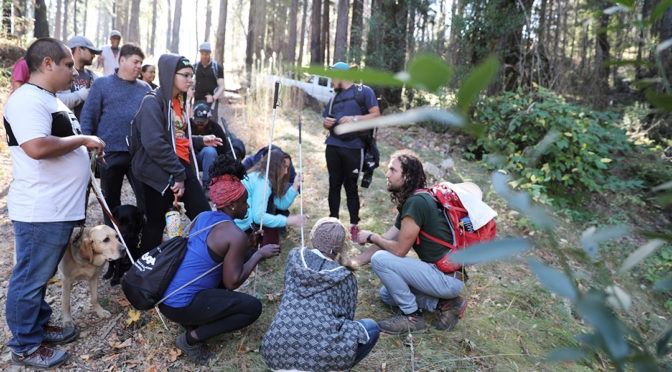
With the devastation of the coronavirus and the state ordered shelter in place safety restrictions, LightHouse’s beloved Enchanted Hills Camp has had to temporarily close its cabin doors. But that doesn’t mean campers will be completely deprived of fun this summer—dust off those hiking boots, grab a cozy camp sweater, and gather around the virtual glow of a Zoom campfire! The terrific staff of Enchanted Hills will be hosting virtual campfires and all campers, young and old, big and small, are invited to join in on the fun starting Saturday, June 6, from 7:00 p.m. to 9:00 p.m.

These fun-filled evenings will consist of all your favorite real campfire traditions, including camp’s traditional opening campfire ceremony rituals, special guest performances, and singalongs. Campfire attendees will also be informed of rebuild updates and all other camp related program offerings.

Enchanted Hills Camp Director Tony Fletcher, reflects on the upcoming virtual campfires.

“I feel strongly that our virtual campfires will keep our camp community connected to Enchanted Hills. Virtual campfires and other activities will prove our resilience and ability to live our motto, that flexibility is key. In offering this program, we are not dismissing the importance of physically being together, but this is a preliminary step for us to take to help us plan on being together again.”

Enchanted Hills is the heart and soul of LightHouse. The EHC staff is working hard to bring the fun and nostalgia of camp to its dedicated community members by adapting beloved camp traditions to an online platform as Tony states, “In reality, what we are doing this summer will have a lasting program impact for the future,

Due to the current global crisis, LightHouse is quickly finding ways to adapt and make virtual events such as EHC’s campfires part of the new normal as Tony explains.

“We may offer virtual programming simultaneously with in person programing in the future such as campfires, talent shows, concerts, discussion groups and educational presentations. We are rebuilding camp with a fiber optic system that will make all of this possible. We have former campers and staff that live all over the world and now they will be invited back to camp.”

If you are one of the hundreds whose heart resides at Enchanted Hills Camp in Napa Valley, then warm up those pipes and sing along ‘til your heart’s content at EHC’s first virtual campfire for everyone June 6. And if you or your campfire neighbor is just a little off-key, there’s always the mute button. Just one of the many perks to the virtual world.

EHC Virtual Campfires run most Saturdays through August 15. There will be sessions for youth and their families, adult campers and teens. Contact Alyah Thomas at athomas@old.lighthouse-sf.org or 415-694-7345 for more info or see the full virtual campfire schedule on our calendar.

Share your wisdom and shine has a youth mentor

Share your wisdom and shine has a youth mentor

I realized that since LightHouse Youth events are all held over Zoom these days, I actually have time to be a volunteer mentor. As a staff member at LightHouse who has low vision, I have often felt the desire to share some of my educational and professional experiences with the younger generation. I was offered some amazing opportunities during my youth, but also remember being discouraged and left out of several interesting programs and events. If an adult has been willing to share their story when I was a teenager struggling to fit in and discover my dreams, I would have appreciated that tremendously. So, I contacted Ann Wai-Yee Kwong and Jamey Gump to see if they could use a mentor volunteer for any of their upcoming programs.

Next thing I knew, I was on the agenda for the next week’s “Not So Bored Game Night” and “Youth PLUG-In”, both held over Zoom. It turned out that the participants had been wanting to talk to a writer who is blind, and the topic for that week’s PLUG-In was “The Art of Writing”. It felt like this was just up my alley as a Communications major in college, a grad school recipient of a Masters, and currently working at the LightHouse in the Communications Department. I write for fun, for work and for processing my inner-most thoughts. It was a joy to share how these forms of writing overlap and differ, and what writing tools I have used over the decades as I have experienced various levels of sight.

Not only was it exhilarating to discuss their professional growth and perhaps spark an interest in writing for pleasure, but I also got to let my inner teen shine at the Not So Bored Game Night. An exciting highlight was being able to judge a house scavenger hunt. Jamey and I judged each of five rounds where students had to gather items. It was a challenge of the heart not to pick the person that seemed to need a little extra love and, instead, go for the person who really deserved it, like the teen who brought their tiger stuffed animal to fulfill the item “something fuzzy”. I’m still crushing on that tiger!

If you find you have some flexibility in your schedule and are comfortable with Zoom, there are plenty of opportunities coming up for you to support our youth by volunteering to be a mentor for their upcoming programs. The Not So Bored Game Night continues on Tuesdays from 7:30 p.m. to 8:30 p.m., and there is a Sensing the Seasons Workshop June 12 through 14. The Youth Employment Services or YES Academy will be online July 6 through August 7 on Mondays, Wednesdays and Fridays. We are even hiring a mentor for the YES Academy, so visit our career opportunities page for details. Check out our website calendar for many other programs and events, or else email youth@old.lighthouse-sf.org for more information and other opportunities.

How One Camp Changed the World

How One Camp Changed the World

“I had to fit into this world that wasn’t built for me” says one former camper at Camp Jened. For myself and many others in the disability community, this sentiment rings true at some point in our lives. Luckily for a large group of teenagers from the 1950s through the 1970s, there was a place built for them, called Camp Jened. Thanks to Executive Producers Barack and Michelle Obama, the documentary “Crip Camp” gives us a glimpse into this world and how that unique time led to the disability rights movement as it stands today.

Camp Jened was founded in the 1950s in upper New York as a place for young people with disabilities to experience summer camp and not feel as though they were on the outside looking in, as they often felt at home without basic civil rights in place. The camp was partially funded and supported by the parent led Jened Foundation

Directed and Produced by Nicole Newnham and Jim Libbrecht (a former Jened camper), “Crip Camp” shows incredible footage taken at the camp in 1971 where campers are seen letting loose and being themselves. While they are often overlooked in their communities back home, they are invited to speak freely about themselves into the camera.

We at the LightHouse recognized some of the crucial people documented and interviewed who were in the disability rights movement. Corbett O’Toole has served as the Accessibility Consultant at the Superfest Film Festival run by the LightHouse. Jim LeBrecht is a long-time friend of the LightHouse. In addition, the part of the film documenting the sit-in at the San Francisco Federal Building portrayed our neighboring building as a character in and of itself. We must also give thanks to Dennis Billups, who had an important role in the passing of the 504 document, regulations to the Rehab Act. He has been a speaker at LightHouse and continues advocating for and inspiring future generations in the blindness community.

A ripple effect spread from Camp Jened across the country, emulating the Civil Rights and other movements. “Their efforts contributed many advocates and philosophies to the American disability rights movement”, says Bryan Bashin, CEO of LightHouse for the Blind San Francisco. You could see they took what they learned at camp to the movement, especially at the 1977 sit-in at the Federal Building in San Francisco. In practicing inclusion, they always refused to hold any meeting until a sign language interpreter was present.

Since the time that Camp Jened started in the 1950s, our own Enchanted Hills Camp has been doing its part on the West Coast for decades to advocate for and foster community in the world of blindness and disability.

Enchanted Hills Camp Director Tony Fletcher reflects on EHC in light of this documentary:
“In 1950, Enchanted Hills Camp was founded on the principles of connecting blind youth to nature and recreation. Rose Resnick, (founder of EHC and an important part of the founding of LightHouse for the Blind San Francisco), felt there was a huge deficit on both accounts for blind youth. She herself had a passion for both nature and physical fitness. To get there, however, she knew campers must develop self-confidence, build independent living skills and become productive members of society. Rose did not want blind folks to be taken care of, she wanted blind folks to have the same opportunities as sighted folks to take care of themselves. Camp was not given to Rose. She was an advocate. She fought, fundraised, haggled, recruited and created the vision for the first camp for the blind west of the Mississippi. More importantly, it was founded by a blind person. As a program that walks the walk, we hold true to those very same values today and realize we produce the future leaders of tomorrow. We believe in promotion of independence, but we have learned to do it thru fun. From the building blocks of independence came advocacy and empowerment. Today many professionals in our field have had a connection to Enchanted Hills Camp. Some come as staff or volunteers, some as guests, but many come as campers that have attended Enchanted Hills Camp in one or more programs offered throughout the years.”

Our CEO Bryan Bashin, looks ahead and shares our vision: “As we rebuild our own camp, we hope it will be even more of a crucible in which friendships, idealism and social justice will be forged.”

LightHouse and Uber partner to provide transport for essential workers

LightHouse and Uber partner to provide transport for essential workers

In December last year, LightHouse was thrilled to be selected by Uber as a partner in its Community Impact Initiative program. Since 2017 the ride-share company, in recognition of the fact that access to transport is often a barrier to opportunity for many people, began partnering with not-for-profit organizations to provide rides free-of-charge to those in need.

The purpose of the LightHouse partnership with Uber was to make it easier for students to get to LightHouse locations to attend classes, one-on-one lessons and social groups. And, we all know what happened next: coronavirus changed everything for us all. LightHouse had to have all employees who could work remotely move to working from home. We had to close all face-to-face classes and any face-to-face interaction had to stop.

What couldn’t stop though was the essential work being carried out at LightHouse Industries (LHI) in San Leandro, for it is here that essential workers are involved in the process of making and shipping Pride All-purpose cleaner, Pure Bioscience disinfectant and tissue packets. In fact, demand has increased exponentially, and each weekday, and on some Saturdays, essential workers who have low vision or are blind have been working overtime to fill orders.

To support this essential work, Uber agreed to change the terms of its partnership with LightHouse, so LightHouse essential workers could benefit. So now Uber is transporting employees who require a ride, to and from the San Leandro factory free of charge so they can continue to do their necessary work and fulfill a need for the community.

LHI employee Jennifer Holloway said in a recent interview with San Francisco local radio station KALW: “I love my job and these people are like my family. But it is hard work, we are on our feet all day, so I am really grateful to be able to take Uber each day.”

Another LightHouse employee, Caitlin O’Malior, also uses the Uber Impact Initiative partnership with LightHouse to do her work. Once a week, Caitlin takes an Uber ride to go into LightHouse headquarters to assess signage sent to the LightHouse by organizations that must make their signage ADA compliant.

Caitlin has recently moved to an area in San Francisco from where it is difficult to reach the LightHouse by public transit. Caitlin is also not comfortable taking public transit during the epidemic. She, like Jennifer, is very grateful to Uber for its Community Impact Initiative program and its partnership with LightHouse, as are we all, thank you Uber.

Need blindness products? Adaptations Reopens for Online Orders

Need blindness products? Adaptations Reopens for Online Orders

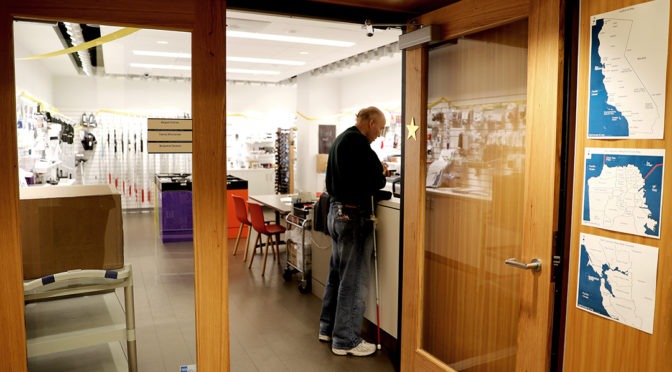
As we continue to shelter in place and do our best to help slow the potential spread of COVID-19, the staff at Adaptations knows how invaluable some of the items we carry can be in the day-to-day lives of people who use them. While we must all do what we can to keep one another safe, we also understand firsthand things like how essential it is for a blind person to have a cane when traveling, perhaps now more than ever. It is imperative that someone who has low vision be able to purchase a new magnifier to read things like cooking directions, or medication instructions. It is helpful for someone who is blind or low vision to be able to order their own, customized tactile map, should they wish to become familiar with an unknown neighborhood. During this time of quarantine, it is critical that we all, blind and sighted alike, have access to an accurate thermometer when we wish to know our body temperature. The good news is that all these things are available from our Adaptations store, and better news still: You will soon be able to resume placing your orders online.

Adaptations.org will begin taking orders again on Friday, May 1, 2020. Shipping times are delayed slightly due to circumstances surrounding COVID-19; however, you will be notified via email as soon as your order ships.

We will also be on hand to answer questions about products and accept orders by phone during our newly extended weekday hours of 8:00 a.m. to 5:00 p.m. Pacific, Monday through Friday. Customers wishing to place a phone order can reach the store by calling 888-400-8933 and leaving a voice mail message, then one of our staff will call you back to complete your order.

To show our appreciation for so many loyal customers, we are taking 10% off any item purchased at Adaptations during the entire month of May. Whether you place your order online or over the phone, don’t miss this opportunity to stock up and save.

We can’t wait to see you there!

Caring Calls from LightHouse

Caring Calls from LightHouse

“I’m so glad that you called.” – said Isabelle, a LightHouse community member in response to a recent Caring Call.

Being a person who is blind or low vision can be isolating. Even prior to the pandemic we are currently facing, far too many people who are blind stay at home, fearful of going out in the world.

Under ordinary circumstances LightHouse works relentlessly to combat this isolation, bringing blind people together in immersive classes and growing a community of support, learning and engagement. But now, as we do our part to flatten and lengthen the curve, LightHouse is finding new and meaningful ways to keep making life-changing connections, despite the limitations of shelter in place.

In response to the mandated social distancing which closed LightHouse offices in March, LightHouse has begun making Caring Calls. Almost one-third of our staff are making thousands of calls to LightHouse community members, checking in on their mental and physical well-being. Staff compiled resource lists for all twelve Bay Area counties with information on getting groceries, eviction and legal resources and transit information. The calls let people know about our new remote programming to foster dialogue, encourage our community’s use of accessible technology to stay connected, ideas on how to maintain fitness and a host of new options for blind people of all ages.

For example, Coffee with Mike Cole, a weekly in-person get together at the LightHouse where people talk about a variety of topics, is now offered by Zoom and phone. In this time of seclusion, this opportunity for camaraderie has proven quite popular, and participation has tripled. Some students are even opting to receive a regular call from a volunteer who checks in on how they are doing.

Isabelle, a 67-year-old student visited the LightHouse to learn white cane skills last year. In a recent call, she told us that, although she was doing fine and had moved in with her family to ensure that she has ready access to meals, she still felt tremendously displaced and disconnected. The LightHouse staff member was able to refer Isabelle to a LightHouse therapist to receive services remotely during this challenging time.

Hands On Goes Virtual

Hands On Goes Virtual

By Caitlin O’Malior, Alternate Media Specialist

With the outbreak of COVID-19 and strict orders on social distancing, the world around us is changing the way we are operating in order to conduct business as usual. The dedicated staff at LightHouse has welcomed the challenge and have been offering a variety of virtual programs and workshops via the online application Zoom. One of the star programs in our virtual lineup is our Independent Living Skills (ILS) workshop, Hands-On Goes Virtual, hosted by a dynamic duo of ILS specialists, Bobbi Pompey and Dawn Leeflang. Every Friday morning at 10:00 a.m. for an hour and a half, LightHouse students from all over the Bay Area call in on their phones or internet devices to learn ILS “life hacks” through interactive instruction and discussions with the group leaders.

“Hands On” is not new to LightHouse students, but Bobbi and Dawn have significantly expanded their program from a monthly workshop offered at two separate LightHouse sites to a weekly workshop. Over the past few weeks, Hands-On has gained a huge following. The most attended workshop thus far has been the COVID-19 and Emergency Preparedness course. The instructors discussed what essential items should be included in emergency “Go Bags,” how and where to obtain these items, and, perhaps the most relevant and requested ILS tip: how to make simple and effective face masks from items found in your home.

“We have had to create the virtual workshops with a short turnaround time; we did not have the curriculum for Zoom workshops in our back pocket, so we had to improvise quickly.” says instructor Dawn Leeflang. “’In Case of Emergency” was initially going to focus on basic Emergency Preparedness, but we expanded it to include shelter in place guidelines related to the current COVID-19 emergency, including making a simple face mask.”

Hands-On regular, Cheryl P. says, “I find the program very informative. It keeps me up to date on information. Being at home right now, it’s just me. So, this also gives me the opportunity to connect with other people.”

Many students agree, the ability to connect and interact with one another has been just as valuable as the skills and information discussed in the workshops. There has been a noticeable increase in participation. Some students with limited mobility or travel options have found the virtual workshops more accessible than the traditional in-person workshops. “The expansion of online services and programs has helped LightHouse staff and students stay connected, informed, and contributed to the blind community.

“Virtual workshops are something I definitely want to continue developing and offering, moving forward,” says Leeflang.

If you are learning about Hands-On for the first time and are kicking yourself for missing the essential “At Home Face Masks” instructions, the steps can be found by following this link to a PDF created by ILS instructor Dawn Leeflang.

Here are the topics for the Hands-on series throughout May:

May 1: A Taste of Cinco de Mayo
Come celebrate Cinco de Mayo with us as we prepare a few festive foods. Dawn Leeflang will do a demonstration of how to prepare quesadillas while explaining the basics of stovetop safety. Afterwards, Bobbi Pompey will demonstrate methods of making the perfect Margarita, complete with flavor variations, non-alcoholic versions, and techniques for pouring shots non-visually. Lastly, students will prepare their own pitcher of refreshing Aguas Frescas! Please come to class with a pitcher or container to store your Fresca, sugar or some other sweetener, and fruit. Fruit can be fresh, frozen, or canned.

May 8: Folding Frenzy
Brush up on those tactile skills while learning how to make beautiful and practical creations. The class will begin with methods of folding dinner napkins into decorative shapes and end with folding paper into whimsical origami. Students should come to class with a fabric dinner napkin or a heavy duty paper towel, one set of silverware, and paper. You can use plain printer paper, colored construction paper, wrapping paper or any other paper you have around the house.

May 15: Sewing Made Simple
Join us as we tackle sewing basics like threading a needle and putting on a button in this week’s installment of Hands On! Sewing has several practical uses and even more fun ones. We’’ll start with the basics and by the end you will have made a soothing hot/cold compress for your eyes. This compress can be put in the microwave or the freezer and be used to ease headaches/migraines or as a way to relax and unwind and decompress. Materials for this workshop will be mailed out to you, so in order to receive your materials, you must RSVP before noon on Friday May 8.

May 22: Keep it Cute: Maintaining Your Appearance as We Shelter in Place
Hair salons, barber shops, nail salons, waxing businesses, and other grooming/beauty related establishments are now closed as we all shelter in place and do our parts to flatten the curve. But, that does not mean you have to go without. Join us as we discuss several ways of maintaining your personal appearance from the comfort of your own home. We’ll cover adapted techniques for applying nail polish, trimming split ends, and tweezing your eyebrows. Making a DIY scrub that can be used on your face, hands, or body will be our closing activity. Please be prepared for class with measuring spoons, sugar, honey is desired and oil. Olive, coconut, avocado, jojoba, vitamin E, grape seed, or any other oil that can be used on the skin can be used for this scrub.
 
May 29: Hands On Hiatus

There will be no Hands On Workshop this week. Join us on June 5 for our next workshop.

LightHouse offers specialized help with Be My Eyes

LightHouse offers specialized help with Be My Eyes

If you’re not yet familiar with the Be My Eyes app, check it out on the App store or Google Play. The idea is brilliant in its simplicity. A blind or visually impaired person needs help finding out what’s in a can, or how to use the washing machine in an unfamiliar hotel laundry for example. Simply open the Be My Eyes app, tap or double tap to call using video, and more than two million plus volunteers around the world are a resource open to you. They have signed up to take video calls to help blind and visually impaired people with visual information. Be My Eyes is a free app and free service for all.

Recently, specialized help has also been available through the app. So if your difficulty is with your Microsoft product, you can choose to contact their technical support from a list within the app. And soon, LightHouse will also be listed as an option to call on for specialized help.

Choose LightHouse from the list and you will be video calling directly to one of our helpful staff. Have a question you’d like to ask about our programs? Be My Eyes us. Want some more info about one of our events? Be My Eyes us. We’re eager to talk to you, and soon there will be one more way to reach us. Look for our official launch in mid-May!

How LightHouse staffer Ethan Meigs went from Sociology to Information Technology

How LightHouse staffer Ethan Meigs went from Sociology to Information Technology

Ethan Meigs, LightHouse Information Technology Technician, writes about his blindness and how he became the first blind IT Technician in LightHouse history.

I am 37 years old and a native Californian, who began life legally blind in both eyes. I spent my childhood in Southern California attending public schools using magnification and large print textbooks. I was always outdoorsy, playing whatever sport I could get my hands on. I could never see the details like the rim on the basketball court or the angle of the landing ramps when taking flight on my BMX, but never let that get in the way of keeping up with my friends. As I got older and my vision slowly began to change, I left to work for UPS in Kentucky. You can imagine the things a 19-year-old and his friend could get up to in the backwoods of Kentucky. One memorable experience was hopping on the all-terrain vehicle in the middle of the woods. I was low vision and following my friend’s bright orange hunting vest at full speed and somehow ended up stuck between two oak trees when crossing a shallow, fast-running creek. I mean, I ended up looking like Austin Powers stuck between two walls in his electric cart. There were other things, but let’s just say if we are ever invaded, I have learned some cool home security tricks. I found that lack of transportation and access were an issue, so I moved back to California in 2002.

While in the middle of my upper division classes, I was offered a job at what was then Junior Blind of America and now Wayfinder Family Services. I became the Assistant Coordinator for the Student Transition and Enrichment Program. I continued to work that job while completing the final research paper for my Masters in Assistive Technology and Human Services at Cal State University Northridge.

Once my time at Junior Blind was done and I completed my degrees, I had time to reflect on what I really wanted to do. I found great value in working with youth. I was motivated to help others avoid the barriers and pitfalls I found in my path up to that point, so I began searching. I fell into Sociology in college because of a girl, and found I really enjoyed it. I didn’t pursue a Masters in Sociology because I didn’t think it had great long-term employment prospects.  I found that technology was vital to leveling the playing field while Sociology developed my talent for understanding people and institutions. I began looking for a job that would allow me to utilize both talents while giving back to the blind community which, through mentors and relationships, had given me so much and brought me to this point in my life.

LightHouse for the Blind in San Francisco promoted itself as an agency which meets people where they are, and I noticed that out of all the agencies I had experienced throughout California, LightHouse seemed to be the only one who walked the walk as far as employing the population they championed: close to half of their staff were blind or low vision. Thus, began my journey with LightHouse in December of 2016.

Through my time in the Access Technology department, I found that I really enjoyed learning the details of how things work and presenting them to groups and individuals. I enjoyed working one-on-one with students but after a few years, I began opening my mind toward new opportunities.

On February 1 this year, I started in my new role at the LightHouse, as an IT specialist. In the last few months, I have found I truly enjoy supporting my coworkers with daily operations and have been learning a lot at the same time. Although, if I had known I would be jumping into this role right as the entire agency was forced to go remote due to COVID-19, I might have more carefully thought about the decision.

It’s been challenging to learn the entire process used for onboarding of machines, and the implementation of Virtual Private Networks, which enable employees working remotely to connect to our networks. Not to mention, the fact that I am still learning on the job.

As a parting note, the two mantras which have stood me up through all my experiences are: “Those who say it cannot be done, should not interrupt the person doing it!” and the Chinese proverb, “The only thing necessary for the triumph of evil, is for good men to do nothing!”


By taking a pause, Enchanted Hills Camp will help flatten the curve

By taking a pause, Enchanted Hills Camp will help flatten the curve

Dear friends and supporters,

For almost a year, we’ve been preparing for the biggest and most fun-filled summer ever at Enchanted Hills Camp for this, our 70th birthday year. We’ve nearly completed the new pool bathhouse, spiffed up the dining hall and its commercial kitchen, deepened our lake and stocked it with fish and cleared away the last piles of debris from the 2017 fires. We’re on track to begin building a half-dozen replacement cabins in lower camp later this year. We’re also midway through a process with Napa County which will give us the permits we need to finish the camp-wide rebuild after the fire. It’s been such a good year in fact, that we committed to bring the entire world of blind camp leaders to EHC in 2021 to show off what we have built and to lead the field in designing the best blind camp programs anywhere.

Then, just three weeks ago, California counties were shut tight in a massive effort to slow the COVID-19 pandemic. Early reports this week show that the heroic isolation actions by Californians in particular are making a difference in the virus spread.

We at the LightHouse have known for some weeks that a decision was looming about whether the epidemic and government regulations would allow us to host our usual 600-plus blind campers, their families, staff and volunteers this summer. We hoped the epidemic would have burned through California by our traditional June start to our summer season. One-by-one, though, organizations are realizing that it may not be possible to host group events this summer. From the Olympics to the Democratic Convention, from the World Blind Union conference to Wimbledon, and the American Council of the Blind and National Federation of the Blind conventions, most are deferring their group gatherings until next year.

Camp Director Tony Fletcher and LightHouse leadership wrestled with these realities as the weeks dragged on. Could we screen campers entering camp to keep everyone safe? The medical facts are that people can harbor the virus for several days without showing symptoms and be infectious during that time. The virus can linger on surfaces for several days. Could we imagine keeping a six-foot distance between 100 campers and staff all week long? Most importantly, we couldn’t bear the heartache if even one camper contracted COVID at Enchanted Hills. To implement real protective measures at camp, we believe, wouldn’t make it camp at all. The closeness, camp spirit, hand-on-hand instruction, the heartfelt hugs and adventurous athleticism – none of this would be possible under current government guidelines.

Accordingly, in an abundance of effort to keep our community safe, for the first time in 70 years we’ve decided to skip the entire summer sessions of EHC. There will be no gatherings of any kind at camp until September 2020 at the earliest. We’re heartbroken to have to deliver this news to the thousands of people who have thrilled to EHC over the years and will thrill to it again when the epidemic is over.

If you are one of those hundreds of people who have already made reservations for your EHC summer, you have a few options. You can:

  • Get a full refund.
  • Apply your deposit to your stay during the 2021 summer season.
  • Donate what you might have spent at camp to our fire rebuild fund.

And you can participate in several distance camper events via Zoom as you’ll see below.

For information about your personal situation please call Alyah Thomas at 415-694-7345 or email her directly at athomas@old.lighthouse-sf.org.

With camp closed this summer, we’ve suddenly found a way to make excellent use of the rare circumstance of having camp empty during summer. We now plan to use the season to dig a massive 3,000-foot-long trench to finally underground all the overhead electric wires now strung haphazardly throughout camp. The trench project will remove fire-causing danger from these overhead wires and will give us stable and reliable power not threatened by falling branches and weather. We’ll fill the trench with new high-pressure water mains for fire hydrants, new pipes to service larger water storage tanks, with state-of-the-art optical fiber for reliable phone and internet service and use the new course to help us irrigate parts of camp never before able to be green in summer.

We could never have undertaken this project during a normal camp season, so it’s a small consolation that we’ll be able to start it sooner than planned. The $500,000 trench project will be finished well before we usher in the next wave of campers beginning next year.

All these post-fire reconstruction efforts take money, lots of money. We’re asking our extended community of friends to help with the reconstruction generously. To make camp safe and secure for the next 70 years takes sweat, imagination, and dollars. If you’re in a position to help with a donation or a pledge to our capital campaign, please write our Development Director Jennifer Sachs at jsachs@old.lighthouse-sf.org or just call her at 415.694.7333. And if you have some very big ideas on how to help camp, please contact me personally.

So, what to do this spring and summer to replace the EHC camp coziness around the campfire, or the easy socializing in the shade? Camp Director Tony Fletcher has the answer for kids, adults and their families. Beginning Saturday, June 6, Tony will host a weekly Saturday evening campfire-by-Zoom. You will be able to gather with Tony and the gang of counselors, volunteers and campers you know from previous sessions: telling stories, catching up and making some new friends. Tony’s first chat will be followed by many others through summer, with gatherings for various ages, personalities, interests and communities. Lighthouse will advertise the times and call-in details as the date approaches.

In the meantime, it’s spring at our camp. The grass is brilliant green, the creeks are running strong, the frogs are croaking and the wildlife abundant. Thousands of redwood seedlings are now eight feet tall after the fire, and visitors say camp has never looked more beautiful. It will be there, stronger and safer than ever when we emerge from our houses, blinking in the sun, and yearning for that special community that will persevere in a place called Enchanted Hills.

Our very best hopes that you stay safe and are well.

Bryan Bashin
CEO
Lighthouse for the Blind and Visually Impaired, San Francisco