Category Archive

LightHouse News

Check out the full schedule of EHC Virtual Teen Camp activities

Check out the full schedule of EHC Virtual Teen Camp activities

We’re just days away from the beginning of EHC’s Virtual Teen Camp. Join your EHC campmates for another magical (but totally unusual) summer of fun.  Virtual Teen Camp runs July 16 through 25 and is for people aged 14 to 20 who are blind or have low vision from all over. Drop in on Zoom for the sessions you like. The full schedule is below.

Thursday, July 16

Crip Camp movie and discussion, 7:00 p.m. to 9:00 p.m.

Friday, July 17

EHC “Give Back” Virtual Concert featuring blind opera singer Cristina Jones, 5:30 p.m. to 6:30 p.m.

Art with Julie Cabrera: Origami, 7:00 p.m. to 9:00 p.m.

Saturday, July 18

EHC Opening Teen Virtual Campfire, 7:00 p.m. to 9:00 p.m.

Monday, July 20

What’s the latest at EHC? From gardens to the cabins, presentation of the rebuilding efforts, 7:00 p.m. to 9:00 p.m.

Tuesday, July 21

So, You Think You Want a Guide Dog?, 1:00 p.m. to 3:30 p.m.

Teen Talk, Being Real, 7:00 p.m. to 9:00 p.m.

Wednesday, July 22

Art with Julie: Making Clay, 4:00 p.m. to 5:30 p.m.

Social Justice/Advocacy Discussion, 7:00 p.m. to 9:00 p.m.

Thursday, July 23

Art with Julie: No Sew Stuffed Animal: 4:00 p.m. to 5:30 p.m.

Music Trivia Night – Hosted by Masceo Williams, 7:00 p.m. to 9:00 p.m.

Friday, July 24

Art with Julie: Tie Dye Night, 4:00 p.m. to 5:30 p.m.

EHC “Give Back” Virtual Concert with blind classical pianist Fernando Apan, 5:30 p.m. to 6:30 p.m.

EHC Talent Show, hosted by Masceo, 7:00 p.m. to 9:00 p.m.

Saturday, July 25

EHC Closing Teen Virtual Campfire, 7:00 p.m. to 9:00 p.m.

To join any or all these activities, RSVP to Alyah Thomas at AThomas@old.lighthouse-sf.org

Now we carry tactile drawings of intersections that help teachers and students alike

Now we carry tactile drawings of intersections that help teachers and students alike

By Caitlin O’Malior

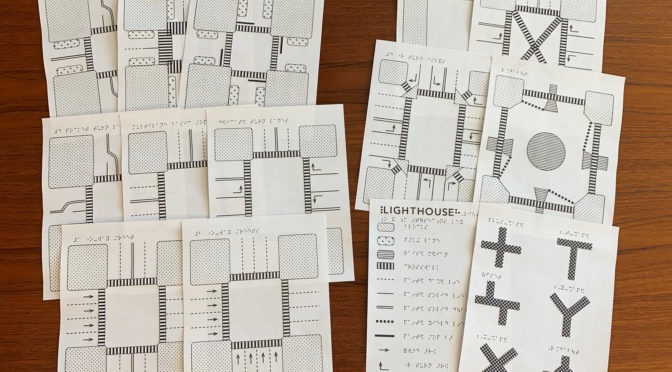
LightHouse and the Adaptations Store are proud to introduce the newest independent travel training tool in the Orientation & Mobility (O&M) field, the Tactile Intersection Diagrams Packet. This innovative tool was created through the collaboration of LightHouse O&M instructor Sarah McIntyre and the designers in LightHouse’s Media and Accessible Design Lab.

Sarah explains how these tactile diagrams will help people who are blind or have low vision better understand street intersections and crossings through tactile representation.

“O&M Instructors can use these diagrams to facilitate discussions about intersection design, the movement of vehicles, lane-by-lane scanning patterns, and other topics, such as street crossing recovery while working remotely or indoors. They can also be used as a supplement to onsite instruction and can be used as the platform for any number of innovative remote or indoor lessons for all students.”

When you purchase a packet, you’ll receive 13 different diagrams, including:

  • Intersection shapes
  • 4-way stop sign
  • Basic stoplight
  • Multilane basic stoplight
  • 2 pocket turn lanes
  • 4 pocket turn lanes
  • Dedicated turn lanes
  • 1 one-way street
  • 2 one-way streets
  • T-shaped intersection
  • 4 right-turn islands
  • Pedestrian scramble
  • Roundabout

All materials are printed on 8.5 x 11 Swell paper and have been produced by a PIAF (Pictures in a Flash) machine which raises the carbon in the ink print, creating smooth raised tactile lines and shapes. These new tactile intersection diagrams are an improvement upon previous designs.

“I’ve created other tactile intersection diagrams in the past, embossed in heavy duty foil, but they were very labor-intensive to make, were very bulky with sharp edges, and weren’t adaptable. Creating something that was easily portable, user-friendly, and adaptable was one of my ‘bucket list’ projects. I always had it in the back of my head to find out what it would cost to have MAD Lab design them…when the shelter in place order hit, I figured this was my chance to give it a try,” Sarah says.

The Tactile Intersections Diagrams Packet costs $55. If you are an O&M student, an O&M instructor, or someone who loves tactile literacy and learning more about intersections, this is the ideal product for you.

Order your Tactile Intersections Diagram Packet online today at Adaptations.org or call our store at 1-888-400-8933 between 8:00 a.m. and 5:00 p.m. Pacific, Monday through Friday, with your questions.

P.S. What’s a pedestrian scramble you ask?

A pedestrian scramble is an intersection that stops all vehicles, allowing pedestrians to cross the intersection in all directions, including diagonally.

Who knew? Our O&M Team…obviously…

Navigating the same storm in different boats: Reflections from Dr. Connie Conley-Jung

Navigating the same storm in different boats: Reflections from Dr. Connie Conley-Jung

I have been in what I call my “low vision zone”–others might call it legally blind–all my life. I grew up in Reno, Nevada. I studied Human Biology and Psychology as an undergraduate at Stanford University. I went on to earn a master’s degree in Special Education at San Francisco State University, with an emphasis in Learning Disabilities, and taught middle school and secondary school students prior to entering a doctoral program in Clinical Psychology. Although I discovered that I had an affinity for working with young people who have learning disabilities, I felt that I needed further training in clinical psychology to support their needs outside the classroom. After earning my doctoral degree and professional licensure as a psychologist, I went to work for a community mental health organization that served children and adolescents. I really appreciated this agency’s unique ability to serve young people from diverse backgrounds in both the educational and community mental health programs that it offered. Eventually, I decided to strike out on my own and started a private practice in the East Bay area.

It was the collaborative and community-oriented focus that the LightHouse places upon skills training and rehabilitation that drew my attention and prompted me to connect with Community Services staff initially. In the past, psychological services that were offered by organizations serving the disability community operated under the assumption that people who were experiencing a disability automatically needed mental health services. Thankfully, times have changed, and we no longer make such assumptions. Organizations like the LightHouse respect people’s ability to determine what type of service would be of benefit to them, as well as the timing of a particular service. The LightHouse’s decision to include psychological counseling services alongside our training services and community programs was an approach I welcomed.

After about 5 years of serving Lighthouse students seeking psychological counseling as they navigated various challenges associated with vision changes, I suddenly found myself in very similar terrain: In April of 2018 I experienced a sudden retinal detachment in the only eye in which I had remaining vision. I underwent three surgeries and was out of work for four months. What I hadn’t factored in at a personal level was just how much adjustment I would need to do, nor did I fully realize the amount of training I would require in order to resume my work fully. I remember thinking to myself at one point, “Where do I start?” With the support of Lighthouse staff, the California Department of Rehabilitation and other caring providers, I began the process in the way some of our students do – starting with the most immediate, practical aspects by placing locator dots on my phone and onto kitchen appliances so that I could operate them tactilely.

It’s been a steep learning curve for me over the past two years to get up to speed with Orientation & Mobility, Accessible Technology, and, yes, addressing the emotional impact of the most recent and significant change in my vision. I have many LightHouse staff members, family members and close friends to thank for their ongoing support and encouragement as I continue my journey.

When students are ready to come to the LightHouse for their training and perhaps also for psychological counseling with me, many of them begin to feel less isolated. But what I am hearing from many students during this COVID 19 pandemic is that sheltering-at-home has brought many of those feelings of isolation to the fore again.

Shortly after our buildings had to close and LightHouse staff had to shelter-in-place, we began calling our lists of students to check in and offer any help where we could. The staff taking those calls found that many of our students requested assistance with accessing food, transportation and other essential services. They needed help to put measures in place for financial assistance, food/grocery delivery, or assistance with filling medical prescriptions, getting to various appointments, etc.  Many with additional health conditions needed help to sort through the risks and potential benefits of getting the medical attention they needed. Worryingly, some are still postponing their usual treatment or need for care due to concerns about coronavirus exposure. All of these and other issues became more complex, particularly as many have been reporting significant vision loss and/or changes that they must somehow also address during this pandemic.

Nothing takes the place of human connection. We at the Lighthouse share this value deep within our souls. Connecting to a community of our peers not only helps us recover from traumatic events, but also supports our growth so that we can pursue a life of meaning beyond the recovery process.

All of us during this COVID 19 pandemic – blind or sighted – are experiencing a time like no other. What exactly this entails for us as individuals, communities and worldwide certainly generates more questions than answers. Yet in this current COVID “storm” each of us, in our own way and in our respective “boats,” encounter both challenges and opportunities. Together, what are we learning?

To find out more about participating in services at the LightHouse, please contact Ms. Esmeralda Soto by phone at 415-323-3673 or email her at info@old.lighthouse-sf.org.

LightHouse offers weekly virtual Mindfulness and Meditation class

LightHouse offers weekly virtual Mindfulness and Meditation class

By Caitlin O’Malior

Photo by Sarika Dagar

As we face these trying times, it’s important to take time to reflect on our mental and emotional health. Fortunately, with the jump from in-person programs to the virtual, LightHouse offers a variety of health and wellness classes via Zoom. Among these classes is Mindfulness and Meditation, offered by Health and Wellness Program Manager, Amber Sherrard.

Amber starts the class with an open discussion and check-in with her students. Fellow class members share their highs and/or lows of the week. Amber encourages positive communication amongst the class and if “lows” are shared, they are received with support and encouraging words to help that person through their difficulties. For those who have been quarantining by themselves or have had very limited connection with others, this time for group discussion and sharing has been invaluable.

After this, comes the meditation portion of the class. This is a guided meditation courtesy of a specifically chosen podcast episode selected by Amber. For anyone who may be new to meditation or needs a little structure to help them reach their inner state of Zen, the guided meditation is a fantastic tool. Find a quiet space, close your eyes, and take in the calming words. You will be amazed at how quickly you are mentally transported into a world of self-reflection.

Life has become chaotic and it is easy to feel overwhelmed when your once-sanctuary suddenly becomes your home office, classroom, childcare center, restaurant, bedroom, etc., all in one. Grab some headphones or find a quiet space, tune into Amber’s Mindfulness and Meditation, and get back a little bit of that centered calmness—even if it’s short lived, it is well worth the effort. Indulge in some surely much needed “me time.”

Mindfulness and Meditation runs every Friday from 12:30 p.m. to 2:30 p.m. via Zoom. RSVP to Amber at ASherrard@old.lighthouse-sf.org or 415-694-7353.

Adaptations Store to feature products at ACB, NFB conventions

Adaptations Store to feature products at ACB, NFB conventions

Don’t miss detailed offerings from Adaptations and the LightHouse at the annual conference of the American Council of the Blind taking place July 3 through July 10. This convention will be held virtually, streaming via the Internet on ACB Radio with the Adaptations team discussing Adaptations products and services throughout the convention radio broadcast.

Then July 14 through July 18, Adaptations will exhibit at the virtual conference of the National Federation of the BlindDetails on the NFB Convention can be found here. We can’t wait to see you there.

Ready to choose from more than 600 blindness products? Visit our Adaptations Store online. Have questions about any products? Call us at 1-888-400-8933  Monday through Friday from 8:00 a.m. to 5:00 p.m. Pacific or email adaptations@old.lighthouse-sf.org.

Count on LightHouse volunteers to assist with 2020 Census

Count on LightHouse volunteers to assist with 2020 Census

By Allyson Ferrari, Volunteer Manager

Every ten years, the United States asks its residents to complete a Census so that we know who populates our country. The impact of the census is huge; it impacts funding for schools, healthcare, housing, food income security and more. An accurate Census allows agencies to monitor discrimination and protect civil rights including voting rights and equal employment opportunity. Finally, the census allows us to know how many of the 435 representatives in the House of Representatives our community will have, giving us a greater voice in Congress.

LightHouse had planned several in-person events, including having LightHouse volunteers meet with our students, to ensure everyone could complete the 2020 Census. With the March shelter in place order, these efforts had to pivot to serving our students remotely.

Because the 2020 Census allows U.S. residents to fill out the Census online, we didn’t want lack of access to the internet or accessible technology to be a barrier in completing it. LightHouse volunteer, Sierra B., spent many hours calling over 280 LightHouse students to ensure that they knew about the Census and had support in filling it out (confidentially of course) if needed. Sierra commented on her experience and how it became an opportunity to connect with LightHouse students.

“The Census interview itself was typically completed in under 10 minutes, but leaving it off there just did not feel adequate. I took the opportunity to do a check in with our students to make sure that everything was going as smoothly as possible given the circumstances… It was lovely learning about how people were passing the time during the shelter in place and learning about people’s pets and lives. There may be a physical distance but there doesn’t have to be a social distance.”

If you have not yet filled out the Census, there is still time! Census workers will start visiting residences who have not responded in mid-July, so fill it out as soon as possible. If you would like support in completing it, please reach out to volunteer@old.lighthouse-sf.org or leave a message at 415-694-7320.

LightHouse Takes the Day to Observe Juneteenth – June 19

LightHouse Takes the Day to Observe Juneteenth – June 19

Juneteenth, celebrated every year on June 19, marks the day when black slaves were freed in Texas after the end of the Civil War.  Its celebration has spread steadily throughout the United States; San Francisco has marked it since 1945.  All but three states now observe it as a commemoration.  It’s been called America’s second Independence Day and more recently has been termed a “day for celebration, education and agitation.”

The recognition of  more than 150 years has now spread from governments to organizations.  There is a push to make June 19 a national holiday.

The deep grief, reflection and authentic conversations sparked most recently by the murder of George Floyd have made the history and meaning of Juneteenth even more poignant for all Americans.  At Lighthouse the trauma, grief and anger at the unremitting history of brutalization has touched us all.  The painful and yet-to-be-finished conversations about race, injustice and our own organizational needs to address it are difficult and welcome.  Leadership continues to encourage staff to take the time needed to turn toward specific actions which our organization can do, individually and collectively.

Therefore, most online LightHouse classes will be cancelled on June 19 in observance of Juneteenth. The events still going ahead on June 19 are:

5:00 pm: Cards Against Humanity (online)]

5:30 pm: EHC Give Back Summer Concert Series: Artist Graham Norwood (online)

Taking this day to reflect, learn, grieve and commemorate is one tangible way we can offer right now to  respect the terrible events symbolized by George Floyd and represents Lighthouse’s recognition of the need to work for respect and freedom.

Bryan Bashin

CEO

EHC Give Back Music Concert Series (online)

EHC Give Back Music Concert Series (online)

Join us for a Facebook Live concert series with marvelously talented musicians every Friday evening June 12 through August 8 at 5:30 p.m PST. Concerts benefit the life-changing programs of Enchanted Hills Camp and the installation of Chimehenge.

We are raising money for Chimehenge, an interactive community musical instrument of epic proportions. Created by the fanciful scientist designers at the Exploratorium in San Francisco, ten-foot tall chimes of various widths are suspended on a frame that make musical tones when hit with mallets.

This interactive, audible sculpture will be installed in a glen in the woods on an offshoot of the main nature trail at Enchanted Hills Camp for the Blind. Enchanting indeed!

Help us raise $25,000 for the surfacing, trail extension and installation of Chimehange for our campers who have low vision and are blind.

EHC Give Back Summer Concert Series Full Schedule:
June 12 Graham Norwood (Folk rock, singer/songwriter)
June 19 Lawrence Brown And the Vitruvian Project (R&B Funk and covers)
June 26 Mariana Sandoval (Opera)
July 10 Maceo Williams (Singer songwriter jam/Fireside camp singalong)
July 17 Christina Jones (Opera singer)
July 24 Fernando Apan (Classical pianist)
July 31 Phil Madeira. (Singer/ Songwriter)
Aug 8 EHC Alumni Showcase Concert (Mariana, Fernando, Graham, Daniel Cavazos, Roberto and Bill McCann Maceo)
Aug 14 Bruce Cockburn (Singer songwriter/ Folk)

Each event will be curated by an emcee, with a live Q&A.

Limited edition Enchanted Hills 70th Anniversary sweatshirts will be for sale at this website.

Attend the online concerts through the LightHouse Facebook Page: https://www.facebook.com/lighthousesf/

For info avecchione@old.lighthouse-sf.org

LightHouse offers Spanish language Access Technology event, June 17

LightHouse offers Spanish language Access Technology event, June 17

We’re pleased to expand our Access Technology offerings with an introduction to Access Technology event, conducted in Spanish June 17. See the description below in both Spanish and English.

Introducción a las Tecnologías de Apoyo Miércoles, 17 de junio. 2:00 p.m. – 3:45 p.m.
Un vistazo a las opciones de accesibilidad, aplicaciones y servicios disponibles para personas Ciegas o con Baja Visión, en teléfonos inteligentes, computadoras y dispositivos para el hogar. Lectores de pantalla, ampliadores, opciones de contraste, reconocimiento de voz. Palabras clave: iPhone, Android, OCR, Alexa, OK Google, Windows 10, Mac. Evento transmitido por la plataforma Zoom. Podrás acceder a Zoom desde una computadora, dispositivo móvil, o marcando directamente desde cualquier teléfono. Recibirás los datos de la reunión de Zoom al confirmar tu participación mediante correo electrónico a: jcolon@old.lighthouse-sf.org o llamando al 415-694-7323.

Introduction to Access Technology, Spanish Language Event Wednesday, June 17,  2:00 p.m. – 3:45 p.m.
An overview of accessibility options, applications and services for blind or low vision users, available in smartphones, computers and home devices. Screen readers, magnifiers, high contrast, speech recognition. Keywords: iPhone, Android, OCR, Alexa, OK Google, Windows 10, Mac. This event will be conducted using the Zoom platform. You can connect to Zoom using a computer, an app, or by dialing in from any phone.

Zoom meeting details will be provided when you RSVP to Jeffrey Colon at jcolon@old.lighthouse-sf.org or 415-694-7323.

Community Outreach Coordinator Sheri Albers: from hiding to claiming her blindness

Community Outreach Coordinator Sheri Albers: from hiding to claiming her blindness

When my sister and I were diagnosed with retinitis pigmentosa (RP) at early ages, there was little known about the disease. My parents were told by experts in the field that we would gradually go blind and there was no cure. My parents left the office without any support or resources.

Due to the nature of RP, I feel that I was very misunderstood by people. My symptoms of night blindness, severe near sightedness and difficulty in recognizing faces made it hard for me to make friends and participate in sports and social activities. As a result, I began at an early age to fend for myself and develop my own techniques for doing things, all with the purpose of hiding the fact that my vision was changing.

For most of my life, there were times that I felt “perfectly fine”, and that I had everything under control.  I had developed quite the system to hide my blindness, and even had a few trusted friends recruited to be my so-called “bodyguards” who would look out for potential hazards for me. My system seemed to work—until the time came that it didn’t.

I was able to get a fabulous job right out of college in New York City and after nine years of secretly struggling with spreadsheets and computer screens that were becoming more and more difficult to read, I felt that I had no other choice but to leave that job. While I now know that accessible technology exists for people who are blind to succeed in their professions, I did not know that then.

The next part of my journey took me out west when my husband’s job transferred to Ohio. We started a family and motherhood became my new career. I poured myself into raising my two daughters. I immersed myself into their activities and volunteered at school, church, Girl Scouts and anything else anyone asked me to do. I had to prove to the world that I was still useful. Meanwhile, I was riddled with fear and anxiety as my vision was failing, living a double life between the sighted world and the blind world. I knew it was time to make some very significant changes.

My transformation began after attending my first National Federation of the Blind national convention where I was surrounded by thousands of blind people who were happy and living independent lives. I now had found a community of blind people who became my role models and mentors.

I came to the realization that I did not want to hide my blindness anymore. I registered with my state vocational rehabilitation agency for white cane and technology training. Because I could no longer read print, I was functionally illiterate, and I knew I needed to learn braille. After that, I served in various leadership roles in the blindness community and participated actively in legislative work to help change the lives of blind people.

My blindness skills also gave me the confidence to go back to college and get a degree in Counseling, which had become a passion of mine throughout the years. I worked as a Counseling Assistant for a treatment center and a Caseload Assistant for the Ohio Bureau of Vocational Rehabilitation.

My journey now brings me to last July when I heard LightHouse CEO Bryan Bashin passionately speaking about the mission and philosophy of LightHouse at a convention.

I was so inspired that I knew at that very moment that my life was falling into place. I just had to be a part of his team.

Through a series of very fortunate events, I now have landed my dream job as Community Outreach Coordinator for LightHouse.  I now have the privilege of making connections throughout the Bay Area and spreading the word to the blind community about all the programs and services that LightHouse has to offer.

I first focused my outreach efforts on our senior population, but now with the COVID-19 pandemic upon us, the implementation of outreach has had to change. I was asked to help develop our Care Calls Program, where we call approximately 1,600 LightHouse students, who we currently serve, to find out where we may assist with any challenges they may be facing during this time of shelter in place.  It is important for everyone to know that even though the doors of LightHouse are closed right now, the lines of communication are still open.

If I can prevent even one person from experiencing the grief that I went through trying to overcome the barriers that hiding my blindness had brought to my life, then my role as Community Outreach Coordinator will be complete.