
Tag Archive

Education

Learn to Travel Blind with LightHouse Orientation and Mobility Instructor Katt Jones

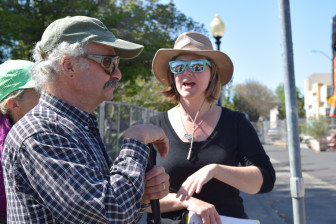
Katt Jones works with LightHouse student George Montag in NapaThe following is one in a monthly series featuring the extraordinary people who make up the LightHouse staff.

“Being an Orientation and Mobility Specialist is a perfect fit for me,” Katt Jones tells us. “I love teaching one-on-one, and empowering people to live their lives. I also value people’s stories, which I get to hear as I teach them how to safely travel as a blind person. She adds, “There’s more to learn about O&M than white cane travel, like using auditory cues to know when to cross the street, or explaining how weather can change the skills a blind person should use to travel.”

Katt, one of our newer Orientation and Mobility (O&M) Specialists, reminds us that O&M is more than white cane travel. “I love nerding out about smartphone apps, GPS and other means of travel. Though I don’t teach in-depth technology training—that’s what our LightHouse technology specialists are for—I do introduce my students to technology they may not be aware can help them.”

Katt earned her Master’s in Special Education with an emphasis on Orientation and Mobility at California State University, Los Angeles. Before she worked for the LightHouse she gained experience working as an O&M Specialist, and also unofficially began to learn independent living skills, which allowed her to more easily spot when someone needs additional training.

When students work with Katt to enhance their O&M skills, they get someone who listens. She says, “At the University of California San Diego, I studied sociology and psychology to understand how the individual fits within society. This led me to running support groups, where people come together to share experiences, learn and grow. When I’m working with a student, lots of personal things surface. We talk about independence, which often leads to conversations about family and friends being overly protective and not understanding. For students who are naturally shy, we talk a lot about how to respond to strangers who offer unsolicited (though well-meant) help because they see someone with a white cane. Family dynamics come up a lot, and I listen to students’ stories and help them talk through solutions. Mostly, however, I remind my students that they are in control of their lives.”

She goes on to say, “People have so many ideas about what it means to be blind. If you’re new to blindness, it’s easy to let it consume your attention. When I’m with a student, I’m teaching them blindness skills, but I also try to remind them of their hobbies and interests. It’s ironic that students of mine spend a lot of time talking to relatives and friends about blindness, and when they come to me, we start talking about theater, dancing, and hiking. I tell my students that it’s ok to say ‘stop talking about my blindness!’ My first priority is O&M instruction, but sometimes people need to be heard—what they really need is someone who sees them as a whole person.”

Katt encourages her students to come up with locations of interest to travel to during their lessons. “Several of my students want to learn how to get to the de Young Museum, the California Academy of Sciences, or how to hop on the F-line and get out to Pier 39 and Fisherman’s Wharf so they can check out the shops and the sea lions. They get really excited when they can show family members from out of town how to get to these iconic San Francisco locations. Just today I got to work with a student who has a membership at Cal Academy of Sciences and wanted some instruction on how to navigate the stair lifts when it is rather dark. I have another student who has been learning how to get to a San Francisco bakery so she can bring back delicious pastries and sourdough bread to her family back home in the East Bay. I try to let my students dream up any route they want or any location they want to get to so that they can focus on learning the skills while on the way to a place that they really would love to get to.”

Very much a people person, Katt runs a co-op in Oakland where she and five other housemates ensure a constant homey vibe. “We eat dinner together, share chores that we rename ‘spheres of influence’, and encourage each other.” In addition to creating a loving home, a portion of the co-op’s rent is given to nonprofits of their choosing. “Living in a co-op means we know how important community is, which is why we also support nonprofits that enrich and support the community around us.”

Katt truly embraces life and the people around her, from her students who are learning new blindness skills, to a team of performers in a local showing of the iconic film the Rocky Horror Picture Show. “I love music and dancing,” Katt says with a twirl of her head, “and I regularly attend live theater.” She reminds us all, “get up, get out, and get along.”

If you’d like to brush up on your O&M skills, or if you’ve been holding off on learning them, Katt has some words of advice: “Take the leap and let’s laugh while learning.” Contact the LightHouse at 415-831-1481 to get started.
 

Touching a Frank Lloyd Wright

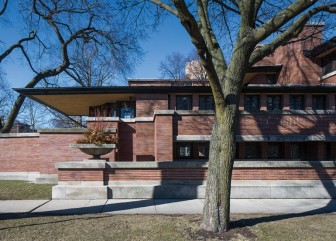
Frank Lloyd Wright’s Robie HouseUntil last month, blind people had no way to explore Robie House. Visiting the Frank Lloyd Wright-designed home in Chicago — a go-to architectural landmark — is a highly sensory, highly visual experience. A cramped low ceiling first guides visitors through a wooden entry hall leading to old playrooms, bedrooms and other private spaces, until you emerge, dramatically, into the main room. For the sighted, this spatial drama, and the ensuing architectural detail revealed in the tour, is quintessential to getting to know a Frank Lloyd Wright building. And now those details that make Robie House so unique and arresting are accessible to the blind, as well.
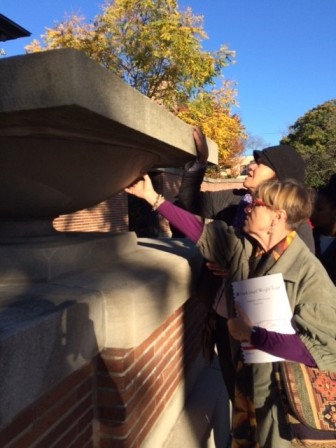
Generally, to preserve these special buildings, visitors cannot touch the fine details. To celebrate the 25th anniversary of the ADA, the Frank Lloyd Wright Trust started offering Touch Tours of several Wright sites in Chicago, and as such, asked the LightHouse to provide tactile plans and accessible architectural details to assist in the guided tour of spaces, affording visitors a spatial understanding of the house without compromising preservation efforts. Using our new tactile plans, blind visitors can experience and understand the architectural elements which make Robie house unique: the window and door geometry, wood fixtures and accents, signature angles, as well as the East and West “prows” bookending the house in the dining and living rooms.

The Robie House is built in the Prairie Style of architecture, characterized by long, flat lines and incorporating colors and materials from the surrounding environment. Influenced by Japanese art and architecture, this American architectural style prioritizes the connection between inside and outside, removing the heavy interior and exterior walls of the Victorian era. To achieve this, 127 art glass windows and doors line the exterior of the home, bringing light, warmth (and cold), and nature into the open floor plan. The wall of windows, open plan, and use of structural steel are common elements found in Modern Architecture, a typology arguably influenced by Wright’s designs, which took hold decades later in Europe and the US.

Visitors touch a planter in the form of Wright’s logo- on the exterior wall of the yard of Robie House.

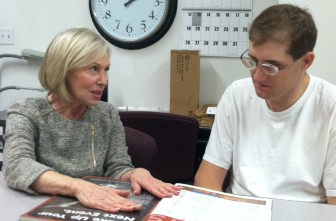
Robie House staff are now using our braille-labeled, physical model to orient blind guests to the forms of the building. Guests receive a booklet with tactile drawings, large print and braille, including a diagrammatic site plan of the ground level, main floor detailed floor plan, and art glass window detail.

“The guests lit up when they felt their way through the window detail,” says Joe Barrett, Daily Operations Manager at Robie House when describing a recent touch tour. “The diagrammatic page was invaluable as a tool to express the open floor plan and the layout of the rooms.” This forced Barrett to think creatively about his tours, as well; at one point, he took the guests out onto the South Balcony, and said he “was able to convey the tone of the windows and lighting by referring to the warmth of the sun pushed through the glass… It was incredible for me, just as it was for them. You guys provided us with such fantastic tools that only made their experience better.”

For more information or inquiries about making your exhibition accessible, email MADLab@old.lighthouse-sf.org.

Our Latest Employment Success – Greg Trela

Greg Trela never quite knew when his vision was going to change. Since age 11, Greg has known that changing vision would be a fact in his life, but it didn’t make the process any less of a challenge. Using only one eye for thirteen years, Greg got through college, pursued all of his interests, and then, in 2011, his other retina detached, requiring four surgeries. At the time he had one quarter left on his master’s degree in engineering.

Greg returned to school, finished his degree program, but did not find a clear path waiting for him once he got out. He put in applications and went on job interviews, but despite his qualifications, something didn’t catch. Finally, in 2013, someone gave him the number of DOR counsellor Sylvia Oberti, who put him on the fast-track to finding good work.

“I didn’t have a cane until I saw Sylvia. She just happened to have one my size.” (Greg is 6’6”). “So I wasn’t using a cane, and I think I had four or five interviews in 2014. What I realize now since I’ve started using a cane is it just changes peoples’ perceptions — and for the most part I think it’s actually for the better.”

Not only was Greg given a cane, but he was introduced to Kate Williams at the LightHouse’s Employment Immersion program, where over the course of the program, he learned how to turn those frustrating interviews into job offers. “I didn’t know about writing thank you notes. Knowing that after you go to an interview you need to write a thank you note to everybody you saw, try to emphasize some point, recognize that it’s part of the hiring process, part of the expectation of the interview. And you can ask questions about the upcoming interview, ask for an updated job description so that you know what’s expected.”

Kate Williams and Greg Trela

It wasn’t just interview training either. With Kate at this side, Greg learned about every stage of the training and hiring process. “For me, the big thing about working with Kate was getting my cover letters better,” he says. “Emphasizing what skills you have can contribute to the company or institution you’re going to go work for. How can you benefit them? Working for them, yes, you will benefit; but in your cover letter it’s more about how you can benefit the company. You have to sell yourself by saying ‘this is who I am and this is how I can help you.’”

All these skills helped land Greg a job this fall as a Junior Civil Engineer for the City of San Francisco, Department of Public Works. He is currently reviewing permits for new constructions, and coincidentally, works right downstairs from the LightHouse’s future home on Market Street. We couldn’t be happier for him.

Next Employment Immersion Session Starts January 12
Get ready for your first or next job. The next Employment Immersion session will run from 9:00 a.m. to 2:00 p.m. every Tuesday, Wednesday and Thursday from January 12 through February 11 at the LightHouse Ed Roberts Campus office in Berkeley. For more information, please contact Kate Williams at kwilliams@old.lighthouse-sf.org or 415-694-7324.

Arm Yourself with the Tools and Attitudes to be Successful with Changing Vision

Calvin James


Many people are inspired by our Changing Vision Changing Life Session and occasionally a participant is moved to write or even compose some poetry. Here’s a recent example:

Changing Vision Changing Life
Relax, open minds, abandon fears, and trust.
Smell, hear, touch, sense, feel.
Enjoy encouraging, supportive smiles and words.
Watch skills grow as tools empower and calm.
Strategy insures safety and melts frustration.
Senses flood with rich detail, more accurate
Also more vivid than mere sight.

Through his writing, above, Changing Vision Changing Life Immersion participant Calvin James shared his thoughts and experiences of the Fall 2015 Training in Napa.

Our week-long session can truly transform the way you set your goals for effectiveness and bring you closer to knowing what you’ll need to learn so you can live the life you want. During the Immersion, you and up to 13 other students will come together in an intensive and immersive week of learning or re-learning skills, sharing your stories, exchanging solutions, supporting each other. Because learning how to do something different takes time, commitment and development of new skills and sensitivities, this week provides you the opportunity to become acquainted with a range of essential skills that support your journey to independent and confident living. The consequent desire for self-advancement and hunger to learn that participants develop in our retreats will help them dedicate the necessary time and concentration in later learning.

Our next Changing Vision Changing Life Immersion Session is in January 2016.
Where: Enchanted Hills Retreat
When: Sunday, January 31 through Friday, February 5
Full scholarships are available for persons who are not consumers of the Department of Rehabilitation and are 55 or older, living in the counties of Alameda, San Francisco and Marin.

Here’s what Changing Vision Changing Life Immersion is all about:

  • Changing Vision Changing Life is a week committed to YOU. It is the opportunity to learn how to take charge of living your life instead of letting your change of vision hold you and your life hostage.
  • Immersive training exposes you to a myriad of independent living skills and strategies; you will also receive a concentrated dose of orientation and mobility and access technology exposure.
  • You’ll work with our trainers in the full group, in small groups and one-to-one (as much as possible). We encourage students to learn using training shades, giving the experience of focusing on skill development through non-visual learning.
  • Changing Vision Changing Life is a personal commitment to having the desire and taking the time to make a change. The week is full of active participation starting as early as 7:30 in the morning with our optional Yoga class and ending at around 9:00 p.m. The days are full, incorporating time for learning, personal time for reflection and time to connect with fellow students. If you have never met another person who is blind or has low vision, he or she will be your roommate, your fellow student throughout the week, your teacher, your mentor and quite possibly your newest friend.
  • LightHouse staff are professionally trained and the majority of the staff is also blind or has low vision. They understand that each student’s goal in training is unique and that your journey is to be respected. All staff will help guide you toward advances in your blindness that make the most sense for you.
  • Part of the Changing Vision Changing Life framework is that personal acceptance, learning and embracing new skills and renewed skills take time and commitment – we expose you to the possibilities.

Group Photo of Students in the Fall 2015 CVCL Immersion session

If you’d like to attend please contact the following LightHouse staff:

San Francisco Bay Area and Alameda County, contact Debbie Bacon at 415-694-7357 or dbacon@old.lighthouse-sf.org.
Marin County contact Jeff Carlson at 415-258-8496 or jcarlson@old.lighthouse-sf.org.
Humboldt or Del Norte Counties, contact Janet Pomerantz at 707-268-5646 or jpomerantz-sf.org.

The LightHouse Youth Program Presents Birding with the Blind: Identifying Birds Through Sound

Tom Grey GoldfinchJoin the LightHouse Youth Program as we explore the Quarry Lake Recreation Area for our first-ever bird identification hike. During the hike students will not be using binoculars, instead we will use our ears to identify the birds by sound. With help from the Merlin Bird ID Application, we will match the sounds we hear on our hike with recorded sounds from the app.

Who: Families with at least one low vision or blind student
What: Bird Identification Hike and Picnic
When: Saturday November 21, 2015, 10:00 a.m. to 2:00 p.m.
Where: Quarry Lake Regional Recreation Area located at 2100 Isherwood Way, Fremont, CA 94536
Meeting Location: We will gather at the Information Stand next to the restrooms and phone, closest to the main entrance and parking lots.
Transportation: Limited transportation from the Union City Bart Station can be made available upon request.
Cost: FREE
Waiver: Each participant must complete a LightHouse Youth Program Application, if you have not done so already.
What to bring: good walking shoes, a smart phone loaded with the Merlin Bird ID App, bag lunch, water bottle, warm layers of clothing and sunscreen.

Here’s more information about the Merlin Bird ID App. Please note that this app has some features that are not accessible with voice over.

If you would like more information or to RSVP for this event please contact Jamey Gump, Youth Services Coordinator, at (415) 694-7372 or by email at jgump@old.lighthouse-sf.org.

This December: Get Back to the Joy of Cooking with Low or No Vision

Teachers and students from our last cooking class stand in front of an array of dishes prepared to celebrate their last day of class with invited guests.Are your culinary skills keeping you from creating what you want and love to eat? Let us get you back in the groove before 2015 ends with the LightHouse class on Essential Kitchen Skills.
When: Tuesdays and Fridays, December 1 through December 18 (December 1, 4, 8, 11, 15 and 18), 9:45 to 2:00 p.m.
Where: LightHouse San Francisco Headquarters
Full scholarships may be available for persons who are not consumers of the Department of Rehabilitation and are 55 or older, living in the counties of Alameda, San Francisco and Marin.

During the class you will be developing or enhancing your skills, techniques and strategies for kitchen organization, labeling, reading recipes, using a knife properly, measuring, pouring plus stove top and oven techniques. In each class we will prep or prepare easy meals that you can do at home.

The class is limited to eight students, so sign up soon. To sign up or for questions, please contact Debbie Bacon at dbacon@old.lighthouse-sf.org or 415-694-7357.

LightHouse Youth Up Their Game at CCB Convention

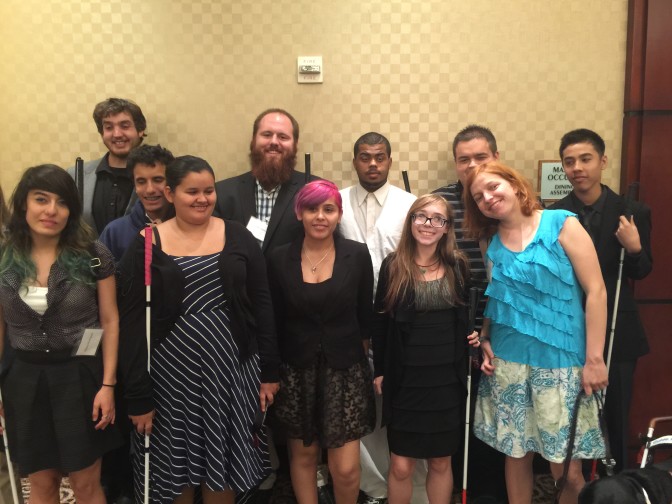
LightHouse Youth gather for a group photo at the CCB Banquet. From left to right; Xianna Rodrigues, Travis Erdmann, Andy Rodriguez, Martha Estrada, Jamey Gump, Carmen Contreras, Jordon Ingalls-Holloway, Olivia Merz, Joe Retherford, Annalisa DiLeonardo and Jacob ObesoLast month nine blind and low vision members of the LightHouse Youth Program traveled with program leader Jamey Gump plus two additional blind adult mentors to Los Angeles to attend the 2015 California Council of the Blind (CCB) Convention. There they experienced, some for the first time, the excitement of attending relevant seminars and workshops, exploring the exhibit hall, networking and making friends while getting a beginners course on how one “does” a convention.

Students spent most of the long days listening to experts discuss topics important to the blindness community. These included upcoming changes at the Department of Rehabilitation, homemaker cases and transition services funding, efforts being made by CCB and partners to make absentee voting accessible plus an update on laws that protect service animals and information about traveling with your guide dog internationally.

Youth Program Leader Jamey Gump told us, “Some of the most important moments during the convention happened during the down time when people were able to speak with other blind and low vision individuals. They were able to meet CCB members from across the state and hear first-hand about what CCB does. They also had opportunities to make friends with youth their own age, encouraging the building of a support network of their peers.”

Joe Retherford–one of the mentors that chaperoned the trip–added, “This was the first convention for a lot of the students and a good experience for all that were involved. Being around that many blind individuals is empowering.”

Jamey is planning future significant excursions for LightHouse Youth in 2016. Read about them first in our Youth Program Events List. To sign up, contact Jamey at 415-694-7372 or jgump@old.lighthouse-sf.org.

Official Apple Watch User’s Guide and other Braille Manuals – Now Available Exclusively at Adaptations

The independence, information and entertainment that the iPhone has given to blind and low vision users has made it the go-to device when it comes to accessible technology. Enter the Apple Watch — the newest mobile device from Apple. And we’ve got the User’s Guide ready for braille readers.

Accessibility features of the Apple Watch:

  • VoiceOver: The gesture-based screen reader, reads out loud what is happening on the screen and how to navigate it. It is available in 14 languages.
  • Font Adjustment: Users can adjust to larger text, as well as switch to bold text for an easier read.
  • Zoom: Magnification up to 15 times.
  • Grayscale: For those whose vision is impaired by color, they can turn to the grayscale.
  • Reduce Transparency: Allows you to increase the contrast on screen by reducing background transparency.
  • Taptic Engine: Tiny vibrations are felt when there is a new notification. It is also used with Maps for directions.

The braille Apple Watch User’s Guide sells for $30.00. Adaptations, the LightHouse Store is the sole source for Authorized braille versions of a variety of Apple User’s Guides. We also carry a wide variety of low-vision and blindness products, including talking watches and alarm clocks, games, kitchen products, braille supplies and much, much more. Give us a call at (415) 694-7301 or stop by our store between 10am and 5pm Monday through Friday.

Buy Tickets Now for Superfest: International Disability Film Festival

Man in fur coat stares intently at the camera. Scene from the film To Be or Not To Be - made and acted by people with disabilities.Join us for the 29th year of the Superfest International Disability Film Festival. Our two-day festival features films that celebrate disability as a generative and creative force in cinema and culture.

2015’s selections showcase innovation, artistry, stunning images and poetic, unique perspectives; they will wow us and take us places we’ve never been. Whether you’re part of the disability community or just love the movies — Superfest is not to be missed.

Each event will include a film screening followed by awards and a filmmaker Q&A.

For more information about the festival, including film descriptions and schedule, visit www.superfestfilm.com.

Saturday Night at The Magnes Collection, Berkeley Saturday, November 14 Reception begins at 5:00 p.m.
Program 6:00 to 9:30 p.m.
Tickets: $12
Address: The Magnes Collection of Jewish Art and Life
2121 Allston Way, Berkeley

Buy Tickets for Saturday

Sunday at the Contemporary Jewish Museum, San Francisco Sunday, November 15
Morning screening, 10:30 a.m. to 1:15 p.m.
Afternoon screening, 2:00 to 5:00 p.m.
Half day: $12 / Full day tickets: $24
The Contemporary Jewish Museum
736 Mission Street, San Francisco

Buy Tickets for Sunday

Presented by:
LightHouse for the Blind and Visually Impaired
The Paul K. Longmore Institute on Disability at San Francisco State

Thank you to our generous sponsors
Woman of Her Word, Contemporary Jewish Museum, Guide Dogs for the Blind, State Street, The George Lucas Foundation, Golden Gate Regional Foundation, Telecare Corporation

And: Bi-Rite Market • Sierra Nevada Brewing Company • Trader Joe’s: Rockridgelogos

Buy Superfest Early Bird Tickets Through October 15

Scene from The Gift (of Impermanence): Axis Dance Company short featuring dancers with and without disabilities. Two dancers on hands and knees.  Dancer in forefront extends her leg to rest on other dancer’s back. Her expression is expectant. Join us for the 29th year of the Superfest International Disability Film Festival. Our two-day festival features films that celebrate disability as a generative and creative force in cinema and culture.

Early bird tickets for Saturday night available through October 15th (see below).

2015’s selections showcase innovation, artistry, stunning images, and poetic, unique perspectives; they will wow us and take us places we’ve never been. Whether you’re part of the disability community or just love the movies — Superfest is not to be missed.

Each event will include a film screening followed by awards and a filmmaker Q&A.

For more information about the festival, including film descriptions and schedule, visit www.superfestfilm.com.

Saturday Night at The Magnes Collection, Berkeley
Saturday, November 14
Reception begins at 5:00 p.m.
Program 6:00 to 9:30 p.m.
Tickets through October 15th: $8.00
After October 15th: $12.00
Address: The Magnes Collection of Jewish Art and Life
2121 Allston Way, Berkeley

Buy Tickets for Saturday

Sunday at the Contemporary Jewish Museum, San Francisco
Sunday, November 15
Morning screening, 10:30 to 1:15
Afternoon screening, 2:00 to 5:00
Half day: $12 / Full day tickets: $24
The Contemporary Jewish Museum
736 Mission Street, San Francisco

Buy Tickets for Sunday

Presented by:
The Paul K. Longmore Institute on Disability at San Francisco State
LightHouse for the Blind and Visually Impaired

Thank you to our generous sponsors.
Woman of Her Word, Contemporary Jewish Museum, Guide Dogs for the Blind, State Street, The George Lucas Foundation, Golden Gate Regional Foundation, Telecare Corporation

And: Bi-Rite Market • Sierra Nevada Brewing Company • Trader Joe’s: Rockridge

logos