Category Archive

LightHouse News

LightHouse Featured in the New York Times

Image of blindfolded person with light shining on its face. Image by Brian Stauffer.LightHouse student Eleanor Lew writes in the New York Times about her experience with our Changing Vision Changing Life Immersion Program for people who are new to low vision or blindness. It shows the impact the program has on our students’ lives.

Read Eleanor’s article, “Travelers in the Dark”

Would you or someone you know benefit from Changing Vision Changing Life?
Our week-long sessions are now being offered at Enchanted Hills Retreat in Napa and also soon, at our new headquarters (with dormitories) in San Francisco.

During the Immersion, up to 14 students come together in an intensive and immersive week of learning skills, sharing stories, exchanging solutions and supporting each other. Because learning takes time, commitment and development of new skills and sensitivities, this week provides our students the opportunity to become acquainted with essential skills that support their journey to independence and confident living. Students focus on a variety of training including orientation and mobility, tech training, cooking and daily living skills.

We have several Changing Vision Changing Life sessions coming up the next few months:
April 4th through 8th
June 12th through 17th
July 11th through  July 15th (for Spanish speakers)
For more information, contact Debbie Bacon at 415-694-7357 or dbacon@old.lighthouse-sf.org.

“Keep Going” Advises Our Latest Employment Immersion Success

Meghan O’Grady“Keep going!” Meghan O’Grady stresses when asked what advice she has for blind jobseekers. Meghan graduated from the Employment Immersion program in May 2015, and started her job in November 2015. “I’m a dorm counselor at Orientation Center for the Blind (OCB), giving back to the community every day.”

For Meghan, Employment Immersion helped her get “unstuck.” Frank, her counselor at the Department of Rehabilitation, urged her to sign up for Employment Immersion. “I needed a push – in addition to perfecting my job seeking skills, I needed to gain confidence in myself.” Meghan now works with blind students at OCB, helping them feel comfortable while at Orientation Center for the Blind, and urging her students to use the blindness skills they’re learning. Meghan tells us, “The students I work with range from the ages of 18 to 60 years old. I check on their physical and mental well-being, secure the dorm, check out and instruct participants on how to use assistive technology, help participants problem solve and find resources and I offer guidance about their training and their adjustment to changes in their vision. I love getting to know the students and help build their confidence. I’m glad I completed the Employment Immersion program, because it really helped me land this job.”

Meghan learned a lot through from the Employment Immersion program. “[Program Leader] Kate Williams taught my class practical skills, like how to write a resume and cover letter, prepare for interview questions, and dress for interviews. She also taught us how to prospect for jobs, from searching postings to reaching out to hiring managers.” Meghan tells us she expected to learn these skills, but what she was surprised to gain was confidence in herself.

“Kate was our cheerleader. She believed in us, and that feeling rubbed off. She reminded us that we had to sell ourselves, and that in order to sell ourselves, we had to believe in ourselves first.” Meghan’s experience is something we’re familiar with; a lot of blind jobseekers downplay what they have to offer employers. Kate Williams said, “Blind people forget that employers need them. We—the blind—have vast skillsets. We are scientists, artists, journalists, you name it. Often our blindness has nothing to do with our careers, except that it can make us stronger, and hiring us adds a diverse voice in the workplace. I remind my students that they truly are assets to any company. It’s not just a line we feed the students; it’s a reality Employment Immersion helps them discover.”

Meghan is thrilled to be at OCB. “I’m very blessed. I’ve received so much assistance from OCB, LightHouse, my college and the disability community. It’s nice to be giving back and helping other people with disabilities, specifically blind people, get the support they need.”

What makes LightHouse’s Employment Immersion unique is that we teach our students how to ask for accommodations, disclose their disability and feel confident when arriving at an interview with a white cane. Meghan notes that being in the Employment Immersion program was positive because she was working towards the same goal—getting a job—with a group of peers who were experiencing similar challenges. “My class shared experiences and encouraged each other. I knew I wasn’t alone, which had an enormous impact on my success.” Kate reiterates this point, “Meghan’s self-confidence soared during her participation in the program. She began to recognize her value as she worked with her colleagues. Their encouragement and validation of her talents propelled her to apply for positions and interview with a ‘can do’ attitude!”

We asked Meghan to share a specific lesson she learned from her job-seeking journey. “Keep trying! You won’t get every job you apply for. Interviews can be disappointing. Not every position you apply to is a fit.” She stresses, “But it’s worth the effort. Don’t give up, don’t get frustrated; just keep going. You’ll get there, especially with Kate by your side! Kate reminded me that people hire people. Once I figured that out, I performed better in my interviews, and ultimately I got the perfect job for me.”

If you think that Employment Immersion might help you land the job of your dreams, but are worried about starting the program, Meghan has this piece of advice: “Just do it!” Employment Immersion works with people who are blind from any background, seeking any job. To learn more, contact Jobseeker Coordinator Wanda Pearson at WPearson@old.lighthouse-sf.org or call 415-431-1481 x370.

Woodworking Intensive with George Wurtzel

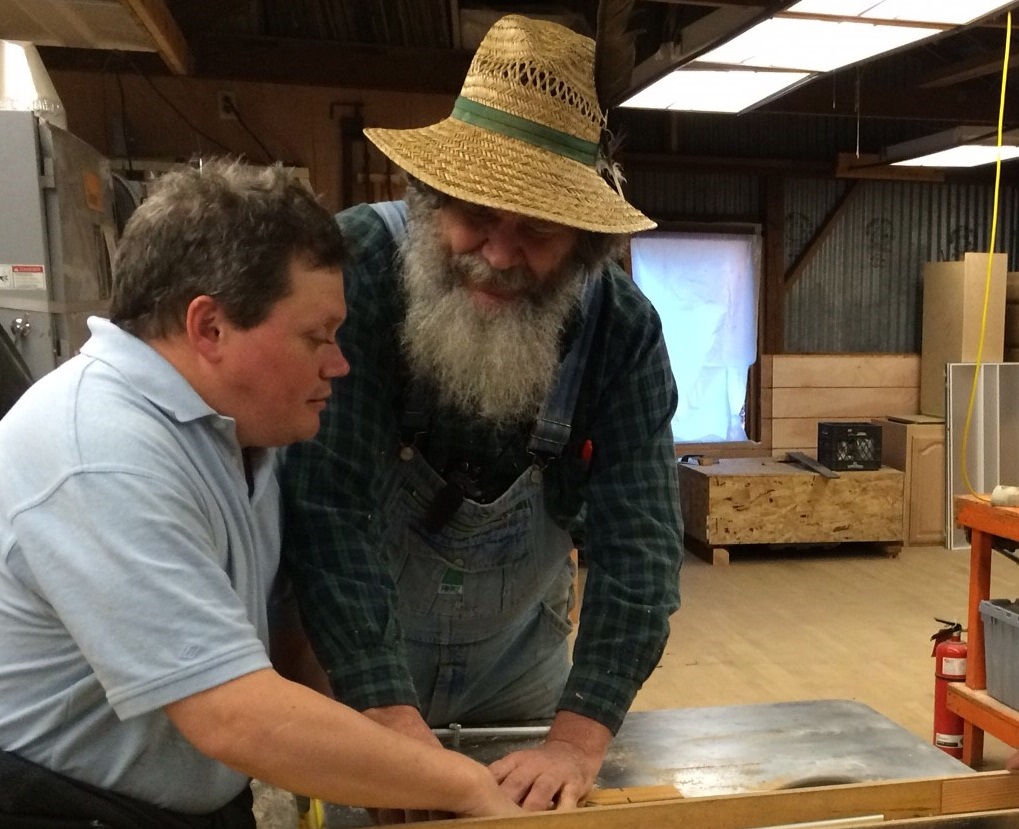
George Wurtzel teaches student Brian Buhrow how to cut wood.Join expert carpenter George Wurtzel at an encore workshop for both beginners and experienced woodworkers.

This class will cover wood turning, hand tool work and an introduction to power tools. We’ll learn how to measure accurately without sight, using click rules, gauge blocks, Vernier calipers and talking tape measures. We’ll talk about wood types and construction techniques and learn when to glue, when to nail and when to use screws. We’ll also touch on finishing techniques.

Who: Adults 21 and older who are eager to learn woodworking
Where: Enchanted Hills Camp
When: Thursday, March 17 through Sunday, March 20, 2016
Cost: $300.00 plus $40.00 for transportation
Class is limited to six participants, so sign up now.

To sign up for this special workshop, contact Camp Director Tony Fletcher at tfletcher@old.lighthouse-sf.org or 415-694-7319 for an application or with any questions.

New Federal Legislation Permanently Extends Tax-Free Treatment of Rollovers of Annual IRA Distributions to Charity

Joseph Chan

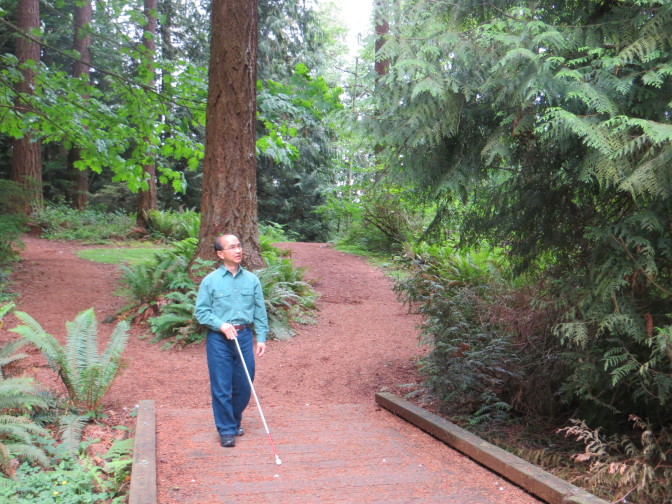
Former LightHouse Board Treasurer Joseph Chan walks using a white cane along a greenery-laden path.

By Gary D. Rothstein, Esq.
The new year brings good news for nonprofits and donors. IRA owners over age 70½ are required to take a minimum distribution annually. Those annual Required Minimum Distributions (RMD) usually generate ordinary income for the IRA participant.

On December 18, 2015, President Obama signed into law the Protecting Americans from Tax Hikes Act of 2015 (PATH Act). The PATH Act makes permanent the ability of IRA owners to exclude from their gross income IRA distributions that are made to a charity such as LightHouse (i.e., “rollovers” of distributions). There are certain limitations, however, on the exclusion of IRA distributions:

  • The individual IRA owner must be at least 70½ years of age
  • The maximum amount of IRA distributions that can be excluded per tax year is $100,000
  • The distributions cannot be made to the individual IRA owner first, but must be made from the IRA custodian directly to the charity
  • The distributions must be made to a public charity; not to a private foundation, supporting organization, donor advised fund, charitable gift annuity or charitable remainder trust

The amount of the rollover will not be included in the taxpayer’s adjusted gross income and subjected to income taxation for the year of the rollover. According to http://leicester.countrywidemediation.co.uk/, there is no need to claim a charitable deduction, and even taxpayers who do not itemize deductions on their income tax returns can benefit from the charitable rollover.

If you otherwise are in a position to forego taking the IRA distribution for yourself in a given year, a charitable rollover of a portion or all of the IRA distribution is an effective way to achieve the dual goals of reducing your income tax liability and supporting charities.

Former Treasurer of the LightHouse Board of Directors Joseph Chan told us, “I learned that by contributing to the ‘Campaign to Build a 21st Century LightHouse’ directly from my IRA plan, I can avoid a tax burden while simultaneously attaining my goal of making an impactful gift for the LightHouse. I am so delighted that my gift will be acknowledged in the naming of the Joseph K. Chan Low-Vision Optometry Clinic in the future LightHouse headquarters!”

Gary Rothstein is Of Counsel in the Trust and Estates practice group of the law firm of Weintraub Tobin Chediak Coleman Grodin. Gary’s practice has focused on estate planning, trust administration, and probate matters since 1993. Gary counsels individuals and families with respect to advanced estate planning techniques, such as revocable and irrevocable trusts, charitable giving vehicles, GRAT’s, defective grantor trusts, family limited partnerships, QPRT’s, and life insurance trusts. Gary also represents corporate and individual fiduciaries and beneficiaries in all aspects of trust administration, ranging from initial funding of trusts to representing clients in Probate Court, in connection with disputes between fiduciaries, beneficiaries and creditors. Gary counsels numerous fiduciaries, beneficiaries and creditors through all phases of contested and uncontested probate and trust administration proceedings in Northern and Southern California Probate Courts.

The LightHouse for the Blind does not endorse or recommend any commercial products, processes, or services. Mention of commercial products, processes, or services on LightHouse’s website should not be construed as an endorsement or recommendation.

Questions about supporting the LightHouse? Please contact Jennifer Sachs, Director of Development, at 415-694-7333 or jsachs@old.lighthouse-sf.org.

Thank You to Our Community Partners

Thank you to the following foundations, corporations and individuals who have recently shown their support by providing significant funds to help our programs go further and reach higher:

Alice Phelan Sullivan Corporation – for general operating support
American Honda Foundation – for STEM programming
Bellini Foundation – for general operating support

Bryan Buhrow – for Enchanted Hills Redwood Grove Theater
Marie-Anne Burkhard – for general operating support
Camberview Partners – for general operating support
C. Edward & Edith Strobel Charitable Trust – for Employment Immersion
Charitable Adult Rides & Services – for general operating support
Carla Crahan – for general operating support
Michael Dellar – for general operating support
Delong-Sweet Family Foundation – for general operating support
Dodge & Cox Investment Managers – for general operating support
Thomas Ellis – for the Campaign for a 21st Century LightHouse and for Enchanted Hills Camp for the Blind
Eva L. McKenzie Memorial Fund – for Employment Immersion
George Sandy Foundation – for Enchanted Hills Camp Scholarships
David Harrison – for the Campaign for a 21st Century LightHouse
Fred and Virginia Herzer – for general operating support
Carol James – for Music Academy and for the Campaign for a 21st Century LightHouse
Jewish Family and Children’s Services – for general operating support
Dwight Johnson – for general operating support
Susan Katz-Snyder – for general operating support
Mr. and Mrs. Kirk Swingle Foundation – for Enchanted Hills Camp
Susan Lapin and Kenneth Ward – for Enchanted Hills Camp
The Marmor Foundation – for general operating support
Suzanne Melchior – for general operating support
Linda and David Myers – for the Campaign for a 21st Century LightHouse
Maxwell Myers – for general operating support
Ian Paget – for the Campaign for a 21st Century LightHouse
Rachel Perkins – for Enchanted Hills Camp
Luciana Profaca – for the Campaign for a 21st Century LightHouse and for general operating support
Fred Ruhland – for the Campaign for a 21st Century LightHouse
S.A. Camp Companies – for general operating support
Donald Schaefer – for general operating support
Richard Schoenberger – for general operating support
Michele Spitz – for providing tickets to JCC performances
Richard Stevens and Virginia Behm – for general operating support
Chuck and Elizabeth Travers – for general operating support
USABA – for LightHouse Community Services
US Bank – for the Campaign to Build a 21st Century LightHouse
Shelia O. Whittemore – for general operating support
The William G. Irwin Charity Foundation – for the Campaign for a 21st Century LightHouse

Robert Alminana: “Life Doesn’t Come to You; You Have to Go After Life.”

AlfredoRobertThe following is one in a monthly series featuring the extraordinary people who make up the LightHouse staff.

“There is a quote I really want you to include in my profile,” says Robert Alminana, an Orientation and Mobility Specialist at the LightHouse. He reaches for a well-loved book he’d brought with him: Le Petit Prince (The Little Prince) by Antoine de Saint-Exupery.

“One sees clearly only with the heart. What is essential is invisible to the eyes,” he quotes from the book. The message, with its obvious relevance to the LightHouse and the blindness community, is also one of Robert’s guiding principle. He says, “I’ve spent my life helping people and communities find better ways to live by uncovering hidden potential.”

It’s possible that Robert’s desire to help people stems from his unique history. “I’ve lived—really lived—in nine countries on three continents. I speak five languages. I grew up with parents who are bilingual, bi-national, and bicultural. Because of this, I don’t identify with a particular country or nationality. Instead, I see myself more as a global citizen, finding it easier to identify with individuals despite our perceived differences.” Living within so many cultures has also made Robert more conscious of the struggles that make us more similar than different. “We’re all trying to find our place in the world regardless of the part of the world we’re from. I’m passionate about helping people find their place in the world, because I know that everyone has a place.”

This fervor for empowering people to feel grounded is what led Robert to Orientation and Mobility. “I used to be an urban planner, with special emphasis on designing communities that make people feel welcomed and at peace, which I know has dramatically positive effects on behavior and the way we relate to one another. I literally worked to create communities that provide people with a ‘sense of place,’ an endeavor that takes time to materialize. I left that field because I wanted to work one-on-one with people and see the results of my work on a more intimate and immediate level. Orientation and Mobility fulfilled that need.”

Instead of designing beautiful, sustainable communities for large groups of people, Robert now works with individuals who are blind teaching them to navigate whatever space they find themselves. “I dreamed of changing the world on a large scale, and did some of that with the urban planning work I conducted. Now, my dream is being fulfilled on a different scale. I’m changing the world for one person by teaching him or her practical skills to move through the world.”

Speaking philosophically, Robert stresses that there are billions of individual worlds—we all live in our own world. “Working one-on-one with a dozen students a week might not seem like the stereotypical ‘world change’ one thinks of, but seeing the immediate impact Orientation and Mobility skills have on people has shown me that I’m changing worlds instead of one single world.”

Robert’s journey to the LightHouse started when he became a LightHouse Volunteer. He tells us, “I enrolled in my Master’s in Special Education program at SF State to become an Orientation and Mobility specialist, but had to wait eight months for classes to start. I was anxious to get going, so I asked Dr. Sandy Rosen, Coordinator, Orientation and Mobility Program at San Francisco State, if she had any recommendations. She suggested I volunteer at the LightHouse. I started off as a Personal Services Volunteer, working with one person – this was an incredibly rewarding experience. I also worked on some projects with MUNI and recording print text to alternative formats.” Robert’s experiences remind us that LightHouse has many different volunteering opportunities, from working one-on-one with students to administrative work.”

After graduating with a Master’s in Special Education in the field of Visual Impairments, Orientation and Mobility, Robert joined the team at LightHouse as an O&M Instructor. He tells us, “I’m also the President Elect of the Northern California Association of O&M Specialists (N-CAOMS), and I have my ACVREP (Academy for Certification of Vision Rehabilitation & Education Professionals) certification, which enables me to design programs to meet our students’ needs.”

Robert goes on to say, “I love what I do at the LightHouse—helping people gain the independence and confidence required to thrive in the world around them. I want people to know that if they’re struggling with getting to where they need to be, they should make an appointment today. There are so many wonderful things to do and people to meet. Life doesn’t come to you; you have to go after life.”

Robert enjoys being philosophical, even when he’s not at work. “What do I do on the weekends or outside of work? I love reading. Some of my favorite authors include Albert Camus, Antoine de Saint-Exupery, Marguerite Yourcenar, Gabriel García Márquez, John Steinbeck and Jane Jacobs. I enjoy going to art and science museums. Traveling is also important to me, and nature is a big part of my life. My last trip was to Alaska. I was absolutely blown away by the quality—and quantity—of the natural beauty. The train trip from Anchorage to Denali was so beautiful it overwhelmed me. Every panorama was filled with life and splendor.”

If you’d like become a more independent traveler the LightHouse can teach you how. Contact us at 415-831-1481 to get started.

Ready to give back? The LightHouse has a robust Volunteer Program and we invite you to enroll. For more information, contact Justine, our Volunteer Coordinator, at 1altruism@old.lighthouse-sf.org.

LightHouse Transitions to Unified English Braille

LightHouse Accessible Media Specialist Julie Sadlier holds UEB braille reference books in braille and braille/large print.As of January 4, Unified English Braille (UEB) became the official braille code in the United States. Therefore, going forward, the LightHouse will complete all new braille translation projects in UEB, unless specifically requested to do otherwise. This includes braille labels on any tactile graphics and maps.

Though accessible signage is not currently required to be in UEB, the LightHouse is recommending to the state that this change be made and included in any upcoming revisions to accessibility codes. We will keep our clients apprised of the progress of this recommendation.

To help with the new code, Access to Information Services (AIS) has created a helpful reference book – Unified English Braille: Contractions, Signs, and Indicators. The book is available in a braille version (BR410, $5), or a combined braille and large print version (BR412, $25) from our store, Adaptations.

You can also find the UEB Rulebook, Second Edition, in both PDF and BRF.

If you have any questions regarding the transition, or about UEB, please feel free to contact us at MADLab@old.lighthouse-sf.org or 415-694-7349.

Adaptations, the LightHouse Store is located at 214 Van Ness in San Francisco, open Monday through Friday 10:00 a.m. to 5:00 p.m. Call us at (415) 694-7301 or email us at adaptations@old.lighthouse-sf.org with any questions.

February Specials at Adaptations

Stella Desk LampThe Stella desk lamp is making waves in the low vision community and is now available at Adaptations in both black and white. It’s a very dynamic lamp with a total of fifteen different lighting intensities. You can choose from three primary light levels – bright white light, soft white light and a softer orange. You can also toggle through five different brightness modes within each of these three light levels. The Stella retails for $180.00, but during February, if you enter the store yelling “Stella!” (à la Marlon Brando in Streetcar Named Desire), we will give you 5% off your purchase of this lamp. You’ll save some money and we’ll share a laugh together.

Special Valentine’s Day Promotion – 10% off select red products
Save 10% on most red and red-packaged items at Adaptations. This includes red wallets, red liquid level indicators, red touch-dots, red magnifiers, redline flashlights, red low vision playing cards, Braille Uno, Wikki Stix, red sunglasses and more. Come by Adaptations to check out our deals for yourself. This sale does not include canes and digital video magnifiers.

Adaptations is located at 214 Van Ness in San Francisco, open Monday through Friday 10:00 a.m. to 5:00 p.m. Call us at (415) 694-7301 or email us at adaptations@old.lighthouse-sf.org with any questions.

Calling 16 to 24-Year-Olds – Become a Counselor in Training at Enchanted Hills Camp

Counselors at Enchanted Hills Camp teach young campers to fish.The LightHouse is looking for youth who are blind or have low vision to come to Enchanted Hills this summer for some work experience.

The Enchanted Hills Camp Counselor in Training Program (CIT) focuses on developing blind/low vision leaders in an integrated environment through job exploration and work based learning experiences. Training takes place through discussion, observation and practice under the supervision of the administrative staff at camp. Most importantly a successful applicant will developed a strong work ethic that they can apply to any leadership experience.

This program is designed for blind participants or participants with low vision who are 16-24 old and are serious about improving their leadership skills by learning to work with children and/or adults in a rigorous camp setting. The importance in this training program is the hands on experience CITs will gain by working with campers and with the EHC counseling staff. CITs, upon completion of the Enchanted Hills Camp CIT program, will be better prepared to work with adults, their peers and children of all ages, interests, and abilities. Participants will also walk away with self-advocacy skills, increased social and independent living skills, plus new friendships. We encourage applicants with a variety of previous camping experiences to apply.

CITs are registered as campers and therefore receive no financial compensation. Food, lodging and bus transportation from our pick-up sites are provided at no cost. Space is limited and interviews will be conducted to choose the best possible candidates for the program.

Expectations of CITs

  • Adhere to the policies established in the Staff Handbook
  • Be a positive role-model for campers
  • Communicate blindness-positive philosophy
  • Demonstrate independent travel skills
  • Demonstrate a strong work ethic
  • Develop conflict resolution skills
  • Develop leadership skills
  • Meet daily with supervisor in a group setting for evaluation
  • Provide a safe and healthy environment for campers
  • Read from suggested best practices reading list prior to summer assignment
  • Support the mission of the camp

 CIT Responsibilities

  • Assist counselors and Area Leaders with management of campers
  • Promote Independence
  • Motivate campers to use non-visual techniques
  • Participate in the development of program activities designed specifically for blind campers.
  • Incorporate active participation in camp meals, clean up and other daily functions through fun activities
  • Communicate with staff about problems or issues that arise with campers
  • Adapt all activities so that all campers can participate fully, regardless of their level of vision
  • Work with counselors to resolve disciplinary issues that arise with campers
  • Be active participants and assist staff during specialist, program and group time
  • Assist campers in being successful with games, projects and activities
  • Facilitate independence in camper participation
  • Participate in activities with campers
  • Assist counselors and Area Leaders in enforcing rules and instructions
  • Assist in leading activities during downtime
  • Assist in the set-up and facilitation of camp events such as theme days
  • Serve as escorts for campers needing extra assistance
  • Assume additional, reasonable responsibilities as assigned by the counselors, Area Leaders and administrative team
  • HAVE FUN and BE SAFE

Deadline to Apply is April 1, 2016.

For further information about the Counselor-in-Training Program, please don’t hesitate to contact Tony Fletcher, Enchanted Hills Camp Director at 415-694-7319 or afletcher@old.lighthouse-sf.org.

Are You a Vision Instructor or Other Blindness Professional? Come to Provider’s Weekend at Enchanted Hills This May

Free to first timers!

For over 20 years the LightHouse has hosted Provider’s Weekend, our signature event where teachers, managers, program staff and students entering the blindness field can meet and network throughout a long weekend.

Be sure to reserve May 20 to 22 now for an enlarged and far-ranging Provider’s Weekend at Enchanted Hills Retreat in Napa.

When: May 20–22, 2016
Where: Enchanted Hills Retreat
Cost: $100.00 (free for first-time participants)

May is the perfect month to swim in our heated pool, meet others in the warm evening around the campfire, and wrestle with bigger questions that take a bit more time than available around the office water cooler. You’ll meet service providers working in the field of blindness from all over northern California, in workshops and presentations. You’ll exchange practical ideas and build a network you might not otherwise have. You might even find your next job.

Stay in a lakeside cabin, the lodge or one of our fully accessible cabins next to the dining hall. The cost for the weekend, including all meals, is $100.00. In addition to discussing philosophies, trends and issues we face in providing services for people with visual impairments, you can enjoy boating on Lake Lakoya, trails for hiking and savory meals provided by a wonderful kitchen staff. You’ll learn from your peers, relax in a natural setting with many educational and recreational opportunities. And it’s not unheard of to find a drop or two of Napa wine from the neighborhood, too.

Special Incentive for First Time Attendees!
As a special incentive for first-time attendees of Provider’s Weekend – have the weekend on us. The free retreat is the least we can do to honor those who are helping shape the blindness field across northern California.

So mark your calendars now and reserve space before it’s gone. We expect with the flood of new faces we’ll fill all available cabins well before May.

For information and reservations contact Tony Fletcher at 415-694-7319 or tfletcher@old.lighthouse-sf.org.