




Submissions are open for Superfest International Disability Film Festival 2015. Read more on our blog!
Submissions are open for Superfest International Disability Film Festival 2015. Read more on our blog!
Are you an individual who believes the simplest pleasures in life sometimes have the most profound impact? Do you prefer to work with people in a one-to-one capacity rather than in large groups? Would you like to make a significant contribution to the life of someone who is blind or has low vision in as little as two hours per week? Or are you blind or low vision and interested in working with one of our dedicated volunteers to promote your independence and fitness?
In addition to all of the other services we provide for blind and low vision folks, the LightHouse has an exceptional Personal Services Volunteer Program, where we match those able to help with those needing assistance with tasks such as going over paperwork, organizing their home or going to the grocery store. And if you are finally ready to “get your fitness on” and looking for someone to walk, run, bicycle or other exercise with, the LightHouse can pair you with a Fitness Partner.
Make a difference in somebody’s life. Contact Volunteer Coordinator Justine Harris-Richburgh at 415-694-7320 or volunteer@old.lighthouse-sf.org to be paired with a Personal Service Volunteer or Fitness Partner today.
Eager to get started? Sign up with our basic online application. Then, call Justine to seal the deal!

Clean out your attics and basements, dust off that Rattan furniture, unload that old straw broom buried in the back of your closet, get out the old photo albums and look for particularly special snapshots. The LightHouse is accumulating historical items from our past, and we need your help. The history of the blind in the Bay Area is precious to us, and we intend to display much of it in an homage to where we’ve been over the 112 years of the LightHouse.
Please consider donating your LightHouse photos and memorabilia, including items associated with the Reading Room for the Blind at San Francisco Public Library and San Francisco Association for the Blind’s Blindcraft operation. Your donations may be tax-deductible. Contact Alex Wilson at 415-694-7333 or giving@old.lighthouse-sf.org
If requested at the time of donation we will gladly return original photos or negatives, after making copies.

Green House of Patti tips by Sydney Maestro who supports our North Coast office serving blind and visually impaired folks living in the remote and sprawling counties of Humboldt and Del Norte in California. She prefers her yard covered in old whisky barrels filled with unique water lily cultivars rather than ordinary grass. “I suppose we aren’t the only people with water gardens in Humboldt County,” Patti laughed; making a clear reference to Humboldt’s other “green-growing”
When she isn’t tending to her aquatic crop, you’ll find her feeding living critters to her carnivorous plants, and though her surname is “Rose,” she’d probably prefer “Darlingtonia” after California’s native carnivorous Cobra pitcher plant. Patti is so facinated with water lilies and carnivorous plants that she and her husband Doug actually sell them as a side business. The only thing more unique than Patti’s garden is Patti herself, which is why we are so fortunate to have her at the LightHouse.
Patti grew up in Glendale, California. After much moving around Los Angeles and Ventura Counties, she landed a job as a technical analyst for Rocketdyne, a small company later owned by Rockwell and then by Boeing and connected with the National Aeronautics and Space Administration (NASA). There she helped to build the $33,000,000 engines of the Space Shuttles.
In 1996, Patti and Doug packed up the car and moved to Humboldt where Patti pursued a degree in Environmental Biology at Humboldt State University. “We love Humboldt. It’s perfect for us,” she said, describing the scent of sea breezes combined with the sweet smell of evergreen forests. In the midst of taking biology courses Patti rediscovered an old skill – technical writing. She switched degree programs and earned her Bachelor’s in technical writing, fusing her experience at Rocketdyne with her advanced writing and teaching skills.
After she graduated, Patti continued to work on her Master’s in Geographical Information Systems.
Patti met Doug, who is blind, in Los Angeles in the mid-80s over a love of computers and emerging technology. Both were tech-savvy and posted on bulletin boards and chat services that were available before the internet. Early one morning Patti noticed Doug online and introduced herself. Doug, using his Versa-Braille, a crude screen reader requiring an acoustic coupler and cassette tape recordings, wooed Patti though binary valentines over the pre-dawn matrix of the internet. This serendipitous happenstance produced a relationship now going into its 27th year.
While living in Humboldt, Doug, a leader in the blind community, help establish our newly opened North Coast office, while Patti worked for us as a driver – a critical position in a place with minimal to no public transportation. “In this rural area, blindness can be very isolating. The impact I had just by providing rides for clients and students was life-changing.” This rocket-builder found meaning as a driver because she saw firsthand the impact she had on so many blind people. “Living with Doug I know how independent a blind person can be if they are given the right tools. At LightHouse of the North Coast we work with people to find their independence and the freedom to pursue their interests.”
These days Patti uses her business savvy and writing background to manage the administrative work at the North Coast office. She also assists with access technology training both for North Coast clients and at training sessions held at Enchanted Hills. She is passionate about preserving the natural habitat in the North Coast and is a champion for the blind, seniors, animal, plants and others with historically unheard voices. She is a letter-writer and an essayist, frequently sharing her thoughts and research with her representatives in local, state, and federal government. Patti reminds us, “You can’t take back the words you never said.”
Patti’s contagious smile and dedication to working with the blind have helped make the LightHouse of the North Coast the amazingly successful satellite it has become. If you are blind or visually impaired and live in Humboldt or Del Norte Counties, we invite you to contact our staff at 707-268-5646. You can read more about Patti’s work with water lilies and carnivorous plants here.
Recently, ViewPlus (makers of the EmFuse which embosses braille, tactile images and prints in four colors) paid LightHouse a visit, introducing us to VoicEye – a cutting edge accessibility technology.
A VoicEye (VE) code looks and behaves much like a QR code, but where QR codes take you to a webpage, when you scan VE codes with your phone the content is actually imbedded in the code and you don’t need to be online to read it. A VE code contains up to two full pages of text, images and links. VE codes can also contain contact or event information that can be saved directly to your phone’s contacts or calendar.
The free VoicEye app (available for most Smart phones) also has a built in video magnifier with contrast control. For a better view, turn your phone’s light on to illuminate the printed page and save the image to your phone. On the iPhone, with VoiceOver activated, the VE app will even guide you, speaking instructions to help you scan the VE code.
AIS is working on several projects that will feature VE code, including upgrades to our many Transit Route Orientation Guides [http://bit.ly/brailletransit] and integration into tactile maps and brochures for the Sonoma State Historic Park.
Check out VoicEye for yourself: To learn more about the software, just download the app and scan some sample VE codes.

A cooking and safety aid for the blind and visually impaired, and a handy assistive tool for just about anyone. Now available at the LightHouse: The Brooks Technology Talking Infrared Thermometer.
Simply point the device in the direction of a heat source and press the button, and the thermometer will announce the temperature in a loud clear voice.
Features include:
The thermometer can be used to measure the temperature of a refrigerator, freezer, an oven, stovetop, cooking oil and countless other heat sources. The Talking Infrared Thermometer is available now for $119 plus tax. Stop by Adaptations for a demonstration of this fascinating new product.
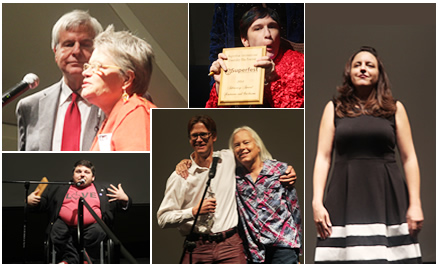
November 2 will be a Sunday to remember at the Contemporary Jewish Museum in San Francisco because Superfest International Disability Film Festival is taking over. You won’t want to miss this family film festival (there are adult films too!), featuring shorts which take a look at disability in cinema. The festival runs from 12:00 – 5:30 p.m., and your ticket will include admission to the entire museum. Stay tuned for ticket sales and more information to come or visit superfestfilm.com.

Last month, the LightHouse took advantage of summer vacation to offer our first Transit Trek Week for youth. Our goals included exposing the students in a fun way to various forms of Bay Area public transit including BART, Caltrain, Muni; honing cane skills, building confidence, and most of all, developing the desire to travel with gusto and savvy.
Our small but powerful pilot program brought together teenagers from California and even some from as far away as Florida. We mixed and matched them with three respected Certified Orientation & Mobility Specialists, Cindy Garcia, Betsy Laflamme and Regina walker, who work in our Bay Area school districts. The youngsters had just spent the previous week at the Enchanted Hills Camp Teen Session and got to experience the contrast between traveling in a natural setting of our campground, without sidewalks and traffic and moving through the hustle and bustle of San Francisco, one of our nation’s busiest cities.
Director of Rehabilitation Kathy Abrahamson said, “The intention of the Transit Trek Week was to have the students learn public transit while improving their travel skills and at the same time learning about San Francisco and the Bay Area. The cool thing is that they not only learned the transit systems in the Bay Area but also the geography of San Francisco. For example, the N-Judah Muni line traverses the width of the city and traveling on it gave the students a sense of the city and its shape, from the Financial District to the ocean. San Francisco is not just a bunch of buildings, streets and cars in a downtown area has is rich with culture, commerce and outdoor beauty including expansive parks and trails. Muni’s busses and trains and BART’s trains connects all these things and makes it accessible to explore.”

Armed with Clipper Cards for the week, the adventure started as students and instructors took the 49 & 38 Muni Bus from LightHouse San Francisco Headquarters out to Lands End and Ocean Beach. They examined the tactile map placed there thanks to work by the LightHouse’s Access to Information Services folks, then walked to the Visitor’s Center and used the indoor area to practice cane skills. The teachers were able to follow the schedule yet be flexible, adapting the lessons to the needs of the students. Hustling to catch the N Judah at La Playa, students walked the wide sidewalks practicing skills or on the beach in the sand – a completely different tactile experience.
Students and instructors started the day with basic travel practice walking around San Francisco City Hall then took the N Judah and transferred to the #28 Muni and headed out to the Golden Gate Bridge where they practiced embarking and disembarking from MUNI train and bus, exploring the access components of each stop and bus shelter; locating open seating and interacting with the driver to confirm destination and drop off points. Traveling on the transit system was especially helpful for the twins from Florida who come to California annually and hadn’t had much experience on public transport. They finished the day by returning to the #28 Muni to Daly City BART station and then BART to the Embarcadero and back to the LightHouse.
LightHouse Youth Services Coordinator Jamey Gump accompanied the group and said, “We were able to encourage the students’ sense of adventure. Sometimes the students became frustrated as they challenged themselves to learn something new, but the teachers encouraged them to push through and persevere. The teachers kept it light with a good balance between instruction and fun.”
By now the students’ confidence was building and curiosity took over. The group set out to explore Powell Street Station, downtown San Francisco Caltrain station and rode on Muni between AT&T Park and Embarcadero. At the top of the Powell Street Station, spontaneity took over and they decided to hop on a nearby cable car and take it all the way to Fisherman’s Wharf. They accomplished all they set out to do and more, because they were able to exercise that very independence of travel which was their overarching goal.
On their final day of instruction the students were introduced to LightHouse Access Technology Specialist Shen Kuan. Shen, who is blind, is proficient and independent traveler and became a model for the teens, teaching them how to make traveling easier and more efficient by using the website 511.org to plan their route. Shen and the group then took BART across the Bay to explore the Ed Roberts Campus in Berkeley (where LightHouse has a satellite office). They walked around the Campus, explored the accessible elevator that goes directly from the Ashby BART station into the Campus and ended up lunching outdoors on the sunny exterior patio. They then hopped back on BART to the Downtown Berkeley station, did more training out on the city streets, and most important, found gelato.
Shen told us, “I thought it was good for the kids to learn what is possible – what can be made accessible. We are fortunate to have a transit system that has many accessibility features, such as talking ticket vending machines.
Florida resident Jennifer is the mother of two of the students – twin teenage boys Dylan and Damyn, who are both blind. She and her sons have come to the LightHouse for training and she regularly checks our website. When she saw the LightHouse blogpost announcing Transit Trek Week, she immediately contacted us to sign her boys up. She told us that in the part of Florida she and her family live in, she faces ongoing challenges in getting her sons the training they need to be confident travelers. “The LightHouse’s Transit Trek Week has been a great opportunity for me to bring the boys out for the kind of training we just can’t find where we live. In the few days they’ve been in the program I’ve seen my boys’ confidence increase dramatically, from 20% to 90%.” One of her sons was so excited about the transit system; his goal is to live in a city like San Francisco where transit provides such accessibility. In addition to working with the kids, Jennifer applauded the Orientation & Mobility instructors’ willingness to include her in some of the training so that she could understand better what her sons needed to learn.
Another student, Jacob, lives in the Bay Area. He has low vision and is preparing himself for less vision in the future by proactively participating in LightHouse programs like Transit Trek Week. Jacob’s goal was to really learn more about the BART system and traveling on transit in San Francisco. Instructor Betsy Laflamme said, “Jacob really appreciated the chance to practice using his cane. He hadn’t used his cane much before because he never really had to travel independently – especially at night when usually take the arm of one of his parents. This training gave him more confidence to walk independently in poorly lighted settings.”
We are so grateful to have the opportunity to collaborate on this project with Orientation & Mobility Specialists Cindy, Betsy and Regina. Jamey Gump told us, “I was very impressed by the teachers’ knowledge and experience and how they effectively taught their students. I’ve traveled independently for a long time – though my observation during Transit Trek Week I found myself rethinking how I use my cane.”
Next year the LightHouse is going to build on the Transit Trek theme by offering weekend day explorations for blind and low vision youth and adults. But you don’t have to wait to take advantage of training right now. As long as our funding lasts, you can receive up to ten hours training at no charge, through May 2015. If you are an independent blind or low vision traveler and are unfamiliar with Bay Area transit systems and stations, you can take advantage of this training. There is no age limit, though if you are under 18 you must have parental consent.
Read how you can get free braille guides for Muni, Caltrain and BART.
“I like that I get to interact with the low vision/blind community [at Enchanted Hills Camp], because I don’t get to do that outside of camp. I also love that we get to do things on our own, be independent, and try new things without people trying to ‘protect us from ourselves.’” – Samantha, age 16
Enchanted Hills Camp has concluded another inspiring summer of camp session, completing a full summer of enriching camp activities, with eleven separate sessions for everyone from blind infants to senior nature enthusiasts.
Exceeding last year’s record, this summer we employed the highest percentage of blind and low vision staff, exceeding 30% of employees, in Enchanted Hill’s history. Each employee, whether camp counselor or kitchen staff, brought their unique expertise to camp, furthering our commitment to provide campers with a diverse and enriching camp atmosphere. Many prior campers returned as staff; their desire to work extra hard and give back to EHC – a program that continues to be important in their own growth and development – created a dynamic team filled with passion and the commitment to make our camp exceptional.
Here are some highlights from this summer:
This truly has been an exceptional year for Enchanted Hills, starting with the countless volunteers we’ve had help build the Redwood Grove Theater, offering international campers the opportunity to come to Enchanted Hills, and the hundreds of families touch by camp. Based on pre- and post-surveys given to teen campers, teens reported an average of 17% increase in mentors, 14% increase in community engagement, and a 13% increase in independence just from share a few enriching days at camp – proof positive that camp is more than just a recreational activity, it is a community enriching, personal development training ground for future blind leaders. After again setting the bar so very high, we look forward to improving yet again in 2015 with the support of our volunteers, counselors, leaders and generous funders’ support.
Each year we push ourselves to deliver more and better programs for our campers. 2014 was no exception. One of the biggest things to happen this summer was the launch of our Music Academy, answering a call from campers to increase musical education at camp. “The individual and collective talent of the staff and campers this summer was unmatched in terms of musical ability,” said Camp Director Tony Fletcher.
Special guest musical director Bill McCann, president and founder of Dancing Dot which sells GOODFEEL, Lime Lighter, and CakeTalking – ground breaking hardware and software programs specially designed to help blind musicians excel – attended camp and taught eighteen eager students how to play music beyond any visual hindrances. Those who already knew of him through his software were thrilled to find that that Bill, who is blind, would be their “personal” teacher and mentor for a few days.
The following article, written by Bill McCann, contains Bill’s eloquent description of Music Academy 2014. It was originally created for publication in Richard Taesch’s “MUSIC IN EDUCATION” column in the CTEBVI Journal – Fall 2014. Used with permission of the author.
What if you could find a place where you could focus on learning to read music better, learning to write your musical ideas down, and how to record your songs using a computer? That’s just what a group of young blind and low vision students found this August during our first-ever Music Academy at the Enchanted Hills Camp near Napa, California. What a pleasure it was for me to work with a group of young people who were so eager to learn and so focused on acquiring new skills. During the course of a week that seemed to fly by with almost lightning speed, all of them progressed in both their music literacy and music technology skills.
Each day was so full with classes in reading music in braille or magnified print music, using software to notate or record music, listening sessions after dinner, time to practice, jam or just hang out with others, plus opportunities to go for a swim, a nature hike, or even try your hand at archery. We shared a few memorable special events: a performance and instrument demonstrations from a local folk music group, the Pickle Creek String Band, Mr. Greg Kehret’s excellent tutorial on Palmas and bass demo/jam, and an impromptu guest performance and lecture on the bagpipes by Joe Retherford. Bryan Bashin, Director of the LightHouse for the Blind and Visually Impaired, sponsor of our Academy, visited and introduced us to Mary Bianco, who led an engaging group discussion on the prevalence and forms of perfect pitch.
Our closing performance and presentation was great fun. All of my students proved to be naturals at putting on a good show. I especially enjoyed their original compositions and arrangements. Live performances were interspersed with digital performances of student compositions created with Lime and SONAR under the guidance of my talented Assistant Director, Roberto Gonzalez. Closing the show, our EHC Music Academy Chorus under the able direction of Shane Dittmar demonstrated just how much our Academy participants improved their skills in reading music whether in braille or magnified notation. The singers read their braille or large print scores as they sang.
It was deeply gratifying for me, on both a professional and personal level, to serve as the Music Academy’s Director. Although Dancing Dots has customers all over the world I don’t get to meet them in person often enough. It was a genuine gift to me to observe these talented and energetic young people, who came from around the United States, Mexico, and Taiwan, learning and applying our accessible music technology.
I’m really looking forward to next year’s Music Academy. Remember to inform anyone who might enjoy being part of it all to apply next year.
Remember, if you or the students you are pursuing the study of music or even working already as a part-time professional, it is most appropriate to request support from your school or local rehabilitation agency to help you to acquire this specialized technology. For details about the technology that the students learned, you can go to www.DancingDots.com and click on the links for “GOODFEEL®”, “Lime Lighter”, and “CakeTalking.” Dancing Dots does offer evaluation versions of our notation software. Note that there is a mainstream version of the Lime notation software available online but it does not come with the accessibility features our students learned to use during the Music Academy.
If you want to try evaluation versions of GoodFeel, Lime Aloud or Lime Lighter, send an E-mail to info@DancingDots.com and I will make arrangements for you to get started.