Tag Archive

Transportation and Travel

Audio/Tactile Map Workshop for Muni Transit – February 19th

Audio/Tactile Map Workshop for Muni Transit – February 19th

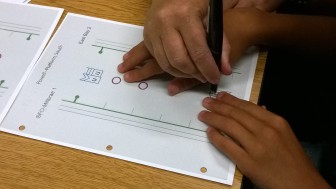
Having a usable map is one very important way in which to understand how to use any public transit system. That’s why the LightHouse has created maps of SF Muni underground stations for blind people: maps that convey information through touch and through sound.

For the first time a person who is blind can sit in their living room and orient themselves to the Muni station they plan on visiting, plan a path of travel from the entrance to the turnstiles, to the platform, and then off the train and to the bus stop. If you would like to learn how to explore and understand tactile graphic representations we invite you to attend an audio/tactile map orientation at the LightHouse for the Blind on Thursday, February 19 from 6:00 to 7:30 p.m.

Very special gift for all attendees: Participants will receive a stipend, a free set of Muni station maps and a Livescribe Smart Pen.

Space is limited and you must make a reservation to attend. Reserve your space by contacting Beth Berenson at info@old.lighthouse-sf.org, or 415-431-1481.  Funding provided by a New Freedom Grant from the U.S. Department of Transportation administered by the Metropolitan Transportation Commission.

Read this in-depth article published on the CityLab website, about our tactile maps: http://www.citylab.com/design/2015/01/making-better-maps-for-the-blind/384495/

Navigating her Way to the LightHouse and Into a New Job

Nancy TabriNancy Tabri forged quite a bit of new territory to sign-up for the LightHouse Employment Immersion Program and land her new job at as an Invoicing Clerk at Moe’s Tire and Auto Repair in South San Francisco. “I almost never left my hometown of Foster City and never took BART on my own before I signed up for the Employment Immersion Program,” she says. “But after two years of looking for a job and not finding anything, I decided to sign up and give it a try.” Rosemarie Lang, Nancy’s counselor at the Department of Rehab, steered Nancy towards the Employment Immersion Program, but Nancy had to get there.

Taking BART to reach the program in Berkeley was the first challenge. “I got my ticket, got on the train, but when I got off at the Berkeley station, I took the wrong escalator up. I was so scared. I felt really vulnerable traveling alone. I called Kate [Employment Immersion’s program leader Kate Williams]. She talked me through it. She told me to get up and keep going.”

Nancy found her way to the Berkeley office – and to whole new set of skills. “I learned so much in the program. The first thing I learned was that there were a lot of people who felt isolated and were having trouble finding a job, just like me. That helped a lot. Before the Employment Immersion Program, I thought I couldn’t do things.” After two weeks in the program, she learned how to take BART, use a white cane to travel independently for the first time in her life, and how to write a resume and cover letter. “I learned that I can do things. I just might have to do them differently than other people, and that is fine. Before, I used to worry about traveling alone, and I thought most jobs would be too hard for me. Now, I have confidence. I know I can do things.”

The most helpful part of the program, she says, was interview practice. She learned “to follow the voice and not to worry about making eye contact. I also got comfortable talking about my disability. I used to avoid talking about it, but now I can, but also don’t feel like I have to. I learned how to navigate illegal or uncomfortable questions about my disability.”

Kate Williams noticed Nancy’s grit and determination: “Nancy has jumped every hurdle and faced every challenge with enthusiasm and a ‘can-do” attitude. Give her a challenge and she will take it on. Prior to attending the Employment Immersion Program, Nancy had never ventured outside of her neighborhood using a cane. Now she travels from her home in Foster City to all points independently.  We are so thrilled the program could facilitate her tremendous growth. We look forward to watching her continue to grow. Her work commute on Caltrain involves a transfer, but characteristically Nancy is taking the challenge.”

Nancy said, “I made a new friend in the Employment Immersion Program, learned new skills and built my confidence. I like my new job. My employer has been very accommodating, and I love my coworkers. I recommend the program to anyone – I got up and found my way, just keep going and you’ll get there too.”

Looking for work for the first time? Is it time for you to re-enter the job market? Our next Employment Immersion session runs from Tuesday, January 27 through Thursday, February 19 at our office at the Ed Roberts Campus in Berkeley. For more information, please contact Kate Williams at kwilliams@old.lighthouse-sf.org or 415-694-324.

Now Enrolling Students: Your First Shot to Learn Effective Blindness Skills This Year

Changing Vision Changing Life, Immersion Training at Enchanted Hills

Next session begins January 11 – sign up now by contacting Debbie Bacon at 415-694-7357 or dbacon@old.lighthouse-sf.org.

Since June 2013, the LightHouse has hosted our 6-day Changing Vision Changing Life Immersion training program at Enchanted Hills Retreat located in the clear air and beauty of Napa’s Mt. Veeder. Each session brings together up to 25 adult students from all over Northern California and the Central Valley. They range in age from mid-20’s to 90 and are either new to low vision or blindness, or have had a significant change in vision and have requested additional training. While gaining skills and confidence with changing vision is the overall theme of the week, the experience of coming together with other adults who are blind or have low vision to learn or relearn skills that bring them back to the kind of life they desire, remains the pivotal impact of the week-long experience.

How do you flip an egg if you can’t see it? How do you keep colored socks together? What’s a secret way to tell the difference between shampoo and conditioner? During our week of immersion, students find new ways to accomplish familiar life activities with like-minded peers – an experience which is supportive, motivational and enjoyable. Students are introduced to skills, strategies and tools that can transfer from home to school to work, from sun-up to sundown, from cooking to home repair. And for many students, this is the first time they have had the chance to meet others and learn from low vision, blind instructors and mentors. While it is an active week, time out is provided for students to relax and share their personal experiences with each other, gaining insight, perspective and support for moving forward.

This week with the LightHouse is life-changing, but the follow-up work we do is just as important. We know our students want more focus “after” the training so we provide Telephone Conferencing so the group can keep in touch and support each other. Plus we contact each student one week after training to see what they are up to, if they are using their skills and how they are applying them. Each student creates their own “Next Steps Check List”, a sort of road map focused on their education, training, social interaction, community engagement and recreational involvement. This Check List provides the focus that students require, allowing each the opportunity to further develop skills after leaving their week of training.

Some of the specific areas that are introduced throughout the week include:
Reading print materials – from magnification to scanning and listening
Enhancing useable vision; understanding how lighting, contrast and magnification can help organization and labeling
Taking Notes
Financial Management
Time and Calendaring
Successfully accomplishing day-to-day tasks
Basic cooking skills
Traveling and moving safely and confidently in home and in the community
Accessible computer and other low-tech equipment
Training your family and friends – “helping” through understanding
Introduction to Braille
Community, state and federal resources
Personal advocacy
Leisure and recreation

There is a fee to attend the Changing Vision Changing Life Immersion week, however, if you are eligible for the training and living in the counties of San Francisco, Marin, Alameda, Humboldt or Del Norte, this Immersion Retreat is at no charge.

Dates of Next Session: January 11-16, 2015
For more information please contact: Debbie Bacon at 415-694-7357 or dbacon@old.lighthouse-sf.org.

Students practice yoga at LightHouse Immersion in Napa

LightHouse Marin Has a New Address as of December 15

“Go back?” he thought. “No good at all! Go sideways? Impossible! Go forward? Only thing to do! On we go!” So up he got, and trotted along with his little sword held in front of him and one hand feeling the wall, and his heart all of a patter and a pitter.”

― J.R.R. Tolkien, The Hobbit

Instead of moving forward with a sword however, the LightHouse is putting its best cane forward and making a move. We’re excited to announce that as of Monday, December 15th, our satellite office LightHouse Marin will be moving to 851 Irwin Street, Suite 206, in San Rafael, only three blocks from our current home, the Whistlestop Active Aging Center. We will still be very accessible from the Marin Transit Hub (east, across Heatherton at 3rd Street). LightHouse visitors and students can sign up with Whistlestop Wheels transportation services to take them from their homes right to our door and there is one hour visitor parking for those driving in.

Our new address: 851 Irwin Street, Suite 206, San Rafael, CA 94901-3343. See below for walking/driving directions.

Our office is expanding and will include space to facilitate our classes and support groups. While we set up our new home, we’ll see students by appointment during December and then be open to the public on January 5, 2015. Our phone number (415-258-8496) and fax (415-258-8501) remain the same. We are also thrilled that our collaboration with Vision Impaired of Marin, who facilitates support groups and social opportunities with other blind and low vision adults, will continue as they make the move with us.

Growth is good for everyone and we congratulate Whistlestop Active Aging Center, our home for the past five years, as they expand into our old space and grow their transportation program, a service our students heartily benefit from. We thank Executive Director of Whistlestop Joe O’Heir and his staff for five years of ‘living together’ and we look forward to future collaboration as close neighbors.

When we first moved to Whistlestop one of our goals was to ensure that our students would develop the skills and confidence to easily participate in classes at Whistlestop, and we’ll continue to do so. The Whistlestop Café is easy walking distance from our new address as are the Whistlestop classes, so LightHouse students can continue to benefit from both agencies: great training and support from the LightHouse and continued participation in the community with Whistlestop.

Come visit LightHouse of Marin in our new space beginning Monday, January 5th – LightHouse Social Worker Jeff Carlson looks forward to greeting you.

By the way, we are looking for a Class B driver to drive our 14-passenger shuttle bus, which we will keep at the Marin office, to special events in and around the Bay Area. If you or someone you know might be interested in this paid position, see our job description or contact Tony Fletcher at 415-694-7319 or afletcher@old.lighthouse-sf.org.

DIRECTIONS TO LIGHTHOUSE MARIN

Again the new address is 851 Irwin Street, Suite 206, San Rafael, CA  94901

Walking Directions/Parking Lot
The new office is one block east of the San Rafael Transit Center, between 2nd and 3rd Streets and between Irwin and Hetherton Streets.

Walking, from the San Rafael Transit Center:
Cross Hetherton at 3rd Street (Hetherton is one-way, heading south)
For Main Entrance, continue one block to Irwin.
Turn right onto Irwin.
Entrance is midblock, on the right, up a few steps.

For Parking Lot (Accessible) Entrance:
Cross Hetherton at 3rd Street (Hetherton is one-way, heading south).
Continue ½ block.
Turn right after the driveway.
Entrance is on the left (no steps), midblock.

Driving Directions
The building is located one block east of the San Rafael Transit Center, between 2nd and 3rd Streets.

Directions from North 101
Take the Central San Rafael exit.
Continue onto Hetherton.
Turn left on 2nd Street.
Turn left on Irwin Street.
Turn left on 3rd Street; halfway down block, turn left into the parking lot.

Directions from South 101
Take the Central San Rafael exit.
Continue onto Irwin Street.
Turn left on 3rd Street; halfway down block, turn left into the parking lot.

Jeff Carlson sits at his new desk

new Marin office building

Staff Profile – Debbie Bacon Offers Her Students Choices

One of a series of LightHouse staff profiles.

“When students come to me they are often in the middle of big life changes because their vision is changing,” says LightHouse Rehabilitation Counselor Debbie Bacon. “People often don’t know where to turn, or if they do, they don’t know what questions to ask. They feel they are stuck, without any tools to navigate their new world.”
Debbie Bacon

Debbie is one of the first people a person new to blindness or low vision speaks to when they first contact the LightHouse. Her job, a job she performs with poise and immense care, begins by interviewing and encouraging. She gets students in the door, helping them assess their goals and needs, and then begins to assist them in meeting their aspirations. She emphasizes that changes in vision can be the beginning of a rich, exciting new journey, and she helps them learn to navigate with grace, dignity and humor. “If the brain were a box,” she says, “then I ‘lift the lid’ on our blind students’ boxes, giving them a glimpse of what their world can be like. Then I encourage them to step outside those boxes and participate wholly.”

Debbie grew up in Colusa, California, in the northern part of the valley – a small farming community of roughly 5000 people. “I was the only person with low vision in my family, school, and community.” Debbie, a trailblazer at heart, didn’t let her vision slow her down in a town unfamiliar with blindness. She developed strong interests in the performing arts, including music, film and theater, as well as a passion for reading. “People in my town learned along with me that blindness is not an excuse for passivity and idleness, that I am a fully capable person with as much potential as anyone else around me.”

She mentions that she is also a fan of the TV show Star Trek and tells us, “I can’t help but notice that some of the ingenious, unimaginable items from Star Trek of the 1960s are now here in real life. Devices like the iPhone and Google Glass, items I believe were first imagined in Star Trek and other sci-fi worlds, are now everyday articles that enrich our lives. For the blind, these devices help us live a more full and rewarding life. Not only can we communicate with anyone, anywhere, anytime with our cell phones, but we can also use our phones to dictate notes, read webpages, and navigate the interior of a complicated airport [a reference to LightHouse’s work with the technology company, Indoo.rs, and their app which audibly helps the blind navigate places such as San Francisco International Airport]. These devices are tools for employment, education and personal independence.”

Debbie has a Master’s Degree in Rehabilitation Counseling. “I am a blind parent of three children who grew up with Special Education Services, with IEPs (Individuals Educational Plan, used by schools to tailor learning to the student with special needs) because of learning disabilities. My teaching degree, special education experience, my blindness, and my children’s learning disabilities all make me uniquely prepared to understand and help parents meet their children’s need and be their champions and advocates.” When she works with families she makes it clear that parents should feel comfortable asking her questions about their children’s educational needs.

A favorite part of Debbie’s work at the LightHouse is teaching blindness skills at our Changing Vision Changing Life sessions, where students come together for weeklong intensive training. “Teaching blindness skills is critical,” she says, “and the core of the Program; but the real power of this week-long immersion is what happens at breakfast, during yoga, and while we hike over bridges and down unpaved paths. It is during these times that our students really begin to see the possibilities in front of them.” Graduates of the Changing Vision program not only leave with skills and the courage to live independently, they also have a lasting support network from which they continue to draw strength.

She says, “The most difficult part of my job is hearing students tell me how they have abandoned their old lives, quitting jobs or school and giving up dreams. On the flipside, the most powerful, rewarding aspect of my job is helping people get back on track.” Contact Debbie at 415-694-7357 or dbacon@old.lighthouse-sf.org.

Construction Begins in December – San Francisco Civic Center Bike Station Improvements

 A message from BART:

Starting December 2014, as part of the Civic Center Station Modernization Improvements, work crews will begin to install the new bike station and bike racks at various locations inside the station. There will be some minor changes to pedestrian access routes, please look for signs and/or barricades. The work will take approximately six months to complete with estimated completion by May 2015.

All construction work will take place inside the Civic Center Station; however, temporary fencing and/or barricades may be placed on the plaza level to protect you and the construction. Although all work is planned to be performed during daytime hours, there may be times when work could be done on nights and weekends.

We do not expect to block the entrances to the station; however if it becomes unavoidable, signs will be posted to assist you and we will keep you informed of any changes through additional passenger bulletins and station announcements.

We apologize for any inconvenience and thank you for your patience.

You can get automated BART Service Advisories (BSA) on your phone. BART offers both email and text options. To sign up for BSAs, please visit us at www.bart.gov/alerts.

For on-demand service information, you can use our mobile site m.bart.gov or request BART real time departures, service advisories and more via text message. To get started text “BART go” to 468311 or jump right in and text “BART” + your station name. We’ll text you back in seconds. Follow us on Twitter @sfbart for news or @sfbartalert for automated service advisories.

If you need language assistance services, please call BART’s Transit Information Center at (510) 465-2278.

LightHouse Builds First UC Berkeley Campus Talking Tactile Map

Visitors and students unfamiliar with the campus at UC Berkeley may experience a bit of difficulty finding their way around the sprawling campus. But by getting their hands on a map and taking time to study it, they can learn the positions of buildings relative to each other, and determine how to get from one place to another. This way they build a “mental map” of the campus.

But for a student or visitor who is blind or has low vision, building that mental map, finding new classrooms each semester on a campus like UC Berkeley – with its non-linear paths of travel, and buildings with multiple entrances – can be daunting. Soon blind and low vision students and visitors to the UC Berkeley campus will be able to use special tactile maps of the campus that “talk”, thanks to the LightHouse.

“If you examine a map tactilely, it really becomes ingrained. It’s as though you’ve walked through the space.” –LightHouse CEO, Bryan Bashin

LightHouse Access to Information Services specializes in conveying “visual” information tactilely, producing braille maps of outdoor and indoor public spaces; college, hospital and corporate campuses; and transit systems. With UC Berkeley we’re taking it one step further, making maps of the campus that are not only tactile, but also large-print, and with an audio component accessible through a Livescribe Smartpen.

When a user taps a feature on a map with a Livescribe Smartpen (basically a slim computer with a tiny camera that can read the underlying micro-dot pattern) a richly detailed audio commentary on each location, including nearby landscape features and assets, pours into the user’s ear. The multiple ways this information is presented help students and visitors tailor their study of the maps to their own individual needs and skill levels; for example, breaking the material into chunks for better retention or working from simple to complex.

UC Berkeley will be making these maps available through their Disabled Students Program in the near future. The LightHouse is also engaged in similar projects including the Stanford campus and San Francisco State, as well as for BART and SF Muni Metro. Contact us about creating a map for your transit system, campus, or building today.

To learn more, visit our braille and tactile maps web page, or contact Greg Kehret to discuss how the LightHouse can help you provide meaningful access to your site. He can be reached at 415-694-7349 or gkehret@old.lighthouse-sf.org.

Enchanted Hills Retreat – Our Improved Connectivity Will Make Your Gathering Connected for Success

Our new roof-mounted antenna with sufficient height for a clear line of sight, brings in a strong internet signal to our visitors at Enchanted Hills Retreat

At Enchanted Hills Retreat, our rustic camp located on beautiful Mt. Veeder in Napa, we are constantly making improvements to make your stay more comfortable and productive. Most recently we completed the installation of a new roof-mounted antenna with clear line of sight. This means no obstacles, such as hills or homes, are in the way of our higher-speed internet capability.

Our clever IT Department, headed by Brian Hardy, worked with contractors to find a 19-mile microwave path in the mountains to make this accomplishment possible. The new service operates at ten megabits per second so that though the Retreat is located in the rural hills of Napa, our internet speed compares well with that found in urban areas. Complimenting this new bandwidth is a wireless architecture that distributes the bandwidth to numerous buildings and locations around the property, literally bringing “wireless to the woods.”

In 2014 both blind and sighted visitors find ever-increasing use for personal technology. Our increased bandwidth adds another layer of services for access and communications and makes our affordable wine country retreat that much more of a desirable place to hold your family reunion, yoga workshop, wedding, spiritual retreat, company off-site meeting or seminar.

Enchanted Hills Retreat, which can be rented nearly year-round, boasts a small lake, several rushing creeks, miles of nature trails for hiking, a heated outdoor swimming pool and a variety of breakout rooms for groups from 30 to 150. There are flexible service options including tasty, home-style meals and more.

For information and reservations, contact Tony Fletcher at afletcher@old.lighthouse-sf.org or 415-694-7310. Read more about Enchanted Hills Retreat.

Beautiful Lokoya lake appears through the trees at Enchanted Hills Retreat

Blind Teens to Fly High at Hiller Aviation Museum

Celebrate the spirit of discovery and innovation of the aviation pioneers whose creativity made the dream of flight a reality for all of us. Join the LightHouse Youth Program on Saturday, November 22 as we explore aviation and flight at the Hiller Aviation Museum. Spend the day with friends as we travel from the LightHouse to the San Carlos Airport where we will enjoy a guided tour of the facility. Blind and Low Vision students will have the opportunity to get a hands-on experience as they learn about the history of flight.

Who: Low Vision and Blind Youth
What: Hiller Aviation Museum Tour
When: Saturday, November 22 from 11:00 a.m. to 4:00 p.m.

  • We will gather at the LightHouse at 11:00 a.m. and travel to the museum where we will have lunch before the tour. We’ll return to LightHouse by 4:00 p.m., traffic permitting.
  • Lunch: Students must bring a bagged lunch with them. A light snack will be provided.
  • Meet at LightHouse for the Blind at 214 Van Ness Avenue, San Francisco. We will travel to the Hiller Aviation Museum, 601 Skyway Road, San Carlos
  • Tour Time: 1:30 p.m. to 2:30 p.m.
  • Waiver: Each participant must submit a LightHouse Youth Program waiver form, if they have not done so for a previous event.
  • Cost: $15.00 per student – includes museum entry, transportation and light snack. Though light snacks will be provided, please remember to bring a lunch with you.
  • RSVP: For more information or to RSVP, contact Jamey Gump, Youth Services Coordinator, at jgump@old.lighthouse-sf.org or 415-694-7372.
  • Space is limited to 12 participants.

Logo Hiller Aviation Museum

Scholarships Available – New Opportunities for Careers in Rehabilitation of the Blind

Scholarships are now available!

The Professional Development and Research Institute on Blindness at Louisiana Tech University is excited to announce that along with its O&M program, it has expanded its training and is launching a brand new concentration in Rehabilitation Teaching for the Blind.

Structured Discovery Cane Travel (SDCT) and Structured Discovery Rehabilitation have been demonstrated to be among the most innovative and effective forms of rehabilitation training for individuals who are blind or visually impaired. Louisiana Tech University has operated its Orientation and Mobility program on this model successfully for 18 years, with upwards of 90% successful employment and employer satisfaction rates.

Scholarships are now available for qualified individuals seeking one of the following degree paths:

  • Master of Arts in Industrial/Organizational Psychology with Concentration in Orientation and Mobility
  • Master of Arts in Counseling and Guidance with Concentration in Rehabilitation Teaching for the Blind
  • Orientation and Mobility Graduate Certification

Why apply?

  •  The field of educating and rehabilitating children and adults who are blind is deeply rewarding and life-changing.
  • The job market is wide open; currently, we receive four times the number of employer requests than we have graduates to provide.
  • Training occurs on campus in Ruston, Louisiana, and can be completed in as little as one year.
  • No prior background or experience in blindness is necessary—we’ll teach you everything you need to know.
  • Scholarships are provided on a competitive basis to qualified persons and can cover costs for attending the university.
  • Scholarship also support travel to conferences, trainings, and field-based experiences at Structured Discovery training programs.

Who can Apply?

Individuals must already possess a Bachelor’s (B.A.) degree from an accredited university, have a grade point average of 2.5 and obtain a minimum of 287 (Verbal and Quantitative) on the Graduate Records Examination (GRE). Individuals must also be willing to attend courses on campus in Ruston, Louisiana on a full-time basis.

What’s the Catch?

  • Payback through service is required. Agreement to receive scholarship funding requires commitment for you to work in the field of rehabilitation for two years for each year of scholarship support you obtain.
  • Scholarships cover at least tuition and fees but may cover living and travel costs as well.
  • You have to move to Ruston, work hard, study harder, and have the heart to be an O&M or Rehabilitation Teacher of blind persons.

Where do I get started?

  • For program details, visit: www.pdrib.com.
  • Send an email for more information to: dreed@latech.edu.
  • Or contact Edward Bell, Director, Professional Development and Research Institute on Blindness Louisiana Tech University to discuss your application: 318-257-4554 or ebell@latech.edu.