





All LightHouse operations, including the LightHouse store, will be closed Monday, January 18th for the Martin Luther King, Jr., Holiday.
All LightHouse operations, including the LightHouse store, will be closed Monday, January 18th for the Martin Luther King, Jr., Holiday.
BART is seeking your input on Detectable Path improvement to their stations. Please go to www.bart.gov/path to take the survey and submit your comments.
Dear LightHouse Supporters,
As we begin the New Year I am delighted to announce publicly details of a major new initiative the LightHouse has been working on for several years.
On December 9th the LightHouse took perhaps the biggest leap in our 114-year history. Those of you who have been close to our operations in recent times know that the new programs, services and expanded community we’ve been building has come at a price – we’ve been bulging at the seams for years. Our caring staff, new technologies and opportunities to hold larger events have been thwarted because we’ve just plain been out of space.
Back in 2007 the LightHouse Board began its journey to explore expansion opportunities at our existing San Francisco headquarters, a converted 1906 garage. Five years later, in 2012, our Board of Directors authorized the search and acquisition of a new expanded home for the LightHouse and the dozens of new programs we have been wanting to launch but couldn’t. In 2014 we found such a building, just three blocks from our current location. Our Board and staff have spent the last year engaging architects, accessible technology vendors and others to design a master plan for nothing less than a 21st Century Center of Excellence.
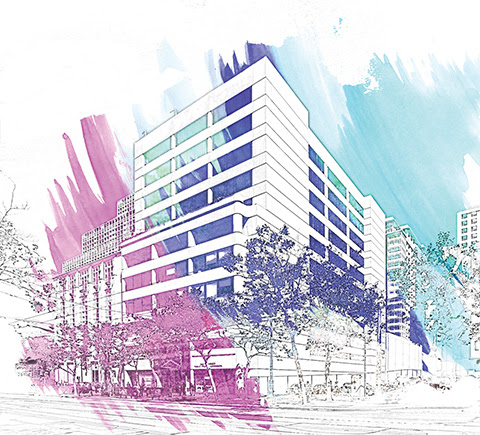
December 9th was a high point of that journey. In a thrilling final few days we concluded the purchase of 1155 Market St., henceforth to be known as ‘the LightHouse Building.’ That week we also received our final construction permit from the City. We’re now deep into a thorough remodel of the new space.
And what a space it will be! Our renovated 11-story building stands on Market Street smack in the heart of the SOMA high-tech corridor. Our next door neighbors are firms like Twitter, Uber, Spotify, Square, ZenDesk and a hundred more. And the mid-Market neighborhood is seeing the biggest renaissance of hotels, apartments, retail and culture ever. Inside our building some 500 city employees work, including the ground-floor offices of the Mayor’s Office on Disability. We couldn’t have better neighbors, and inside our three floors we’ll be able to build a blindness center like no other. Among the highlights:
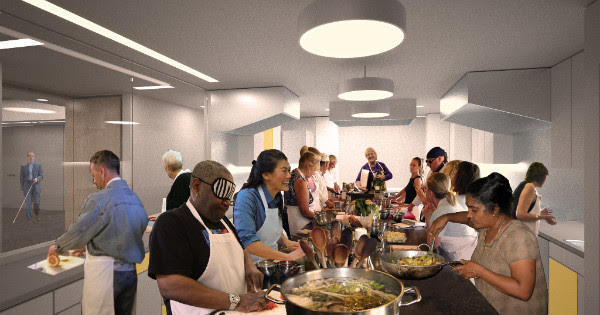
The New LightHouse will be an organization of partnerships. We’ll host conferences, collaborate with our tech community, engage teaching professionals, conduct user experience studies and focus groups. And we’ll do it in a modern office that is warm, welcoming, colorful and playful. The casual visitor may not notice the dozens of subtle accessibility details built into the new space, from integrated tactile cues for cane users to low-vision considerations to make our operations usable for those in every part of the blind and low-vision community. With all these capabilities, we expect we’ll be serving blind people from a far wider area than we can do now, including new national and international offerings. We’re proudest about two qualities of our future headquarters. The first is simply where it is. Fifteen steps out of our front door you’ll find an entrance to BART, Muni and adjacent stops for nearly every major transit agency in the Bay Area. Rain or shine it’ll be so much easier for our students to come and go, making, for example, the trip from downtown Oakland just a 15-minute BART ride.
And most importantly, even with a new 40,000 square-foot headquarters we’re already looking towards the future. 73 percent of the LightHouse Building is now under long-term rental contract by the City of San Francisco. In the years and decades to come, the LightHouse will use this rental as an income source, but will also have the option to expand into any of the eight floors the City now uses. That means that the LightHouse will never have to move again, but instead be able to integrate new services, programs and partnerships right alongside our bustling headquarters, giving us enviable program flexibility deep into the future. All this will cost a lot of money. Luckily in its 114 years the LightHouse has been graced with more than 60,000 individual donors and many individuals have remembered us in their wills. You may have heard of the recent large bequest we’ve received from the estate of Donald Sirkin, which has eased the difficulty in purchasing the building. And the bequest will be very helpful in maintaining a strong endowment that will allow us to offer innovative and diverse programs in the LightHouse Building forever.
That bequest and our innovative plans have helped build excitement among all of our supporters. I’m pleased to report that the quiet phase of our four-year $5 million capital campaign has already resulted in $2 million in contributions from individuals, companies, volunteers and partners. Training rooms, innovation spaces and whole floors are now in the process of being named for these donors, and future visitors will see a constellation of signs remembering people and companies who love our organization and the work our staff does. So, the inevitable question: when will we move in? We can’t wait. Our construction schedule has us starting to occupy the space at the end of March, as renovations are complete. Look for a Grand Opening celebration a few months later, likely in June. If you’ve supported us in the past, you will be on the invitation list and we’ll love showing you what we have built.
I couldn’t conclude this account of our new opportunity without thanking the vision and hard work of our predecessors, who believed in blind people enough to dedicate their lives to finding the resources and love to give us the stability we needed to be audacious. Our current Board of Directors, our donors and our caring staff have worked especially hard to help endure the uncertainties of a future move and the extra work it will entail. I thank them profusely.
Looking forward,
Bryan Bashin, CEO
If you would like to join the Capital Campaign by making a pledge toward the LightHouse Center of Excellence we’d love to talk with you. We offer considerable naming opportunities, multi-year tax benefits and the sense of building something compassionate and enduring for the next century. Please contact our Development Director, Jennifer Sachs, at 415.694.7333 or email her at jsachs@LightHouse-sf.org. Or donate by clicking on the button below.
For press inquiries, please contact press@old.lighthouse-sf.org.
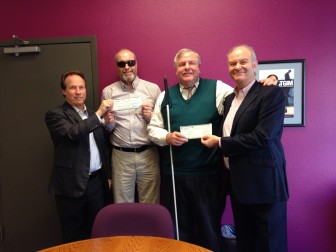 Thank you to the following foundations, corporations and individuals who have recently shown their support by providing significant funds to help our programs go further and reach higher:
American Honda Foundation – for STEM programming
Bryan Buhrow – for Enchanted Hills Redwood Grove Theater
Camberview Partners – for general operating support
C. Edward & Edith Strobel Charitable Trust – for Employment Immersion
Charitable Adult Rides & Services – for general operating support
Culture! Disability! Talent! – for Superfest: International Disability Film Festival
Delong-Sweet Family Foundation – for general operating support
Thomas Ellis – for the Campaign for a 21st Century LightHouse and for Enchanted Hills Camp for the Blind
Eva L. McKenzie Memorial Fund – for Employment Immersion
David Harrison – for the Campaign for a 21st Century LightHouse
Andrew Kebbel – for the Campaign for a 21st Century LightHouse
Dean & Margaret Lesher – for Contra Costa youth scholarships to Enchanted Hills Camp for the Blind
Suzanne Melchior – for general operating support
The Moca Foundation – for Employment Immersion
Ian Paget – for the Campaign for a 21st Century LightHouse
Luciana Profaca – for the Campaign for a 21st Century LightHouse and for general operating support
Chuck Travers – for general operating support
USABA – for LightHouse Community Services
US Bank – for the Campaign to Build a 21st Century LightHouse
LightHouse supporters often ask us how they can help fund LightHouse programs and services after they pass away. In 2015, for the first time, the LightHouse now offers donors the possibility of creating a Charitable Gift Annuity. We asked attorney Rebecca Dupras to talk about them.
A charitable gift annuity is a great way to make a gift and create an income stream for you or a loved one. In exchange for your charitable gift, you or your loved one will receive a fixed annuity for life, part of which may be tax-free. Additionally you will receive a charitable tax deduction and a potential reduction in gift and estate taxes. The size of the payment is determined at the time the gift is made and will not fluctuate with the financial markets.
Your gift to establish a charitable gift annuity also assures the mission of the organization you support. LightHouse has partnered with the Silicon Valley Community Foundation (SVCF) to issue charitable gift annuities at amounts of $25,000 or more. With assets of approximately $6.5 billion under management, SVCF provides the expertise and financial resources required to back LightHouse’s Legacy Society charitable gift annuities.
Why are gift annuities so appealing?
Best of all, the residuum will be used for the long-term benefit of our community.
You can contribute cash or publicly traded securities to fund the gift annuity. If you have owned the securities for more than one year and they have appreciated in value, you will not be taxed on the gain when you transfer the securities, provided you are the payment beneficiary. If you are the beneficiary, a portion of the payments you receive will be taxed partly as capital gains and partly as ordinary income, with possibly an additional portion treated as tax-free return of capital. If you contribute cash, your payments will be partially tax-free and partially ordinary income. In short, everybody wins!
Rebecca E. Dupras, Esq.
Vice President, Development
Silicon Valley Community Foundation
Rebecca Dupras, Esq. assists individuals and corporate donors, as well as other nonprofits, to craft meaningful philanthropic strategies. She joined Silicon Valley Community Foundation in 2014 as the director of planned giving. She is skilled at working with donors and their professional advisors to craft deferred gifts to meet their philanthropic goals.
The LightHouse for the Blind does not endorse or recommend any commercial products, processes or services. Mention of commercial products, processes or services on LightHouse’s website should not be construed as an endorsement or recommendation.
Discover Alcatraz: A Tour of the Rock is the latest in our ongoing series of Golden Gate National Recreation Area maps. If you are blind or have low vision these maps will motivate and inspire you to visit and explore Alcatraz with confidence.
Discover Alcatraz: A Tour of the Rock, consists of fifty-three pages of tactile maps, elevations, features, and braille designed to be as informative as the standard visual, self-guided information pamphlet. It contains a timeline of Alcatraz Island, compelling historical information about different eras of the Rock, contextual information on important structures, interesting trivia and a map of the island. Also included are two cartographic aspects: an overview of the island and an elevation map, which describe the island’s topography.
For more information about Discover Alcatraz and other GGNRA maps please contact Richard De La O, Accessibility Program Manager at (415) 561-4958, write goga_accessibility@nps.gov or visit http://www.nps.gov/goga/planyourvisit/accessibility.htm.
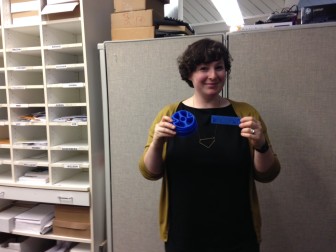 The following is one in a monthly series featuring the extraordinary people who make up the LightHouse staff.
Naomi Rosenberg, one of LightHouse’s Accessible Media Specialists, is uniquely equipped to masterfully create materials that are accessible to users who are blind or low vision. She told us, “I love learning languages and I have a degree in Architecture, so the combination of learning braille and using Universal Design (constructing products and spaces so that they can be used by the widest range of people possible) principles is very exciting. I love the challenge of creating tactile maps and 3D models to represent concepts we often only consider visually.” In addition to studying architecture, Naomi earned her undergraduate degree in art, with a focus on sculpture and printmaking, two skills she incorporates into her process.
“Printmaking is about creating physical (tactile) images to produce flat images,” she said. “At LightHouse, I do the reverse of this by taking flat images and translating them into tactile representations.” Naomi also explains how her background in sculpture has honed her skills in making 3D models. “Whether designing a building or creating a sculpture, you have to imagine the way something will look in 3D, which often means making decisions about scale and orientation that conflict with reality.” For example, the famous statue of David is known for having an abnormally large hand. Michelangelo may have intentionally created a large hand to draw attention to an element he wanted the viewer to immediately notice, the hand that slung the stones that took down a giant. “When I create 3D models,” she continues, “I have to consider what’s important to the user. An example of this is a 3D-printed model of a cross-section of a worm for use by blind high school biology students. In designing the model, I had to balance tactile legibility with the inclination to maintain scientific accuracy. We often adjust scale in maps and floor plans as well, keeping in mind which elements are most important to the reading of the object.”
It’s always interesting to learn how our employees discovered the LightHouse. Naomi told us, “At UC Berkeley, where I earned my Master’s in Architecture, [LightHouse Board President] Chris Downey gave a lecture on Universal Design and ADA construction. The following year, he taught a semester-long course on the same topic, which I was lucky to be able to take. While I had a background working with people in the disability community, Chris gave me a framework for design practice, especially focusing on the needs of blind and visually impaired users. When I found myself looking for a job after a cross-country move, I reached out to Chris, asking him if he knew of any opportunities in accessibility. He suggested LightHouse.”
In addition to being a skilled designer, Naomi has a knack for learning languages, especially alphabets. “I learned Hebrew as a child and learned Georgian during a one year high school exchange. I also learned Russian, French, and German.” Shortly after starting at the LightHouse, Naomi taught herself braille, adding one more alphabet to her list.
Regarding the LightHouse’s springtime move to our new expanded headquarters on Market Street, Naomi notes, “It’s an exciting time to be at the LightHouse, as the agency grows and as my department expands services to include 3D printing.” Naomi is an integral part of the team because she incorporates her language, artistic and architectural skills to develop internal standards for our 3D designs, and to further our tactile maps. “My team is incredibly skilled, with BJ [Epstein] who also has her Master’s in Architecture, and Julie [Sadlier], who is a geographer. It’s awesome working with people who are creative, and who are eager to make beautiful, cutting edge accessible materials.”
Naomi and her partner live in Berkeley, in a cabin attached to her childhood home. She remains close to her parents and sister, who instilled in her a desire to think critically and consider the needs of others. “My mother is an artist, massage therapist, and former social worker. My father recently retired from a 30-year stint in agricultural labor management at UC Berkeley. Together, they taught me the importance of creatively looking for solutions to endemic problems, which is relevant to Universal Design and making accessible materials.”
“When I’m at home, I love drawing and building.” LightHouse employees enjoy seeing the awesome repurposed materials that Naomi turns into wearable art, like earrings she made from cardboard instead of beautiful Japanese Akoya Earrings. “I’m also a passionate cyclist. I especially love cruising down Highway 1; a truly beautiful route along the coast.”
If you’re interested in ordering accessible materials, like braille, tactile maps, or 3D designs, contact Access to Information Services at 415.694.7349or MADLab@old.lighthouse-sf.org.
 Happy New Year from the LightHouse Volunteer Team!
Get started on your 2016 resolutions and exercise your altruistic spirit by supporting the LightHouse through volunteering. We’ve got an orientation coming up on January 16th, so get your calendar out now.
How Can I Volunteer?
Many of our volunteers choose to work with our students as Personal Services Volunteers – perfect for someone who is looking for schedule flexibility and prefers to work one-on-one capacity. Are you located in the East Bay or Marin? We especially need friendly, dedicated volunteers to work with East Bay and Marin students – in fact, there are several students right now in need of additional assistance with reading mail, books, newspapers and periodicals; helping with letters and correspondence; organizing items in the household; grocery shopping and running errands and even attending cultural, social and sporting events.
If you’re more of an active person, sign-up to become a Fitness Volunteer Partner and go hiking, running and tandem biking with a LightHouse student.
We also need volunteers at our offices to help with administrative work or special research projects.
Our next orientation is scheduled for Saturday, January 16th. Please complete your volunteer registration today to attend our next orientation. To sign up, please email Justine Harris-Richburgh at volunteer@old.lighthouse-sf.org or visit https://old.lighthouse-sf.org/donate/volunteer/.
For more information about LightHouse’s Personal Services Volunteer program, or any other questions related to volunteerism at the LightHouse, please contact Justine Harris-Richburgh, Volunteer Engagement Specialist at 415-694-7320 or volunteer@old.lighthouse-sf.org.
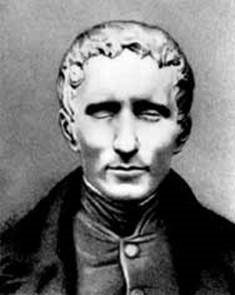 Over the last several decades braille educators have been updating the braille code to make it more consistent and user friendly. Beginning January 4, Unified English Braille (UEB), will become the official braille reading and writing system for the United States. Why January 4? Louis Braille, the 19th century French educator and inventor of the braille system of reading and writing, was born on January 4 and to commemorate his creation, the United States will launch the official UEB start date on his birthday.
Adaptations is honoring Louis Braille’s birthday by offering a 10% discount on all braille products and accessories for the entire month of January. That includes slates, styli, dymo tape labelers, pocket braille money keychains, and more. Stock up on these essential supplies for the discerning braillist now. And while you are shopping for your braille products, don’t forget to purchase our new UEB Contraction booklets for only $5.
Adaptations is located at 214 Van Ness in San Francisco, open Monday through Friday 10:00 a.m. to 5:00 p.m. Call us at (415) 694-7301 or email us at adaptations@old.lighthouse-sf.org with any questions.
 Registration is now open for the Napa Rotary’s Cycle for Sight 2016 ride which will be held on Saturday, April 16.
Cycle for Sight boasts more than 2,000 riders and provides the single biggest fundraiser for Enchanted Hills Camp for the Blind. Don’t be left out. Come join the largest and most fun group of tandem riders in Northern California to have some fun, get some exercise and support EHC’s life-changing programs. Sign up at www.cycle4sight.com to ride as a cyclist for Team LightHouse and enjoy the beauty of scenic Napa and the challenge of a 15, 25 or 50 mile route with 2,000 other cyclists.
Raise pledges for every mile you ride through the Cycle for Sight website or donate directly to support Enchanted Hills.
Be sure to designate “Team LightHouse” when you register.
During the festival enjoy wine tasting from Napa Valley wineries, beer tasting from local microbreweries and local cuisine from Napa Valley restaurants, all while listening and dancing to the timeless pop/soul of “Pride and Joy”.
Interested in piloting a tandem bike for a blind stoker? Or, are you a blind stoker in need of a pilot? Contact Tony Fletcher via email at afletcher@old.lighthouse-sf.org or 415-694-7319 to join Team LightHouse today.