

Category Archive

LightHouse News

Spaces Filling up Fast for Horse, Music and Woodworking Special Camp Sessions

Our special STEM, woodworking and horse camp sessions return to Enchanted Hills Camp for another summer. Read on for details on each session.

STEM (Science, Technology, Engineering and Math) for Youth
This year Enchanted Hills Camp is again offering a special STEM program within our Youth Session at Enchanted Hills. The STEM program will run from July 13 to 16 and will provide students ages 11 to 15 or are blind or have low vision with an unforgettable, hands-on learning experience in Science, Engineering and Technology and Math. More than education and fun, though, all participants will work with real-life blind scientists, chemists and engineers who will leave an unforgettable impression that adult science success is possible with little or no vision.

During the class, students will take part in hands-on, accessible and innovative activities including computing, rocket building, plant biology and chemistry. Students will also have the opportunity to take a field trip to the Exploratorium in San Francisco for some special hands on instruction by Exploratorium scientists.

Parents and guardians who wish to register their children for the STEM program can do so on a supplemental section which is included with the Youth Session application.

Who: Youth ages 11 to 15
When: Wednesday, July 13 through Saturday, July 16
Cost: $60 Session Fee (free for those attending the youth session)

To find out more about this session, contact Camp Director Tony Fletcher at afletcher@old.lighthouse-sf.org or 415-694-7319, for an application or with any questions.


Woodworking with George Wurtzel

Student Amy Liu works with wood during a session at Enchanted Hills

 Join expert carpenter George Wurtzel for a week long workshop designed for transition aged campers that are beginners and intermediate woodworkers.

This class will cover wood turning, hand tool work and an introduction to power tools. We’ll learn how to measure accurately without sight, using click rules, gauge blocks, Vernier calipers and talking tape measures. We’ll talk about wood types and construction techniques and learn when to glue, when to nail and when to use screws. We’ll also touch on finishing techniques.

Who: Youth ages 16 through 24
When: Monday, August 1 through Sunday, August 7, 2016
Cost: $300.00
Class is limited to 12 participants, so sign up now

To sign up for this special workshop, contact Camp Director Tony Fletcher at tfletcher@old.lighthouse-sf.org or 415-694-7319 for an application or with any questions.

Horse Camp with Diane Starin

Join us again for Horse Camp. Participants will have a chance to learn from avid horseback rider and wrangler, Diane Starin. Starin, who is blind, has owned, ridden, taught and cared for horses for more than 30 years. She has an Associates of Science degree in agricultural business, a Certificate in Horse Husbandry and is a certified Therapeutic Riding Instructor.

This camp session is for blind or visually impaired riders, ages 16 through 24. It is geared for those that have ridden before, but not a lot. Starin has a wealth of knowledge about the proper care of horses, and students will have a truly unique chance to learn from a blind professional how it’s done with little or no sight.

Diane told us, “Horses have been my passion since I was about two and I have wanted to teach a horse camp for as long as I can remember. This is especially important to me, because blind people don’t have as much of a chance to ride and handle horses.”

Who: Youth ages 16 through 24
When: Monday, August 1 through Sunday, August 7, 2016
Cost for each camper is $300.
Space is limited to six participants, so sign up while spaces are available. We expect this session to be very popular.

A separate application is available for this session. Campers must have independent mobility skills.

Objectives for Horse Camp:

  • Teach safety
  • Teach grooming
  • Teach tacking up
  • Teach good care and maintenance
  • Expand each camper’s knowledge of different kinds of equipment and their different applications
  • Riding and lessons as time and skill level allows

To find out more about this session, contact Camp Director Tony Fletcher at afletcher@old.lighthouse-sf.org or 415-694-7319 for an application or with any questions.

Enchanted Hills Retreat in Spring – Spend an Enchanted April, May or June in the Heart of Napa

Spring in Enchanted Hills. One of the many paths through the grounds – this one surrounded by verdant green grass, vivid yellow flowers and graced by one of the local goats who help us with brush clearance.Did you know that Enchanted Hills, our historic camp for the blind and visually impaired located on Mt. Veeder in Napa, also accepts reservations for retreats, getaways and events of all sorts?

A stay at Enchanted Hills Retreat will make you and your group feel renewed and the clean air and babbling springs will make you feel refreshed. Your retreat sojourn also supports the unique programs of Enchanted Hills Camp for the Blind. This summer these offerings include our annual Music Academy for young aspiring musicians, STEM (Science, Technology, Engineering and Math) camp for budding blind scientists, horse camp for blind horse aficionados and hands-on wood working in our new Arts Barn.

To reserve Enchanted Hills for your get-together of 30 to 120, please call (415) 694-7310 or go to enchantedhillsretreat.com.

Estate Planning: Five Documents to Create (or update) in 2016

There are five estate planning documents that every adult should have in place, and it is best practice to review and update these documents at least every five years. Make 2016 the year to craft or review these important papers.

  • Power of Attorney for Medical Matters
  • Power of Attorney for Financial Matters
  • Living Will
  • Will
  • Beneficiary Designations

If you are unconscious or cognitively impaired and a decision needs to be made about medical treatment, who decides? A Power of Attorney for Medical Matters appoints an agent to make medical decisions for you when you can’t do so yourself.

Include the person’s physical address, e-mail, and phone numbers for your Power of Attorney for Medical Matters so that medical providers can find them. It’s a good idea to name a back-up person too, in case the first named person cannot or will not serve.

Power of Attorney for Financial Matters
This is the most important thing for every person to have. A power of attorney names someone to handle your finances for you. If you are hurt or disabled, temporarily or permanently, you need to make sure that you have designated an agent to take care of your financial affairs. No matter your age you could have an accident or a periods of unavailability or incapacity.

Your spouse does not have the authority to act for you. Just being married does not give your spouse control over your finances.

Things a power of attorney can do include: paying bills, making Insurance claims, DUI rights, managing investments, filing tax returns. Make sure that you name a back-up agent in case the first named person cannot or will not serve.

If you can’t take care of your finances yourself and you haven’t designated someone as an agent under a power of attorney, the only alternative is a court-appointed guardian. That’s a very expensive, inconvenient and burdensome alternative.

Advance Health Care Directive or Living Will
A “Living Will” is the opposite of what it sounds like. In a Living Will you can state your wishes you’re your end of life care. Whether you want to be on life support, continue dialysis, donate your organs and other directives can be included in this document. The “living will” will only go into effect if you are terminally ill and unable to communicate your preferences. This is a vital document to eliminate doubt and guilt for your loved ones.

Will
Making a will allows you to appoint an executor (who will be in charge of settling your estate), appoint a guardian for minor children and designate who receives your property including individuals and organizations with whom you’d like to support.  Financial assets can be distributed as percentages or fixed amounts.

Everyone should have a will. If you die without a will, your state intestacy statute will spell out who gets your property. The estate will go into probate- a long and needless delay. The usual distribution is a portion for a surviving spouse with the balance to children or parents.

Beneficiary Designations
Some types of assets cannot be designated in your will.  A beneficiary for retirement plans, IRAs, life insurance and annuities are allocated to your chosen beneficiaries (people or organizations). They do not pass according to the will. Passing these types of assets to individuals can mean a heavy tax burden, and therefore it may make sense to have an estate plan to satisfy your charitable goals.

To learn more about estate planning or the benefits of joining the LightHouse Legacy Society, contact 415-694-7333 or jsachs@old.lighthouse-sf.org.

Thank You to Our Community Partners

The LightHouse wishes to thank its devoted friends and community partners who have recently shown their support by providing significant funds to help our programs go further and reach higher:

Bellini Foundation – for general operating support
Marie-Anne Burkhard – for general operating support
Business Links – for general operating support
Brook and Shawn Byers – for Enchanted Hills Camp Adults with Developmental Disabilities session
Carla Crahan – for general operating support
Dodge & Cox Investment Managers – for general operating support
Robert Foster
Disability Communications Fund – for Technology Training
Don and Peggy Fromm – for the Campaign for a 21st Century LightHouse
Fred and Virginia Herzer – for general operating support
Carol James – for Music Academy and for the Campaign for a 21st Century LightHouse
Jewish Family and Children’s Services – for general operating support
Dwight Johnson – for general operating support
Andrew Kebbel
C. Scott and Danielle Kulicke – for Community Services
Lucas Family Foundation – for Superfest: International Disability Film Festival
Marco A. Vidal Fund
Marin Community Foundation
Linda and David Myers – for the Campaign for a 21st Century LightHouse
Susan O’Sullivan – for the Campaign for a 21st Century LightHouse
Safeway Foundation – for Employment Immersion
Richard Schoenberger – for general operating support
Alan B. Snyder & Susan R. Katz-Snyder Family Fund, in memory of Annabelle Katz – for general operating support.
Richard Stevens and Virginia Behm – for general operating support
Chuck and Elizabeth Travers – for general operating support
USABA – for LightHouse Community Services
Wells Fargo – for sponsorship for our Grand Opening Celebration and for Employment Immersion

Jennifer Huey – “When Life Gives You a White Cane, Blaze a Trail!”

Jennifer HueyThe following is one in a monthly series featuring the extraordinary people who make up the LightHouse staff.
“My first goal is to make my students feel comfortable by demystifying Orientation and Mobility. People ask, ‘What’s that?’ I tell them that Orientation and Mobility is a fancy phrase to describe the set of skills people who are blind or have low vision use to safely navigate the world around them,” Jennifer Huey, one of LightHouse’s Certified Orientation and Mobility Instructors, tells us. She continues, “For example, I teach students how to properly use a white cane. In addition to cane travel, I teach people how to use all their senses to move about independently. People wonder how a blind person can cross a busy intersection, walk with a white cane and an umbrella or find an exit. I teach students those critical skills, which we call Orientation and Mobility or O&M.”

Jennifer comes to the LightHouse after being in the court reporting industry for over 20 years. “It was time for a career change. I wanted to make a tangible difference in the lives of others. My job in the court reporting field was just that – a job. Jennifer reflected on her history when considering a second career. “My mom developed eye cancer several years ago, which was a wakeup call to my family. Life is short; do what you love. On a more literal level, my mother’s diagnosis, coupled with my twin sister’s congenital monocular (‘single eye’) vision, led me to the field of blind services. I went back to San Francisco State (she got her Bachelor’s degree in Communicative Disorders, with a minor in Special Education there as well) to earn my Master’s in Special Education, with a special emphasis in O&M.”

Kathy Abrahamson, LightHouse’s Director of Rehabilitation, was one of Jennifer’s instructors at SF State. “Kathy was infectious, with her bubbly personality and passion for helping people. She talked so highly of the LightHouse, and the satisfaction she felt in her career. Like my classmate Robert Alminana (who is also an O&M instructor at the LightHouse), I knew I wanted to work here.”

Students who meet Jennifer are quickly put at ease by her warmth and great cheer. “We laugh a lot. I’m empowering people to live their lives, why not start living during our training? I learn about students’ concerns, many of which are similar to all students, but I also dig deeper to learn more about the individual I’m working alongside. That’s a key point: I’m working with—beside—my students, not teaching at them. One of my major goals for every student is that they understand that their white cane (if they need a cane) is a tool and not something stigmatizing. We reach that point together by setting personal goals that have an immediate impact, like learning how to deftly use a white cane and navigate a busy sidewalk.”

Born and raised in San Francisco, Jennifer certainly hasn’t let city lines keep her boxed in. “I love traveling. My last big trip was last August, when I went on a mission to bring assistive equipment like wheelchairs, crutches, canes and training to the Ugandan disability community. I set up a website to fundraise for adult and child-sized canes, various cane tips and cane accessories, to be distributed free of charge to Ugandans in need. It was an incredible journey – I can’t wait for my next trip.” Jennifer is also a thrill seeker, having skydived twice, and she loves drama, from movies to musicals. She emphatically states: “Go to Shakespeare in the Park. Do it! You’ll love it!”

If you’re wondering if you should sign up for Orientation and Mobility training at the LightHouse, Jennifer has this to say: “Pick up the phone, shoot us an email, stop by…you have to be the one to make the first step. I assure you, you’re in control of your training, but we’re here to help you figure out what you need to thrive.”

To get started, call us at 415.431.1481 or write us at info@old.lighthouse-sf.org.

LightHouse Youth Program – Blind Kids are Doing it for Themselves

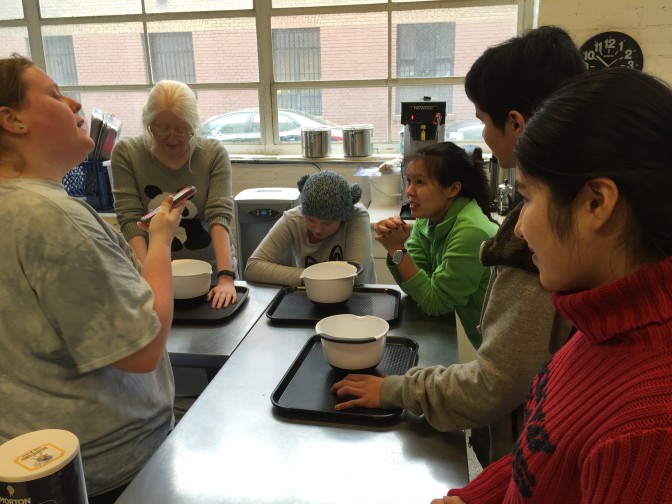
Students in our Cooking 101 class, mixing bowls at the ready, stand at their counters waiting to put a recipe together.What are a handful of motivated young blind people doing at the LightHouse early on a Saturday? The LightHouse Youth Program provides programming all year for energized youth who are blind or have low vision. One Saturday last month, the day went something like this:
Starting in the morning, LightHouse Volunteer Robin Patche led that week’s edition of Cooking 101. In this class we aim to teach young blind people how to be competent and confident in the kitchen. On the day’s agenda – how to make simple snacks such as smoothies, trail mix and cheese crackers, using accessible measuring cups, spoons and other cooking tools. Kitchen safety and sanitation were also incorporated into the discussion.

Next up, artist Ruthie Campbell Miller led the young people in an art project that had them using tissue paper to create tactile “paintings”. Why do young blind people benefit from art classes? Youth Program Coordinator Jamey Gump, who has low vision himself, told us, “We’re glad to have been able to offer an art class to the Youth Program and plan to reboot it in the fall. The more exposure students have to experience art their own way, the more they extend this sense of space to exploring and learning about their environment. Creating art can improve a blind person’s spatial acuity which in turn helps improve their ability to travel and to organize their environment.”

In the afternoon, Wells Fargo Personal Banker Nina Toia gave a presentation on how to successfully manage one’s money, including how to create a budget, what a credit score is and how to build credit. She answered both basic and complex questions and led a lively discussion on how the way in which we value the things we purchase can affect our budget.

An important aspect of our classes is introducing our younger blind students to blind college-aged mentors. This particular Saturday ended with a training session for the mentors. Jamey led a discussion about the best ways to make activities enjoyed by entire families work for both the sighted members and the members who are blind or have low vision.

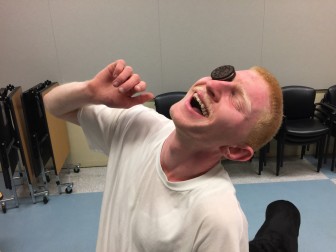
Mentor Nasir, with a big grin on his face, practices how to roll an Oreo cookie from the forehead to the mouth without using ones hands.

Our Youth Program Fills a Great Need
A lot of times young people who are blind may not know anyone in their neighborhood or school system who is blind. While all of our Youth programming promotes the independence, camaraderie and creativity while having fun, perhaps the most important aspect of these gatherings is providing them with the opportunity to meet other blind young people. Likewise, a side benefit to the gatherings is that the parents who bring their kids to these classes and field trips also get the chance to meet other parents of blind youth and exchange advice and solutions about the various challenges they may face.

We plan on having new cooking and art classes for youth in the fall, so stay tuned. To sign up for our Youth Events e-newsletter or for more information about our Youth programs, contact LightHouse Youth Coordinator Jamey Gump at jgump@old.lighthouse-sf.org or 415-694-7372.

Just in Time for Tax Season: Special Pre-Move Sale at Adaptations

We found a way to make tax time a little more palatable for our customers. We’re offering a 10% discount on ALL Products (excluding CCTVs and digital video magnifiers), while supplies last.

This moving sale will run from now through April 22nd (that is, the last day we’ll be open at our current address of 214 Van Ness Avenue in San Francisco).

LightHouse t-shirt

Adaptations Store Associate Starrly Winchester holds up a t-shirt emblazoned with the historic LightHouse logo

Historic LightHouse Logo
With our move to 1155 Market Street, our logo will change to reflect this exciting next step in our agency’s growth. Meanwhile during April you have a last chance to get a piece of LightHouse history. We have all kinds of swag branded with the “historic” LightHouse double-yellow-doors logo representing 214 Van Ness Avenue. Our pull-over sweatshirts, ladies t-shirts, water bottles, coffee tumblers and assorted writing guides are all on sale for 10% off through April 22nd, and when they’re gone, they’re gone. (Please note that there are no returns on this merchandise.)

So stock up on everything you need from canes to talking watches, kitchen supplies to lighting needs, plus brailling supplies, magnifiers, color readers, games, sunglasses and more…all at 10% off their regular price.

Stop by the Adaptations Store at 214 Van Ness San Francisco through April 22nd, call us at (415) 694-7301 or email us at adaptations@old.lighthouse-sf.org.

LightHouse San Francisco Headquarters and the Adaptations Store will be closed from April 23rd through May 1st and will re-open at our new address of 1155 Market Street on May 2nd.

Take Me Out to the Ball Game – Braille Giants Schedules Now Available

KNBR LogoBatter up! The LightHouse has provided KNBR radio station with brailled copies of the Giants 2016 game schedule.

If you’d like a copy, mail your request to Leah Phillips, KNBR’s Promotion Director, at the address below, and she will send it your way. Or contact Leah at 415-995-6996 or leah.phillips@cumulus.com.

Attn: Leah Phillips
KNBR
750 Battery Street
San Francisco, CA 94111

LightHouse Report from South by Southwest

Our South by Southwest panelists and partners: (L-R top row) Hans Jergen (BE My Eyes), Jacob (Be My Eyes), Will Butler (LightHouse), Dr. Rupal Patel (VocaliD), Ed Gray (Avid), Christian Erfurt (be My Eyes)  (L-R bottom row) BJ Epstein (LightHouse), Jennifer Sachs (LightHouse)This year the LightHouse has begun branching out in new directions, not just with our new San Francisco headquarters but in all parts of the world. One of the most important parts of our expansion is an emphasis on current and cutting-edge technology. As such, we were asked to coordinate a dedicated event at the mecca of all things tech, art and media: South by Southwest (SXSW) 2016 in Austin, Texas.

Throughout the conference LightHouse got to show-off our tactile maps, and in fact our Access to Information (AIS) Department created tactile maps of the Austin Convention Center for blind attendees to SXSW in trade for our SXSW passes (a value of $1,200 each).  We all made incredible connections and got the word out about LightHouse for the Blind at this mind-boggling convergence of minds.

LightHouse had a fantastic turn out for our convening entitled “Mainstreaming Accessibility”. We had an incredible panel of speakers: Christian Erfurt from Be My Eyes, Dr. Rupal Patel from VOCALiD, Ed Gray from Avid, moderator Will Butler of the LightHouse and Jonas and Paul from Pixar by video. Here’s some press about our panel published in the online tech and business publication, re/code. Though the headline is a bit tongue-in-cheek, the article in this uber-cool and important media site is truly substantive.

Here are the details on our presenters:

Jonas Rivera and Paul Cichocki and the Academy Award-winning production staff at Disney•Pixar have been working tirelessly for years now to make audio description for blind moviegoers better — not just in quality, but in the tech that delivers this important audio track for those who can’t see the screen. They told us the origin story of their brand new feature from Disney Movies Anywhere, and why it’s so important.

Ed Gray has been working at Avid for more than twenty years, and never imagined he’d be an accessibility leader until he became blind later on as an adult. Now, he has helped take ProTools, the industry standard for recording, to a peak of accessibility, making sure that once again, blind people can be audio engineers.

Christian Erfurt is the CEO of Be My Eyes, the video assistant app that first launched just sixteen months ago out of Denmark. Now living in San Francisco and pushing Be My Eyes’ technology to the next level, Christian and founder Hans Jergen shared how their technology helps not only blind people, but everyone else, too.

Dr. Rupal Patel is the founder and CEO of VocaliD, Inc., an east coast based company with a big goal: To create a million voices, literally. If Be My Eyes crowdsources eyesight for those who need it, VocaliD does the same for those with speech disorders. The winner of an innovation award at SXSW Interactive last year, Rupal came back again this year to share how VocaliD makes custom voices to fit any human, and why that’s important to society.

Will Butler is the Media and Communications Officer at LightHouse for the Blind and has worked with all of these companies in some capacity over the past few years, whether it’s as a journalist, critic, or collaborator. He moderated the panel discussion.

Summer in the City – Changing Vision Changing Life, Immersion Training in San Francisco

For more than three years now, over 150 active adults from all parts of Northern California have participated in the LightHouse immersion training programs at the Enchanted Hills Retreat in Napa. Come June, we are excited to add a new venue for our immersion training, our new headquarters in San Francisco at 1155 Market. You can be one of the first to go through our 2016 Immersion training in San Francisco.

In our new urban environment you and your peers will be immersed in building a foundation of independent living skills, access technology skills, orientation and mobility and peer support to get you started on your journey of living your life the way you want in maintaining your independence. All of this along with the energy and vibrancy of one of the most beautiful cities in the world surrounding you.

The CVCL curriculum, presented in four or five sessions per day, includes: ways to read printed materials; understanding how lighting, contrast and magnification can help you every day; techniques for organizing and labeling in your home or office; best methods for taking notes; basic cooking skills; traveling and moving safely and confidently in your home and in the community and understanding how accessible computers and other high and low tech equipment can enhance your life.

Evening discussions focus inwards, from conversations about holding yourself accountable on your journey, to self-advocacy, to questions about how friends, family and partners can understand/support you and your path. Sometimes the process is planned, other times it becomes very organic. Every person and every group of students is different and we individualize much of the experience depending on your own aspirations.

Gaining understanding of what is available to you, getting hands-on with new skills and developing renewed confidence with changing vision is the overall theme of the week. While the experience is different for everyone, the act of coming together with other adults, both students and teachers, who are blind or have low vision, to learn or relearn skills, and to get back into the stream of life, remains a pivotal part of the week-long experience.

In San Francisco, students will live in comfortable shared accommodations (minimum two to a room) and are provided continental breakfast, lunch and dinner. The lodging is akin to a modern Bed and Breakfast – private men’s and women’s facilities are a short walk down the hall from each room. The student lodging is secure and comfortable for learning and connecting with others when there is a break from training.

Transportation access to San Francisco from Humboldt County will be provided for North Coast students and for those who reside in the bay area, 1155 Market sits right above the Civic Center BART and is only a short cab ride or bus from the Cal Train Station and the temporary Trans Bay Terminal.

Blind or low vision students who are interested should have a genuine interest in learning the skills for moving forward; enjoy learning with a group of peers and are able to participate full day (from 9:00 a.m. to 9:00 p.m. every day) of active learning and physical participation (urban mobility and public transit in San Francisco).

Note, there is no cost to attend if you are 55 or older and living in San Francisco, Alameda, Marin, Humboldt or Del Norte counties and limited scholarships are available for persons under 55 and not eligible for Department of Rehabilitation Services.

Dates for our upcoming training sessions, all at our new headquarters in San Francisco

June 12 through 17
July 10 through 15 (note: all training in Spanish)
July 31 through August 5

The Changing Vision Changing Life Immersion Training is open to adults who are ready for a jump start or a recharge as their vision has changed. Interested? Contact LightHouse staff in San Francisco, San Rafael or Eureka: